
Why Understanding How IUL Fits into Overall Retirement Plan Matters
How IUL fits into overall retirement plan is a key question for those looking beyond 401(k)s and IRAs. An Indexed Universal Life (IUL) policy can serve as a tax-advantaged supplement that offers downside protection, flexible access to cash, and no Required Minimum Distributions (RMDs).
Here’s how an IUL can complement a retirement strategy:
- Tax-free income source: Access cash value via loans or withdrawals without increasing taxable income.
- Volatility buffer: Use IUL cash during market downturns instead of selling depreciated assets.
- Downside protection: A 0% floor prevents cash value from dropping due to market losses.
- Flexible funding: No IRS contribution limits, unlike 401(k)s or IRAs.
- No forced withdrawals: IULs have no RMDs at age 73.
Modern retirement planning must address market volatility, rising taxes, and longevity risk. Traditional accounts like 401(k)s and IRAs grow tax-deferred but are fully taxable upon withdrawal, which can increase your tax burden in retirement.
IUL offers a different approach. It’s permanent life insurance with a cash value that grows based on a market index, but with a floor that protects you from losses. The cash value grows tax-deferred and can be accessed tax-free in retirement through properly structured policy loans.
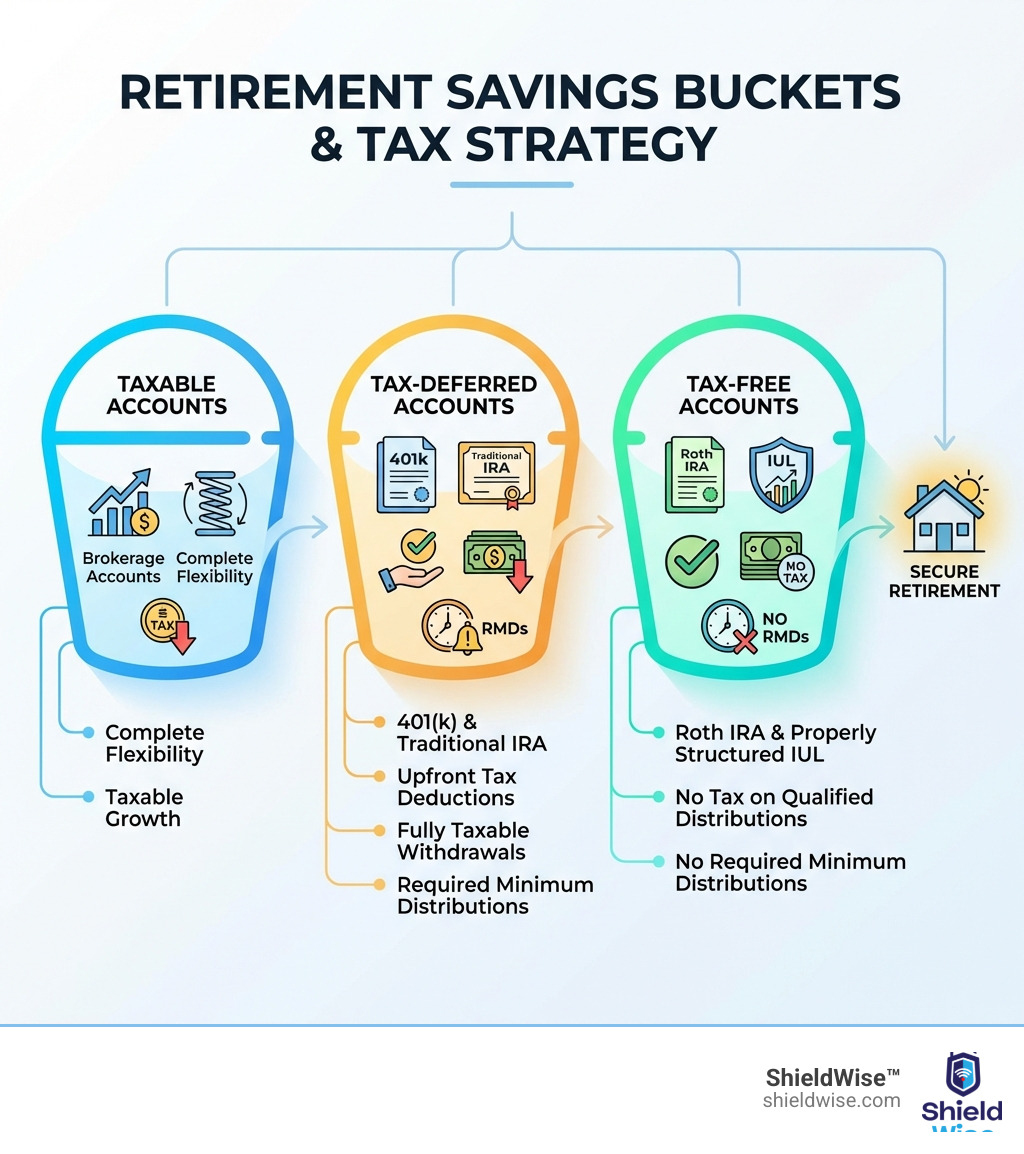
An IUL doesn’t replace your 401(k) or IRA; it supplements them, adding tax diversification. Think of it as creating three buckets for retirement: taxable (brokerage), tax-deferred (401(k), traditional IRA), and tax-free (Roth IRA, IUL). This strategy gives you more control over your retirement tax bill.
At ShieldWise, we provide clear, jargon-free guidance to help you understand if an IUL makes sense for your specific situation.
What is an IUL and How Does It Compare to Traditional Retirement Accounts?

To understand how IUL fits into overall retirement plan, you first need to know what it is. An Indexed Universal Life (IUL) policy is a type of permanent life insurance that combines a death benefit with a cash value component. This cash value grows tax-deferred, and its growth is linked to a market index, like the S&P 500, but with safeguards against market losses.
For a deeper dive into the fundamentals, explore our complete guide on What is an IUL? Complete Guide.
The table below highlights the key differences between an IUL and traditional retirement accounts:
| Feature | Indexed Universal Life (IUL) | Traditional 401(k)/IRA | Roth IRA |
|---|---|---|---|
| Primary Purpose | Life insurance + cash accumulation | Retirement savings (employer-sponsored/individual) | Retirement savings (individual) |
| Tax Treatment | Tax-deferred growth, tax-free access (loans/withdrawals) | Tax-deferred growth, taxable withdrawals in retirement | Tax-free growth, tax-free withdrawals in retirement |
| Contribution Limits | No IRS-imposed limits | Annual limits (e.g., $23,500 for 401k in 2025, $7,000 for IRA in 2025) | Annual limits (e.g., $7,000 for IRA in 2025), income restrictions |
| Risk Exposure | Market-linked growth with downside protection (0% floor) | Direct market exposure (full upside & downside risk) | Direct market exposure (full upside & downside risk) |
| Withdrawal Rules | Tax-free loans/withdrawals, no RMDs | Taxable withdrawals, RMDs at age 73 (as of 2024) | Tax-free qualified withdrawals, no RMDs |
| Death Benefit | Yes, typically tax-free | No direct death benefit (assets pass to beneficiaries) | No direct death benefit (assets pass to beneficiaries) |
| Access to Funds | Flexible, via loans/withdrawals | Penalties for early withdrawals (before 59 1/2) | Contributions can be withdrawn tax-free anytime, earnings after 59 1/2 and 5 years |
| Employer Match | No | Often available with 401(k)s | No |
For more details on Individual Retirement Arrangements, refer to the IRS’s page on IRAs.
The Core Mechanics: How IUL Growth Works
The cash value in an IUL grows based on the performance of a market index, but your money isn’t directly invested in the market. Instead, interest is credited to your account based on the index’s performance. When the index performs well, your cash value earns interest up to a limit (a “cap” or “participation rate”). If the index performs poorly, a “floor” (usually 0%) ensures your cash value doesn’t decrease due to the market downturn. This provides market-linked growth potential without direct exposure to losses. To learn more about how this works, check out our article on How Cash Value Works in Indexed Universal Life.
Key Differences from 401(k)s and IRAs
As the table shows, IULs differ significantly from 401(k)s and IRAs. Here are a few key distinctions to consider:
- Contribution Flexibility: IULs have no IRS-imposed contribution limits, making them a powerful tool for those who have maxed out their 401(k)s and IRAs and want to save more in a tax-advantaged vehicle.
- Employer Match: A 401(k) often comes with an employer match, which is essentially free money. An IUL does not have this feature, making it critical to contribute enough to your 401(k) to get the full match before considering other options.
- Required Minimum Distributions (RMDs): Unlike 401(k)s and traditional IRAs, IULs have no RMDs. This gives you more control over your taxable income in retirement, as you are not forced to take distributions at age 73. You can learn more about 401(k)s at Investopedia’s 401(k) guide.
- Risk Exposure: While 401(k)s and IRAs expose your savings directly to market volatility, an IUL’s built-in floor mitigates direct market loss, offering a degree of stability not found in traditional investment accounts.
The Core Benefits of IUL in a Retirement Strategy

An IUL brings powerful advantages to a retirement strategy, primarily through tax benefits, risk mitigation, and flexibility. These features are precisely how IUL fits into overall retirement plan as a strategic asset. You can learn more in our guide on Using Life Insurance in Retirement Planning.
Tax-Advantaged Growth and Tax-Free Access
An IUL’s cash value grows tax-deferred, allowing for more efficient compounding over time. The key benefit, however, is the potential for tax-free access to funds in retirement. Unlike taxable 401(k) or IRA withdrawals, you can access your IUL’s cash value through policy loans that are generally not considered taxable income. This allows you to supplement your retirement income without increasing your tax bracket, a significant advantage for those concerned about future tax rates.
For more on this, see our article on Indexed Universal Life for Retirement.
Mitigating Market Risk with the “Zero is Your Hero” Floor
Market volatility, especially early in retirement, poses a “sequence of returns risk” that can deplete assets. An IUL’s zero-floor protection is the solution. In years when the market index is negative, your cash value is contractually guaranteed to not lose money from the downturn, typically earning 0%. This protection provides a powerful volatility buffer for your portfolio.
Many policies also have an annual reset feature, which locks in any gains at the end of each year. This means your cash value is protected from subsequent market declines, providing stability that is invaluable for retirees. We dig deeper into this in our discussion on Universal Life Cash Value and Flexibility.
Flexibility and Control
IUL policies offer a degree of control that other retirement vehicles often lack.
- No Contribution Limits: Unlike 401(k)s and IRAs, IULs have no IRS-imposed contribution limits, allowing high-earners to save more in a tax-advantaged vehicle.
- No RMDs: IULs do not have Required Minimum Distributions (RMDs). This gives you complete control over when to access your funds, helping you manage your tax bracket in retirement. For official information on RMDs, you can visit the IRS website.).
- Living Benefits: Many IULs include riders for long-term care or chronic illness, allowing you to access a portion of your death benefit while alive to cover qualifying medical costs. This can protect your other retirement assets from being depleted by a health crisis.
Understanding the Costs, Risks, and How IUL Fits into Overall Retirement Plan
While IULs offer compelling benefits, it’s crucial to understand their costs and complexities. A balanced perspective is key to knowing how IUL fits into overall retirement plan for your specific situation. For general guidance on diversification, the Department of Labor offers useful insights on Investing and Diversification. Our IUL Basics Education: Complete Guide also provides foundational knowledge.
Acknowledging the Drawbacks: Fees, Caps, and Complexity
One of the most common criticisms of IULs revolves around their complexity and higher fees. Unlike a simple savings account or even a mutual fund, IUL policies have several moving parts, and understanding them requires careful attention.
Here are some key drawbacks to be aware of:
- Policy Costs: IULs have internal charges, including the Cost of Insurance (COI), administrative fees, and surrender charges for early cancellation. These costs can impact cash value growth, especially in the early years.
- Growth Caps and Participation Rates: Your growth potential is not unlimited. Policies have caps (a maximum interest rate) or participation rates (a percentage of the index’s growth) that limit your upside, meaning you won’t capture all the gains of a booming market.
- Complexity and Illustrations: Policy illustrations are projections, not guarantees. They are based on assumptions about future performance that can change. It’s vital to understand the underlying mechanics rather than relying solely on optimistic projections.
How IUL fits into overall retirement plan: A Volatility Buffer
Despite the drawbacks, an IUL’s downside protection makes it an excellent volatility buffer. This is a key aspect of how IUL fits into overall retirement plan.
During a market downturn, instead of selling stocks or bonds at a loss to generate income, you can draw income from your IUL cash value. Because the IUL is protected by a 0% floor, it doesn’t lose value in a market crash. This allows your other investments to recover, mitigating “sequence of returns risk” and protecting your portfolio from permanent damage.
An IUL helps bridge the gap between a growth-focused strategy and an income-focused one. It provides a stable, protected income source that can be tapped when market conditions are unfavorable, making your overall retirement plan more resilient. For more on different types of universal life insurance, see our Universal Life, Term Versus Permanent guide.
Special Considerations for High-Earners and the Self-Employed
IULs offer unique advantages for certain individuals looking at how IUL fits into overall retirement plan:
- High-Net-Worth Individuals: For those who have maxed out their 401(k)s and IRAs, an IUL provides another vehicle for tax-deferred growth and tax-free retirement income. It’s also a valuable tool for estate planning due to its tax-free death benefit.
- Small Employers or the Self-Employed: An IUL can personally supplement a business owner’s retirement savings. It allows them to build cash value without the contribution limits of qualified plans, provides a death benefit to protect their family and business, and offers flexible access to funds. The IRS provides resources on Choosing a Retirement Plan for small employers, and an IUL can be a complementary personal strategy.
A Practical Guide to Integrating an IUL into Your Retirement Blueprint
Navigating IULs can feel complex, but with the right approach, we can simplify how IUL fits into overall retirement plan for your specific needs. Integrating an IUL into your retirement blueprint involves assessment, evaluation, and monitoring. Our comprehensive Universal Life Insurance Guide offers a great starting point.
Step 1: Assess Your Financial Goals and Needs
Before considering any financial product, the first and most crucial step is to take Taking Stock of your current financial situation and clearly define your retirement goals. Ask yourself:
- What are my long-term retirement income needs?
- What is my risk tolerance?
- Do I have life insurance needs for family protection?
- Have I already maxed out my 401(k)s and IRAs?
Answering these questions helps determine if an IUL is a suitable addition to your plan. For families in Illinois, this is a key part of overall protection, as highlighted in our guide on Universal Life for Families and Protection.
Step 2: How to Evaluate an IUL Policy for Your Plan
Not all IULs are created equal. When evaluating policies, look for:
- Carrier Financial Strength: Choose a reputable insurance company to ensure long-term security.
- Cap Rates, Participation Rates, and Spreads: Compare these growth mechanisms, as they determine your potential returns.
- Fee Structures: Scrutinize all fees (COI, administrative, surrender charges) as they impact net performance.
- Illustration Assumptions: Ask for illustrations based on conservative and mid-range scenarios to get a realistic picture of potential performance, not just optimistic ones.
Step 3: Funding, Monitoring, and Adjusting Your Policy
An IUL is not a “set it and forget it” product. Proper management is critical.
- Premium Funding Strategy: Consistently funding the policy, especially early on, is key to building cash value and preventing a lapse. Be mindful of overfunding, which can trigger Modified Endowment Contract (MEC) status and change the tax treatment of withdrawals.
- Annual Policy Reviews: Review your policy annually with a financial advisor. This allows you to monitor performance, review rates, and ensure it still meets your goals. Adjustments can be made as your life changes.
Frequently Asked Questions about IUL for Retirement
We get a lot of questions about how IUL fits into overall retirement plan. Here are some of the most common ones:
Can you lose money in an IUL policy?
You are protected from losing money due to direct market downturns because of the 0% floor protection. If the market index drops, your cash value simply earns 0% interest for that period. However, your cash value can decrease if the interest credited is not enough to cover the policy’s internal costs, such as the cost of insurance and administrative fees. This is why proper funding and monitoring are crucial to prevent the policy from lapsing or the cash value from eroding.
Is an IUL better than a 401(k) or Roth IRA?
An IUL is not better or worse—it’s a different tool. It’s best viewed as a supplement to, not a replacement for, 401(k)s and IRAs. A 401(k) offers an employer match, and both 401(k)s and IRAs are excellent primary retirement savings vehicles. An IUL adds a layer of tax diversification (a tax-free income source), risk management (the 0% floor), and flexibility (no contribution limits or RMDs). For most, the priority should be to capture any 401(k) match, then fund an IRA, and then consider an IUL for additional savings. You can compare IULs, IRAs, and 401(k)s in more detail at Investopedia.
How does IUL fit into overall retirement plan as an asset allocation?
There is no single percentage for how IUL fits into overall retirement plan as an asset allocation; it depends on your age, risk tolerance, and goals. Think of it less as a percentage and more about its role. An IUL can serve as a stable, conservative asset—a “safe money bucket.” Its key role is to act as a volatility buffer. During a market downturn, you can draw income from the IUL, allowing your other, more aggressive assets to stay invested and recover. We recommend consulting with a qualified financial professional to determine the optimal allocation for your specific circumstances.
Conclusion: Building a Resilient and Tax-Efficient Retirement
In conclusion, understanding how IUL fits into overall retirement plan is about recognizing its unique strengths as a complementary tool, not a replacement for your existing strategies. Indexed Universal Life insurance, with its tax-deferred growth, potential for tax-free access to funds, and crucial 0% floor protection against market losses, offers a powerful way to improve your retirement security.
It serves as:
- A valuable source of tax diversification, providing a “tax-free bucket” alongside your taxable and tax-deferred accounts.
- A robust risk mitigation tool, acting as a volatility buffer against market downturns and sequence of returns risk.
- A flexible and controllable supplemental income source that isn’t subject to IRS contribution limits or Required Minimum Distributions.
While it’s not a silver bullet and comes with its own set of costs and complexities, a properly structured and managed IUL can be a cornerstone of a truly resilient and tax-efficient retirement blueprint. It empowers you to steer market uncertainties with greater confidence and maintain control over your financial future.
At ShieldWise, we believe in providing clear, jargon-free guidance to help you make informed decisions about your financial protection and retirement planning. We’re here to help you understand if an IUL is the right fit for your unique situation in Illinois.
Learn more about how an IUL works and if it’s right for you.