
Reviewed October 14, 2026. Educational information; individual circumstances, applicable rules and actual policy terms govern. Featured artwork is illustrative.
Universal Life Cash Value: Statements, Charges and Flexible Payments
Universal life cash value needs to be read together with the cost of maintaining insurance. A quoted crediting rate, a planned premium and a projected balance do not by themselves establish the money available or how long coverage will last.
This guide explains what to request from the insurer when reviewing values or considering a change. The UL introduction covers the broader product choices.
Read the Policy and Current Statement Together
Start with the actual policy, any riders, the latest statement and an explanation of its figures. Ask the insurer to reconcile premiums received, credits, deductions, transactions and the closing value.
The North Carolina regulator’s consumer guidance warns that interest and charges can change how long a UL policy lasts. Its general monitoring lesson does not establish rules or licensing in another state.
Compare the Actual Contract Provisions
For whole life, UL or another offer, compare payment requirements, guarantees, values and consequences of access. A generic “low risk” label or a standard growth-rate range cannot replace the actual guaranteed schedule.
The NAIC overview explains that cash values and payment provisions vary. Ask which values are guaranteed and which reflect current assumptions or nonguaranteed dividends.
Distinguish the Figures on the Statement
| Figure | Question to Resolve |
|---|---|
| Policy or account value | Which additions, deductions and transactions produced this figure? |
| Net surrender value | What amount would actually be payable after applicable charges and policy debt? |
| Loan balance | What principal and accrued interest are outstanding, and how are they treated? |
| Death benefit | What amount is payable under the selected benefit option and current policy conditions? |
Use the insurer’s definitions for the contract. These figures are not interchangeable balances in an unrestricted savings account.
Separate Credits from Net Growth
Request the declared or indexed crediting provisions, applicable minimums, current terms and the basis to which a credit applies. Then account for deductions and transactions when examining the actual change in value.
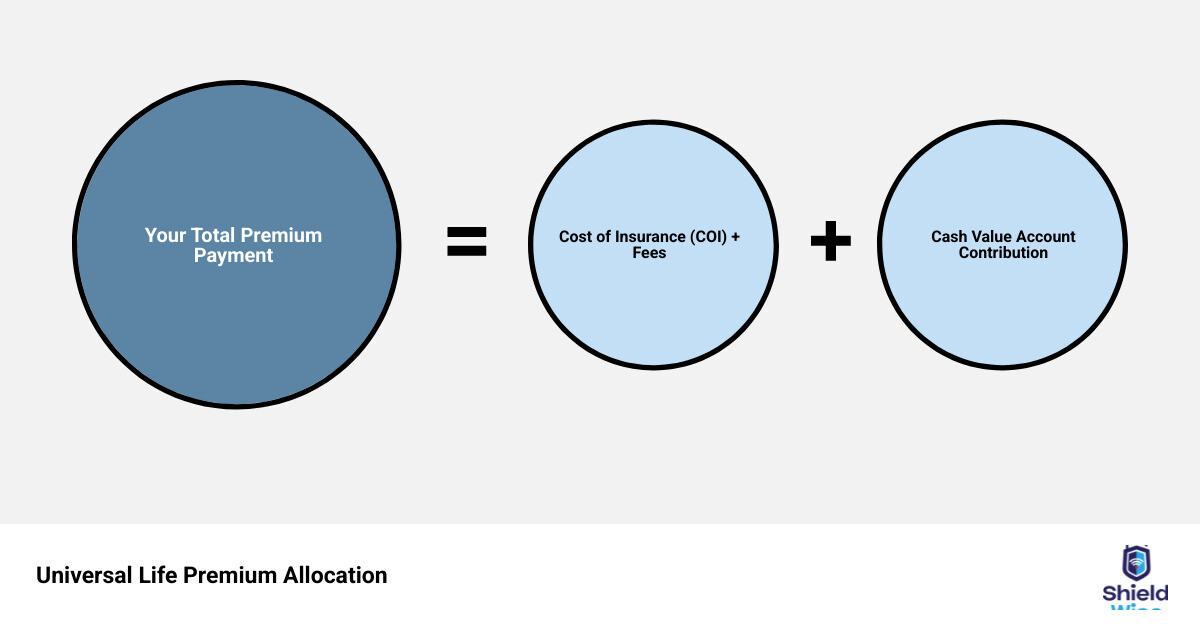
A simplified premium illustration cannot establish your allocation percentages or future results. Check recurring costs even when no new premium is paid.
Review Payment Changes before Making Them
Ask the insurer what happens if you increase, reduce, delay or stop payments. Request a revised illustration and an explanation of any effect on guarantees, coverage, premium limits or tax classification.
A target payment is not a universal assurance that coverage will remain in force. Nor does early extra funding guarantee that the policy will later sustain itself. Check the actual requirements and lower-credit scenarios before relying on either assumption.
Identify the Crediting and Guarantee Design
Fixed, indexed, variable and guarantee-focused UL can use different value and funding provisions. Determine the exact design before comparing rates or access.
Ask which terms can change, whether values are available for the proposed transaction, and what maintaining the intended benefit requires. No product label alone establishes the cheapest price, highest return or safest outcome.
For IUL, Check the Formula and Ongoing Costs
Review the index measurement, caps, participation, spreads, strategy charges and any adjustable terms. An index-credit floor is not a guarantee of net cash-value growth after all deductions.
Nationwide’s published IUL guide, for example, identifies ongoing insurance, administration and other charges. Those are product-specific disclosures, not a ShieldWise offer or a universal fee schedule. Our IUL cash-value guide explains the related questions.
For Variable Coverage, Examine Investment Risks
The SEC’s variable-life guidance explains that investment performance and expenses can reduce value, including loss of the original investment. Read the policy and underlying fund prospectuses and verify the professional’s appropriate registration.
Compare risk, expenses, available options and lapse conditions. Do not assume the fixed-rate or indexed provisions of another policy apply to variable coverage.
For a Guarantee-Focused Design, Read the Conditions
Ask exactly which benefit and duration the guarantee covers. Check the required amount and timing of payments and the effects of policy debt, withdrawals or benefit changes.
Do not equate a no-lapse feature with abundant accessible cash value or unrestricted premium flexibility. Obtain confirmation of the actual requirements before changing funding.
Review Costs and Access Consequences
Request the current and contractual maximum charges, surrender schedule, transaction charges, rider costs and loan provisions. Ask which amounts can change and whether adding coverage can create new charges or conditions.
Check the net amount available and the resulting insurance position before accessing value. An early balance or generic rate is not enough to establish liquidity.
Resolve Tax Questions before Accessing Value
The IRS surrender guidance states that proceeds above the investment in the contract can be taxable. Prior refunds, distributions and debt can affect that investment; do not use total premiums alone without checking.
Section 72 contains special rules for modified endowment contracts, including an additional tax on some taxable distributions with exceptions. Ask a qualified adviser about the actual contract, MEC status and proposed transaction rather than relying on a blanket “tax-free” description.
A policy that terminates with debt can also create tax consequences. Our IUL loan guide explains why borrowing requires its own review.
Check What Maintains a No-Lapse Feature
Request the insurer’s explanation of whether the feature is currently satisfied, how it is calculated and what future action is required. A premium described as “minimum” may refer to a different requirement from the one you need to preserve.
Ask how late payments, loans, withdrawals, changes or reinstatement affect the feature. Do not assume a guarantee continues unchanged after every transaction.
Common Cash-Value Questions
Use the questions below with the insurer’s figures and current illustration. Contract terms and applicable rules govern the answer.
Can Value Decline Despite a Crediting Minimum?
Yes. Credits and net available value are different questions. Costs, transactions and policy debt can reduce values even when a crediting provision has a minimum.
Compare actual experience with the earlier illustration and ask how long coverage is supported by the current funding. Do not wait for a projected future balance to become an actual lapse notice before reviewing the plan.
What Is Payable at Death?
Ask how the selected benefit option calculates proceeds and how outstanding debt affects the amount. Determine whether cash value is included in the stated benefit or added under a particular provision; do not add the two figures automatically.
Confirm the beneficiary designation and any assignments. The cash-value balance alone does not establish the beneficiary’s payment.
Can I Rely on Value for Retirement or Emergencies?
Identify the amount actually available, the method of access, future interest or charges, and the effect on coverage. A hypothetical loan plan is not a guaranteed retirement-income payment.
Compare the insurance need and funding commitment with resources outside the policy. Evaluate scenarios in which values or credits are lower and costs continue. Do not commit emergency funds solely on an optimistic projection.
Keep a Written Maintenance Checklist
- Reconcile the latest statement and identify any unexplained movement.
- Check the applicable guarantees and required future payments.
- Request an in-force illustration and lower-credit scenarios.
- Review debt, beneficiary information and planned changes.
- Resolve coverage and tax consequences before a transaction.
The NAIC illustration guidance distinguishes guaranteed and nonguaranteed elements and explains in-force updates. Keep actual results separate from projections. ShieldWise’s educational pages do not bind coverage or provide an individualized funding decision.