
Why Medicare Alone Won’t Cover Your Long-Term Care and Final Expenses
How to coordinate medicare long term care and final expense is essential for protecting your family from financial hardship during your later years. Here’s the quick answer:
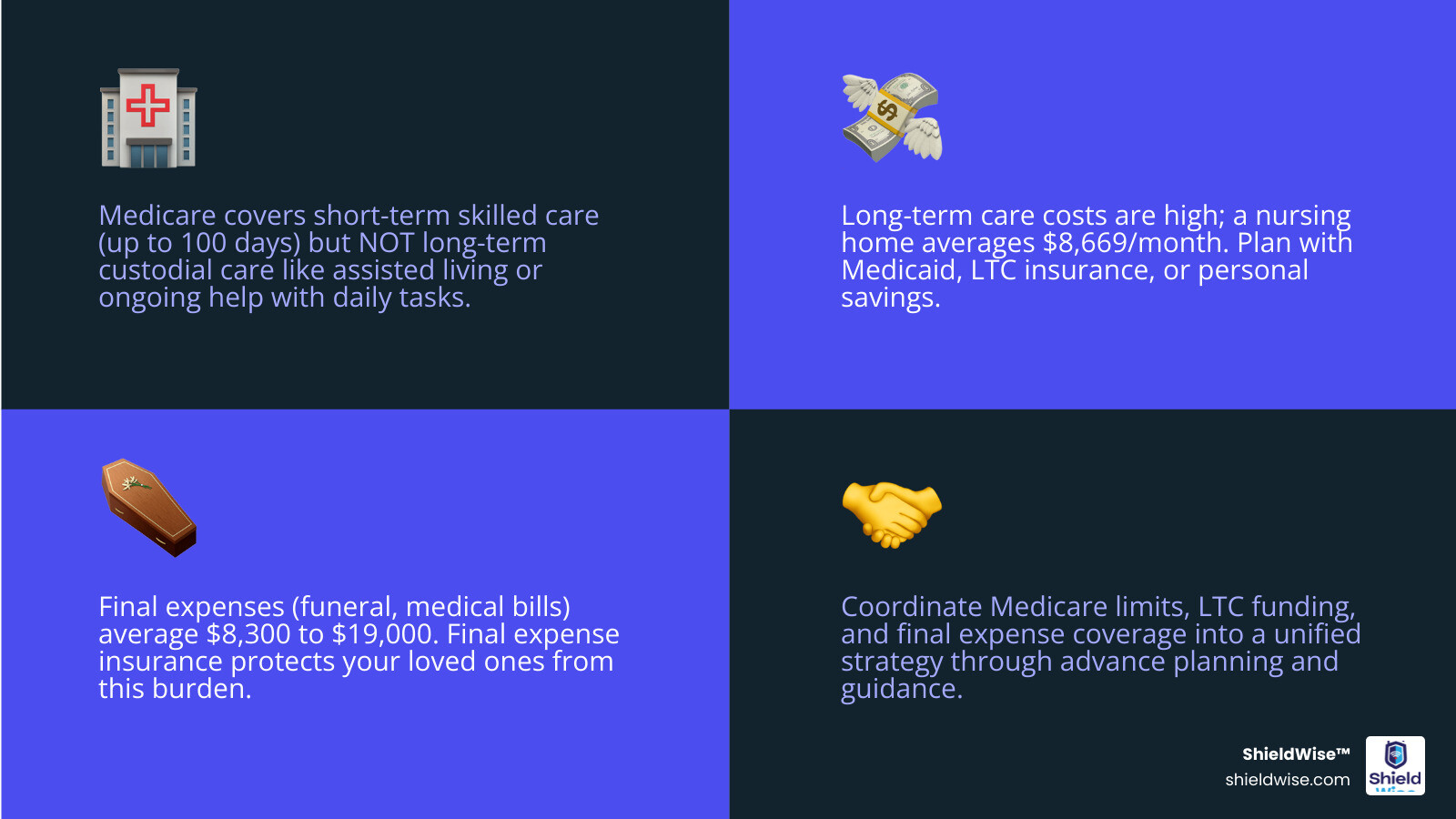
- Understand Medicare’s limits – Medicare covers short-term skilled care (up to 100 days) but not long-term custodial care like assisted living or ongoing help with bathing and dressing.
- Plan for long-term care funding – Use Medicaid (if you qualify), long-term care insurance, or personal savings to cover the average nursing home cost of $8,669 per month.
- Secure final expense coverage – A small final expense insurance policy ($5,000–$50,000) ensures your funeral costs (averaging $8,300) and remaining bills don’t burden your loved ones.
- Create a unified strategy – Coordinate all three components through advance planning, professional guidance (SHIP, AAA), and regular review of your coverage.
Many people assume Medicare will cover them if they need years of help at home or in a nursing facility. That’s not true. Medicare only pays for skilled care after a hospital stay—and only for a limited time. When you need ongoing assistance with everyday tasks like bathing, dressing, or eating, you’re on your own unless you’ve planned ahead.
The same goes for final expenses. Medicare coverage ends the day you pass away. Your family will face funeral bills, outstanding medical costs, and possibly credit card debt—often totaling nearly $19,000. Without a plan, those costs come straight out of your estate or your children’s pockets.
The good news? You can coordinate these three pieces—Medicare, long-term care, and final expenses—into a single, protective strategy. It requires understanding what each program does, where the gaps are, and how to fill them affordably.
At ShieldWise, we’ve helped hundreds of families steer how to coordinate medicare long term care and final expense through clear, unbiased education and real-world guidance. Our mission is to give you the tools and clarity you need to make confident decisions without sales pressure or jargon.
Understanding Medicare’s Role in Your Later Years
Medicare is the federal health insurance program that helps pay medical costs for people age 65 or older, and for some younger people with certain disabilities or serious health conditions. It’s a lifesaver for many, covering hospital stays, doctor visits, some home health care, and preventive services. However, a common misconception is that Medicare will cover all your healthcare needs, especially long-term care.
To truly understand how to coordinate medicare long term care and final expense, we must first clarify what Medicare is designed for. It’s primarily for acute medical needs and short-term recovery, not for ongoing personal care. For more information on eligibility and enrollment, explore our guide on Medicare Basics: Turning 65.
What Medicare Covers (and For How Long)
Medicare Part A (Hospital Insurance) and Part B (Medical Insurance) cover what are considered “medically necessary” services. This means care that is required to diagnose or treat an illness, injury, condition, disease, or its symptoms and that meets accepted standards of medicine.
For long-term care specifically, Medicare’s coverage is quite limited:
- Skilled Nursing Facility (SNF) Care: Medicare Part A can cover short-term skilled nursing care if you meet certain criteria. This is for rehabilitation after a qualifying hospital stay (at least three consecutive days as an inpatient). Medicare pays 100% of the costs for the first 20 days. However, for days 21-100, you’ll face a daily coinsurance. In 2025, this coinsurance will be $209.50 per day. After 100 days, Medicare coverage for SNF care typically ends, and you’re responsible for all costs.
- Hospice Care: If you are terminally ill with a life expectancy of six months or less, Medicare Part A covers hospice care. This focuses on comfort and symptom management rather than curing the illness. It can be provided at home or in an inpatient facility. For a comprehensive overview of these crucial benefits, refer to the Medicare & Hospice Benefits explained guide.
It’s important to differentiate between “skilled care” and “custodial care.” Skilled care requires the expertise of trained professionals like nurses or therapists. Custodial care, on the other hand, involves assistance with Activities of Daily Living (ADLs).
The Major Gap: Medicare and Long-Term Custodial Care
Here’s the crucial detail: Medicare generally does not cover long-term custodial care. This includes non-medical care that helps you with daily tasks like bathing, dressing, eating, using the bathroom, or getting in and out of bed. These are the kinds of services often needed in assisted living facilities or for ongoing help at home.

Medicare’s official stance is clear: it does not cover assisted living or long-term care. For instance, if you need help with ADLs but don’t require skilled nursing care, Medicare won’t pay for your stay in an assisted living facility or for a nursing home’s room and board. This is a significant gap in coverage, leaving many families to shoulder substantial costs out-of-pocket. You can read more about Medicare’s official stance on long-term care directly from the source.
Understanding this limitation is the first step in learning how to coordinate medicare long term care and final expense, as it highlights the need for alternative funding strategies for long-term care. Medicare coverage, unfortunately, ends the day a beneficiary passes away, offering no assistance for final expenses.
Funding Long-Term Care When Medicare Won’t
Given Medicare’s limited role, how do people manage the staggering costs of long-term care? The expenses are indeed daunting. The average nationwide cost of nursing facility care is approximately $8,669 per month. For many, this exorbitant cost makes paying out-of-pocket for an extended period simply impossible.

When planning for long-term care, individuals typically rely on a combination of personal funds, government programs, and private financing options.
The Role of Medicaid in Long-Term Care
Medicaid is a joint federal and state program that provides health coverage to millions of Americans, including those with limited income and resources. Unlike Medicare, Medicaid is the largest payer of long-term care services in the U.S., particularly for nursing home care.
The key difference between Medicare and Medicaid for long-term care is that Medicaid is a needs-based program. To qualify, you must meet strict income and asset limits, which vary by state. In Illinois, like many states, these limits are quite low (e.g., in 2025, income under $2,901/month and assets under $2,000 for an individual are general guidelines, though specific rules can be complex and change). Many individuals find they must “spend down” their assets to qualify for Medicaid, meaning they deplete their savings and other resources until they meet the program’s financial thresholds.
Medicaid can cover long-term custodial care in a nursing home for as long as it’s needed, provided you continue to meet eligibility requirements. Beyond nursing home care, many states, including Illinois, offer Home and Community-Based Services (HCBS) waivers. These programs allow eligible individuals to receive care in their homes or other community settings, helping them avoid institutionalization. To learn more about the specifics of Medicaid in your state, you can visit Medicaid.gov.
Private Financing Options for Long-Term Care
Relying solely on personal funds or Medicaid isn’t always feasible or desirable. This is where private financing options come into play, offering ways to protect assets and ensure a wider range of care choices.
- Long-Term Care Insurance: This specialized insurance policy helps cover the costs of services like home care, assisted living, and nursing home care. Policies typically kick in when you can no longer perform a certain number of Activities of Daily Living (ADLs) or have cognitive impairment. While premiums can be significant, especially if purchased later in life, securing a policy earlier can be a smart move. For those in Illinois, it’s worth exploring state-specific partnership plans which can help protect assets if you eventually need to apply for Medicaid.
- Hybrid Life Insurance Policies: Some life insurance policies now offer riders for long-term care. These “hybrid” policies combine a life insurance death benefit with the option to use a portion of that benefit for long-term care expenses if needed. This can be a flexible solution, as any unused portion of the death benefit still goes to your beneficiaries.
- Accelerated Death Benefits (ADB): Certain life insurance policies include an ADB rider, allowing terminally or chronically ill policyholders to access a portion of their death benefit while still alive. This cash can be used to pay for long-term care expenses. However, it reduces the amount left for your beneficiaries.
- Reverse Mortgages: For homeowners aged 62 or older, a reverse mortgage allows you to convert a portion of your home equity into cash without having to sell your home or make monthly mortgage payments. The loan is repaid when you move out, sell the home, or pass away. The funds can be used for any purpose, including long-term care costs.
- Annuities: Some annuities can be structured to provide a guaranteed income stream that can help cover long-term care costs. There are also “long-term care annuities” that offer improved benefits if used for qualified long-term care expenses.
Navigating these options can be complex. We encourage you to review a comprehensive Paying for Long-Term Care guide for more details. Additionally, caregivers often play a vital role in coordinating these financial strategies, and we have dedicated resources for Information for caregivers.
Securing Your Legacy: Final Expense Insurance
Beyond the costs of living, we all face the inevitable costs of passing away. These “final expenses” can create an unexpected financial burden for grieving families, often at a time when they are least prepared.
The national median cost of a funeral with a viewing and burial in 2023 was approximately $8,300. However, this number can vary significantly by state. For example, in Illinois, the average total final expenses are just over $20,000. These costs can include:
- Funeral home services (embalming, viewing, cremation, burial, memorial service)
- Cemetery plot or urn
- Headstone or marker
- Obituaries
- Legal fees for estate settlement
- Outstanding medical bills not covered by Medicare or other insurance
- Credit card debt or other personal loans
While the Social Security Administration does offer a one-time death benefit, it’s a mere $255 – hardly enough to cover even a fraction of typical final expenses. This is why planning for these costs is a critical part of financial preparedness. To understand the full scope of these costs, read our article on What are Final Expenses?.
What is Final Expense Insurance?
Final expense insurance is a type of whole life insurance specifically designed to cover end-of-life costs. It’s often referred to as “burial insurance” because its primary purpose is to provide a smaller, affordable death benefit to help cover funeral and burial expenses, as well as any lingering debts.
The key characteristics of final expense insurance that make it appealing for seniors and those with health concerns include:
- Smaller Death Benefit: Typically ranging from $5,000 to $50,000, these policies are custom to cover specific final costs without being overly expensive.
- Simplified Underwriting: Unlike traditional life insurance, final expense policies usually have a straightforward application process. Often, there’s no medical exam required; you just answer a few health questions.
- Guaranteed Acceptance Options: For individuals with significant health issues, some policies offer guaranteed acceptance, ensuring coverage regardless of health, though these may come with a waiting period before full benefits are paid.
- Fixed Premiums: Once you purchase a policy, your premiums typically remain the same for the life of the policy, providing predictability.
- Cash Value: As a type of whole life insurance, it builds cash value over time, which you can borrow against or surrender if needed, though this would reduce the death benefit.
This coverage provides immense peace of mind, ensuring that your loved ones aren’t left with a financial burden during an already difficult time. Learn more about it in our comprehensive guide to Final Expense Insurance explained.
How Final Expense Differs from Traditional Life Insurance
While both final expense insurance and traditional life insurance provide a death benefit, their purposes and structures differ significantly:
| Feature | Final Expense Insurance | Traditional Life Insurance (e.g., Term or Whole Life) |
|---|---|---|
| Primary Purpose | Cover end-of-life costs (funeral, medical bills, debts) | Provide income replacement, mortgage payoff, wealth transfer, or estate planning |
| Coverage Amounts | Smaller, typically $5,000 – $50,000 | Larger, often $100,000 to millions |
| Underwriting | Simplified; few health questions, often no medical exam | More extensive; medical exam, detailed health history, blood/urine tests |
| Eligibility | Designed for seniors, often up to age 85, including those with health issues | Broader age range; healthier individuals typically qualify for best rates |
| Premiums | Generally affordable and fixed | Can be higher, especially for larger benefits, but may be level or increasing |
| Cash Value | Builds cash value over time (whole life type) | Whole life builds cash value; Term life does not |
Final expense insurance is specifically designed to address the immediate financial needs that arise upon death, without the complexities or higher costs often associated with traditional life insurance policies. It’s a focused solution to a very specific problem. For a deeper dive into options custom for seniors, check out End-of-Life Insurance for Seniors options.
How to Coordinate Medicare, Long-Term Care, and Final Expense
Now that we understand the distinct roles and limitations of Medicare, long-term care funding, and final expense insurance, the real work begins: bringing them all together into a cohesive, protective strategy. This coordination is key to safeguarding your assets, ensuring you receive the care you need, and preventing your family from facing financial strain after you’re gone. It’s about creating a unified plan that covers the full spectrum of your later-life needs.
A crucial component of this coordination involves advance care planning. This process involves discussing and preparing for the care you would want in the future, should you be unable to make decisions for yourself. This includes creating legal documents like a Living Will and appointing a Power of Attorney for healthcare. These documents are vital for ensuring your wishes are respected and can influence the type of care you receive, and by extension, the costs involved. You can find more comprehensive advance care planning information to guide you.
Here’s a list of key planning documents to consider:
- Living Will: Specifies your wishes regarding medical treatment, such as life support, if you are unable to communicate.
- Durable Power of Attorney for Healthcare (Healthcare Proxy): Designates someone you trust to make medical decisions on your behalf.
- Durable Power of Attorney for Finances: Designates someone to manage your financial affairs.
- Will or Trust: Outlines how your assets will be distributed after your death.
Step 1: Assess Your Medicare Coverage and Gaps
The foundation of your plan starts with a clear understanding of your current Medicare coverage.
- Original Medicare (Part A & B): Review what it covers for skilled nursing and home health services, and crucially, where its coverage ends for long-term custodial care. Understand the coinsurance amounts and benefit periods.
- Medicare Advantage Plans (Part C): If you have a Medicare Advantage plan, check its specific benefits for skilled nursing care. While these plans are offered by private companies and can include extra benefits like dental or vision, their long-term care coverage remains limited, similar to Original Medicare. We offer tools to help you Compare Medicare Advantage Plans to find the right fit.
- Medigap Policies: If you have Original Medicare, a Medigap (Medicare Supplement) policy can help cover your out-of-pocket costs like deductibles and coinsurance. Some Medigap plans might cover the skilled nursing facility coinsurance for days 21-100, which can save you thousands. Learn more about Medicare Supplement and Medigap details.
By identifying potential out-of-pocket costs for skilled care and the complete lack of coverage for custodial care, you pinpoint the areas where your long-term care funding strategy needs to focus.
Step 2: A strategic approach to how to coordinate medicare long term care and final expense
This is where you weave together different financial tools to create a robust safety net.
- Evaluate Personal Savings: Assess your current savings, investments, and other assets. How much could you realistically afford to pay for long-term care each month without jeopardizing your spouse’s financial security or other essential needs?
- Project Future LTC Needs: Consider your health, family history, and lifestyle. While impossible to predict precisely, understanding the average duration and cost of long-term care can help you estimate how much you might need.
- Consider LTC Insurance: If your health and age allow, long-term care insurance can be a powerful tool to protect your assets. The younger and healthier you are when you purchase it, the more affordable the premiums tend to be. This can significantly expand your care options beyond what Medicaid might offer.
- Use a Final Expense Policy: A final expense insurance policy plays a distinct but complementary role. By earmarking funds specifically for burial, cremation, and immediate debts, you ensure these costs are covered without dipping into your long-term care savings or leaving your family scrambling. This protects the assets you’ve set aside for living expenses or long-term care, allowing them to serve their intended purpose. It also relieves your family of a significant emotional and financial burden during a time of grief.
Step 3: Use Free Resources and Professional Guidance
You don’t have to steer this complex landscape alone. Many organizations and professionals are dedicated to helping seniors and their families plan for these critical life stages.
- State Health Insurance Assistance Program (SHIP): SHIP provides free, unbiased counseling on Medicare, Medicaid, and related health insurance issues. They can help you understand your options, compare plans, and steer appeals. For residents of Illinois, the Illinois Department on Aging offers SHIP services. Find your local SHIP office at shiphelp.org.
- Area Agencies on Aging (AAA): AAAs are local organizations that connect seniors and caregivers with a wide range of services, including information on long-term care, transportation, meal programs, and legal assistance. They are an excellent starting point for understanding local resources. Connect with your Area Agency on Aging.
- Financial Advisors: A financial advisor specializing in retirement and elder care planning can help you evaluate your assets, project future costs, and recommend appropriate financial products like long-term care insurance or annuities.
- Elder Law Attorneys: These legal professionals specialize in issues affecting older adults, including estate planning, Medicaid planning, wills, trusts, and advance directives. They can ensure your legal documents are properly prepared and help you steer complex Medicaid eligibility rules.
For a comprehensive approach to planning, we recommend our End-of-Life Planning Checklist for Seniors and Families.
Frequently Asked Questions
When it comes to how to coordinate medicare long term care and final expense, some questions pop up more often than others. Let’s tackle a few of them.
Does Medicare or Medicaid pay for funerals?
No, neither Medicare nor Medicaid pays for funerals or final expenses. Medicare coverage ends the day the beneficiary passes away, offering no financial assistance for post-mortem costs. Medicaid is a needs-based health program and does not cover funeral costs. As mentioned, the Social Security death benefit is a mere $255, which barely makes a dent in the average funeral cost of $8,300. This is precisely why final expense insurance is designed for this purpose, ensuring your loved ones aren’t left with a significant financial burden.
What is the main difference between Medicare and Medicaid for nursing home care?
The main difference boils down to the type and duration of care covered, as well as financial eligibility. Medicare primarily covers short-term, medically necessary skilled nursing care for recovery after a qualifying hospital stay, typically limited to 100 days. It does not cover long-term custodial care. Medicaid, on the other hand, is the primary payer for long-term custodial care in a nursing home, but only for individuals who meet strict income and asset requirements. It covers assistance with Activities of Daily Living (ADLs) for as long as needed.
Can my family members get paid to take care of me?
Yes, sometimes! Many states, including Illinois, have Medicaid-funded programs (often called waivers or Home and Community-Based Services) that allow eligible individuals to hire and pay family members (excluding spouses) for in-home care services. The rules and eligibility criteria for these programs can vary by state, so check with your local Area Agency on Aging or State Medicaid office for specific details in Illinois. These programs can be a great way to keep loved ones at home while providing financial support to family caregivers.
Take Control of Your Future with a Coordinated Plan
Navigating the complexities of healthcare and end-of-life planning can feel like a daunting task, but as we’ve explored, a proactive and coordinated approach can make all the difference. Medicare is an invaluable resource for your acute medical needs and short-term recovery, but it is not designed to cover long-term custodial care. That gap requires thoughtful planning through government programs like Medicaid, private long-term care insurance, or careful use of personal funds.
Furthermore, ensuring your final expenses are covered is a profound act of love for your family. A final expense insurance policy ensures that your loved ones can grieve without the added stress of unexpected financial burdens.
By understanding these distinct roles and strategically coordinating your resources, you can protect your assets, ensure you receive the care you need, and secure your family’s financial future. This coordinated plan is not just about money; it’s about peace of mind for you and those you care about most.
At ShieldWise, we’re dedicated to empowering you with the knowledge and tools to make informed decisions. We provide clear, jargon-free guidance to help you compare options and build a comprehensive strategy. Secure your peace of mind by creating a comprehensive strategy for your End-of-Life Expenses today.