
Is Universal Life Insurance Right for You — or Is Term Enough?
Knowing when to choose universal life over term can save you from a costly mismatch between your coverage and your long-term goals. Here’s a quick answer:
Choose universal life over term if you:
- Need lifelong coverage that never expires
- Want to build tax-deferred cash value you can access later
- Are doing estate planning or need to transfer wealth efficiently
- Have income that varies and need flexible premium payments
- Risk becoming uninsurable before a new term policy is needed
- Have a lifelong dependent, such as a child with special needs
- Are a high earner who has maxed out other tax-advantaged accounts
Stick with term life if you:
- Need coverage only for a defined period (mortgage, child-rearing years)
- Are on a tight budget and need maximum coverage per dollar
- Have temporary obligations and plan to invest the premium difference
Most people start with term because it’s affordable and simple. A 40-year-old nonsmoker can get $500,000 of term coverage for around $55 per month — compared to roughly $294 per month for a comparable universal life policy. That’s a real difference.
But affordability isn’t the whole story.
Over 97% of term life policies never pay out a death benefit. People outlive their coverage, their health changes, and renewal becomes expensive or impossible. For many, that’s where universal life starts to make a lot of sense.
The right choice depends on your goals, your health, and how long you’ll need protection. That’s exactly what this guide breaks down.
At ShieldWise, we specialize in helping individuals and families navigate the real-world question of when to choose universal life over term — drawing on hands-on experience evaluating permanent and term coverage options across a wide range of financial situations. In the sections ahead, we’ll walk you through the key scenarios, trade-offs, and decision points so you can choose with confidence.
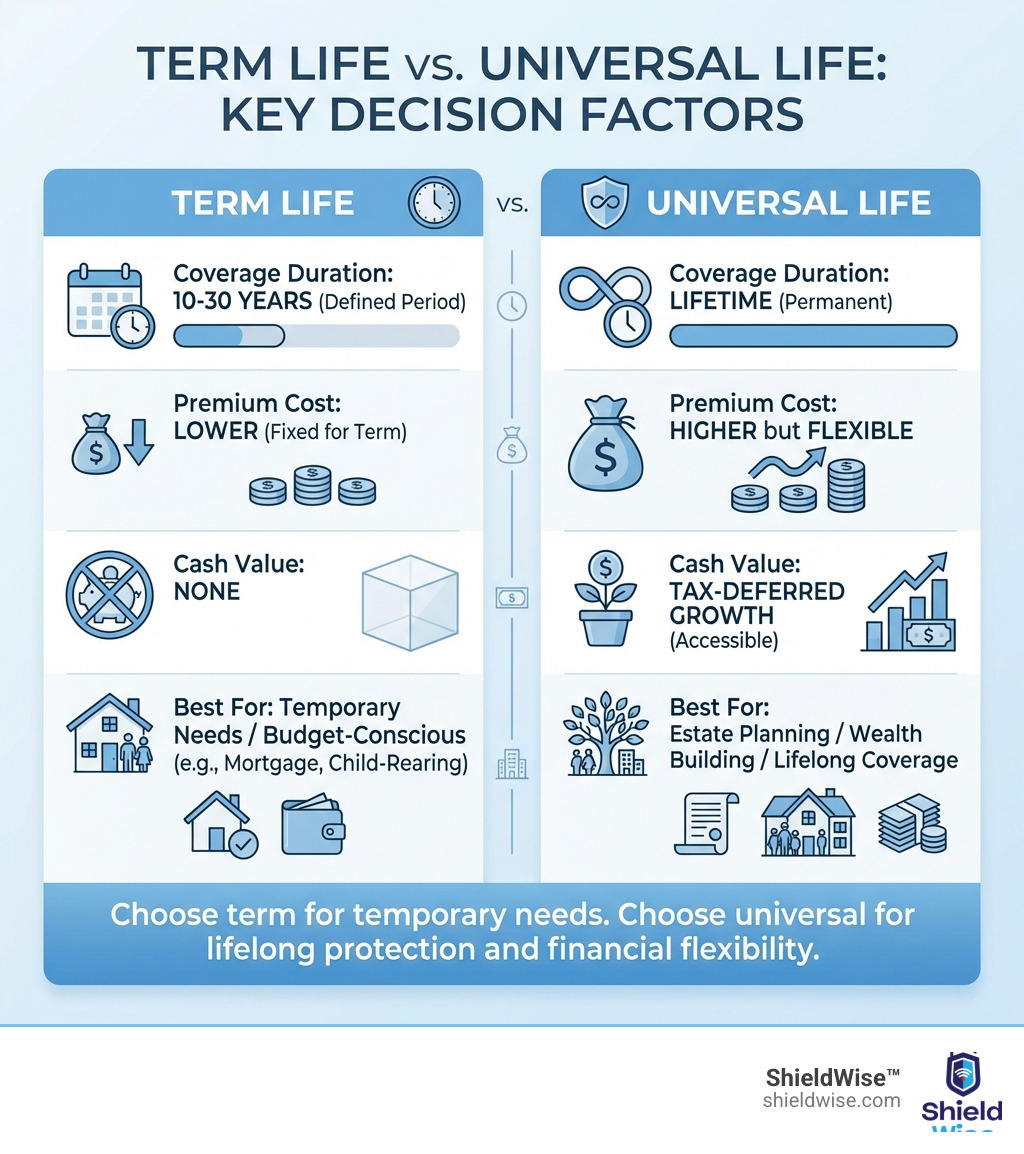
When to choose universal life over term helpful reading:
The Core Differences: Term vs. Universal Life
To understand when to choose universal life over term, we first have to look at the mechanics of these two engines. Think of term life insurance like renting a home. You pay a set amount for a specific period (usually 10, 20, or 30 years). If you “move out” (the term ends) or stop paying, you walk away with nothing but the memories of being protected. It’s efficient, cheap, and does exactly one job: paying a death benefit if you pass away during the lease.
Universal life (UL), on the other hand, is more like buying a home with a flexible mortgage. It is a type of permanent insurance designed to last your entire life. It includes a death benefit, but it also features a “cash value” component. A portion of your premium goes toward the cost of insurance, while the rest accumulates in an account that earns interest—generally at market rates or a minimum guaranteed rate.
The major differentiator is flexibility. While term insurance has fixed premiums that never change during the term, universal life allows you to adjust your premiums and even your death benefit as your life evolves. However, this flexibility requires more “property management” on your part. You have to monitor the policy to ensure the cash value is sufficient to cover the rising costs of insurance as you age.
| Feature | Term Life Insurance | Universal Life Insurance |
|---|---|---|
| Duration | Fixed (10–30 years) | Permanent (Lifelong) |
| Cash Value | None | Yes (Tax-deferred growth) |
| Premiums | Fixed & Level | Flexible & Adjustable |
| Death Benefit | Fixed | Can be adjusted |
| Complexity | Simple | Moderate to High |
For a deeper dive into these structures, you can check out Investopedia – Term vs. Universal Life Insurance: What’s the Difference? or read our guide on universal-life-term-versus-permanent.
When to Choose Universal Life Over Term for Long-Term Wealth
If your financial goals extend beyond just “making sure the mortgage is paid if I’m gone,” you might find that universal life is a superior tool for wealth accumulation. One of the most compelling reasons when to choose universal life over term is the tax-deferred growth of the cash value.
Unlike a standard savings account where Uncle Sam takes a cut of your interest every year, the gains inside a universal life policy grow tax-deferred. This means your money compounds faster. For those who have already maxed out their 401(k)s and IRAs, a universal life policy offers another “bucket” for tax-advantaged growth.
Furthermore, universal life is a cornerstone of legacy building. Because the coverage is permanent, you are guaranteed to leave a tax-free death benefit to your heirs, regardless of how long you live—provided the policy is funded correctly. This makes it an ideal vehicle for those who want to ensure a specific inheritance for their children or grandchildren.
Learn more about these mechanics at Forbes – What is Universal Life Insurance? and explore our insights on universal-life-cash-value-and-flexibility.
Why High-Net-Worth Individuals Choose Universal Life Over Term
For high-net-worth individuals, the decision of when to choose universal life over term often boils down to estate taxes. Currently, the federal estate tax exemption is just under $13 million per individual. However, this is set to drop significantly—down to approximately $5 million—in 2026.
If your estate exceeds these limits, your heirs could face a massive tax bill (up to 40%) shortly after your passing. Universal life insurance provides the “liquidity” needed to pay those taxes without forcing your family to sell off businesses, real estate, or other illiquid assets at a discount. By placing the policy inside an Irrevocable Life Insurance Trust (ILIT), the death benefit can even be excluded from your taxable estate entirely.
For more on this strategy, see RSM US LLP – Irrevocable Life Insurance Trusts explained.
Scenarios When to Choose Universal Life Over Term for Flexibility
Life isn’t a straight line. Sometimes you’re “flush” with cash, and other times things are tight. This is where universal life shines. Unlike term insurance—where missing a payment usually means losing the policy—universal life allows you to skip or reduce premiums if your cash value is high enough to cover the monthly costs.
We often see this benefit certain life stages:
- The “Gig” Economy Worker: If your income fluctuates month-to-month, you can overfund the policy during good months and lean on the cash value during lean ones.
- The Career Changer: If you take a pay cut to start a business, you can lower your premiums temporarily without losing coverage.
- The Empty Nester: Once the kids are through college, you might choose to reduce your death benefit to lower your costs while keeping the permanent protection in place for your spouse.
Explore how to tailor your policy in our article demystifying-universal-life-your-policy-your-way.
Key Advantages: Why Permanent Coverage Outperforms Term

While term insurance is great for “what if” scenarios, universal life is built for “when” scenarios. One of the biggest advantages is guaranteed insurability. If you buy a 20-year term policy at age 30, it expires when you are 50. If you develop a chronic illness at age 49, you might find it impossible (or incredibly expensive) to get a new policy. With universal life, as long as you keep the policy active, you are covered for life, regardless of how your health changes.
Avoiding the Risk of Outliving Your Coverage
The statistic is startling: over 97% of term policies end without a payout. While that’s technically “good news” (it means you didn’t die!), it also means you spent decades paying for protection that is now gone. If you still have a need for insurance at age 65—perhaps to cover final expenses or provide for a spouse—buying a new policy at that age will be exponentially more expensive than if you had locked in a permanent rate years earlier.
Universal life avoids the “cliff” at the end of a term. It provides a sense of certainty that your family will receive support, no matter when the time comes. For more on the risks of renewable term, see Investopedia – Yearly Renewable Term (YRT).
Leveraging Cash Value for Retirement and Emergencies
Think of the cash value in a universal life policy as a “financial bedrock.” Unlike a 401(k), you can often access this money via policy loans or withdrawals without the same age restrictions or “hardship” requirements.
Many of our clients use universal life as a supplemental retirement income stream. Because policy loans are generally tax-free, they can be a great way to take income during a market downturn, allowing your other investments time to recover. It’s a versatile tool that provides both protection and a “living benefit.”
Dive deeper into these benefits with our universal-life-insurance-guide-2026 and universal-life-for-families-and-protection.
Frequently Asked Questions about Universal Life Insurance
Can I convert my term policy to universal life later?
Yes! This is one of the best “secret” features of many term policies. Most high-quality term plans include a conversion rider. This allows you to swap your term coverage for a permanent universal life policy without taking a new medical exam. This is a lifesaver if your health has declined during the term. Just be sure to watch the deadlines; most conversion options expire before the term actually ends (e.g., at age 65 or 70).
Is universal life insurance worth the higher premium?
It depends on your perspective. If you only look at the monthly cost, universal life looks expensive. But if you look at the lifetime value, the math changes. With term, you pay a low rate for a 3% chance of a payout. With universal, you pay a higher rate for a 100% chance of a payout (assuming the policy is maintained), plus you get the cash value account. For those with lifelong needs or high tax brackets, it is often very much “worth it.”
How does the flexibility of universal life work?
Universal life is “unbundled.” This means you can see exactly how much of your money is going to the insurance company’s costs and how much is going into your savings. Within certain limits set by the IRS, you can choose to pay more into the policy to grow the cash value faster, or pay the bare minimum to keep the lights on. You can also increase or decrease the death benefit (though increasing it may require a new health check).
Conclusion
Choosing when to choose universal life over term isn’t about finding the “best” policy—it’s about finding the best policy for you. Term is an excellent, cost-effective tool for protecting your family during your peak earning years. But universal life is a sophisticated financial instrument that offers lifelong security, tax advantages, and unparalleled flexibility.
At ShieldWise, we believe in making insurance simple. Whether you’re a young family in Illinois looking for your first policy or a high-net-worth individual planning your estate, we’re here to provide jargon-free guidance and instant quotes. Don’t leave your legacy to chance—let us help you build a shield that lasts a lifetime.