
Understanding Life Insurance Needs After 65
How much life insurance do I need in retirement depends on whether you have remaining debts, want to leave an inheritance, need to protect a spouse’s income, or cover final expenses—many retirees need less coverage than during working years, but some require permanent policies for estate planning or legacy goals.
Quick Answer for Retirees:
- If you have no dependents and sufficient savings for final expenses ($15,000+), you may not need life insurance at all
- If you want to leave an inheritance or have estate tax concerns, consider $500,000–$750,000 in permanent coverage
- If your spouse depends on your pension or Social Security, calculate the income gap they’ll face and cover 10x that annual shortfall
- If you have unpaid debts (mortgage, loans), add those amounts to your coverage target
- For final expenses only, a $15,000–$50,000 final expense policy typically suffices
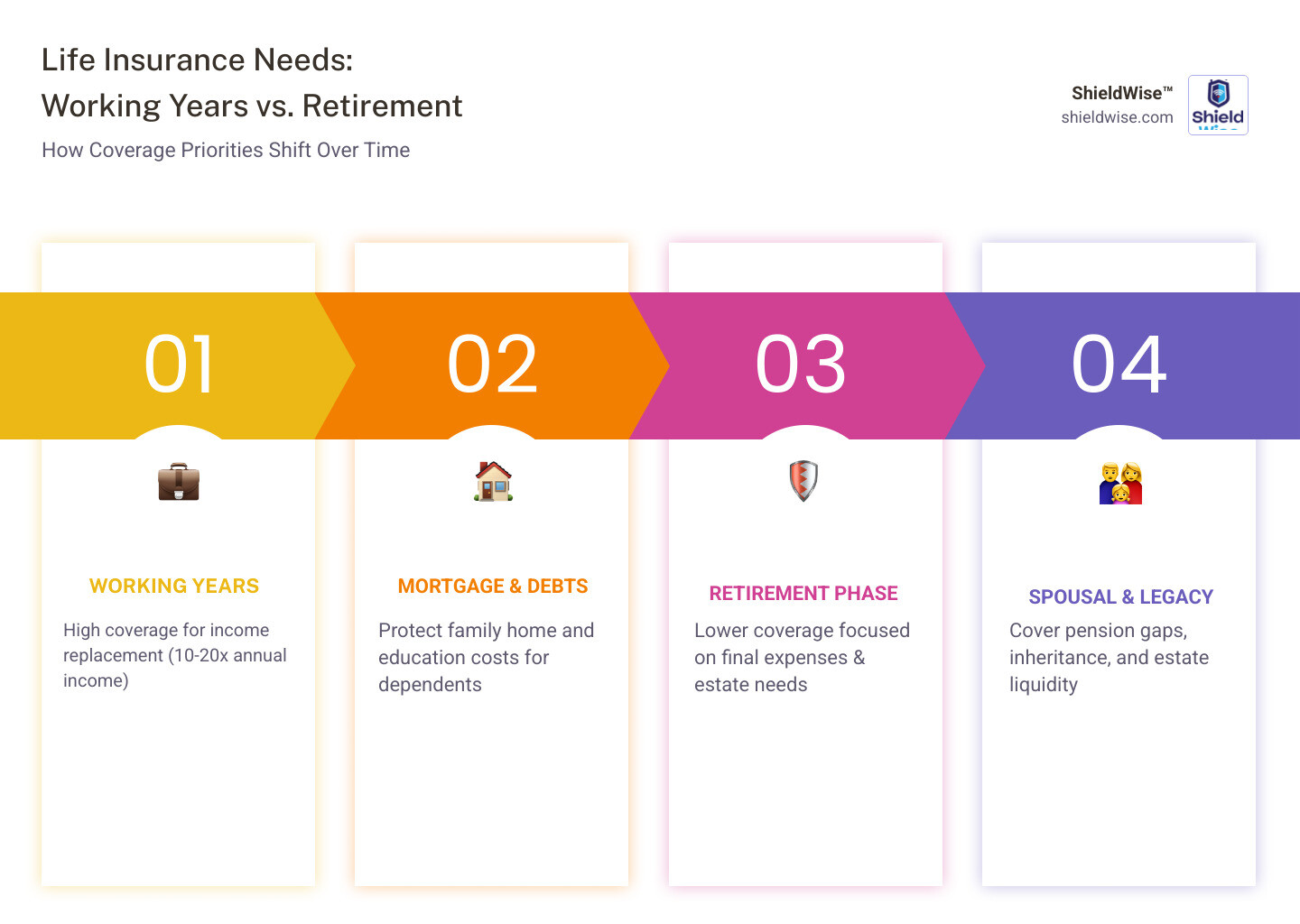
The shift from working years to retirement fundamentally changes your life insurance calculation. At 40, you might have needed coverage equal to 20 times your income to replace decades of lost earnings for young children. At 67, your kids are independent, your mortgage may be paid off, and income replacement isn’t the primary concern anymore—but new factors like estate taxes, spousal pension gaps, and long-term care costs enter the equation.
At ShieldWise, we’ve guided hundreds of retirees through the process of right-sizing their life insurance coverage for this new life stage, helping them balance legacy goals with fixed-income budgets while determining exactly how much life insurance they need in retirement. This guide will walk you through the specific calculations, policy options, and decision factors that apply after age 65.
How much life insurance do i need in retirement vocab to learn:
Do You Still Need Life Insurance After Retiring?
One of the most common questions we hear is: “I’m retired, so why do I still need a policy?” For many, the answer might be that you don’t. If you have no dependents, your home is paid off, and your bank account is healthy enough to cover your burial, you are what we call “self-insured.”
However, life isn’t always that tidy. Many retirees still carry financial responsibilities. You might still have a mortgage, or perhaps you’re one of the many grandparents helping to fund a grandchild’s education. If your death would cause a financial “hiccup”—or a full-blown crisis—for someone else, life insurance remains essential.
Another critical factor is Social Security survivors’ benefits. While these benefits provide a safety net, they often don’t replace 100% of the household income. If a spouse relies on your Social Security check or a pension that doesn’t have a 100% survivor benefit, they could see their monthly income drop significantly the moment you pass away. Life insurance acts as a bridge to fill that gap.
Furthermore, using life insurance in retirement planning isn’t just about death; it’s about estate liquidity. If your wealth is tied up in a family business or real estate (common among our Illinois clients), your heirs might be forced to sell those assets quickly (and cheaply) just to pay for estate administration costs or taxes. A life insurance payout provides the cash needed to keep those assets in the family.

Determining How Much Life Insurance Do I Need in Retirement
When you were 30, the calculation was simple: “How much would my family need if I disappeared tomorrow?” In retirement, the calculation shifts toward asset protection and legacy. Instead of looking at “Human Life Value” solely as a multiple of your salary, we start looking at your net worth and the specific “jobs” you want the money to do.
A common starting point for retirees is to ensure they have at least $15,000 to $20,000 set aside for funeral costs, taxes, and the administrative costs of winding up an estate. Beyond that, the amount depends on your goals.
To help you visualize the shift, consider this comparison:
| Factor | Needs at Age 40 | Needs at Age 65+ |
|---|---|---|
| Primary Goal | Income Replacement | Estate/Legacy/Final Expense |
| Debt Coverage | High (Mortgage/Student Loans) | Low to Moderate (Remaining Mortgage) |
| Dependents | Children (High Cost) | Spouse or Adult Children (Legacy) |
| Calculation | 10x – 20x Annual Income | Based on Net Worth & Specific Gaps |
| Health Risks | Low | High (Longevity/LTC Risks) |
Understanding longevity risk and life expectancy is also vital. In Illinois, we see many retirees living well into their 90s. If your plan is to “spend it all,” you run the risk of outliving your money. Life insurance can serve as a guaranteed “backstop” for your heirs, allowing you to spend your retirement savings more freely while knowing a legacy is already secured.
Calculating Your Specific Need for Life Insurance in Retirement
To get a precise number, start with your “must-pays.” If you still have $100,000 left on your mortgage, that’s your baseline. Next, look at the spousal income gap. If your spouse will lose $1,500 a month in Social Security or pension income when you pass, that’s $18,000 a year. To replace that for 15 years, you’d need roughly $270,000 in coverage.
We also have to talk about the “silent thief”: inflation. A $50,000 income today will only have the purchasing power of about $38,300 in ten years (assuming 3% inflation). When calculating how much life insurance do i need in retirement, always add a cushion for rising costs.
For those looking for a budget-friendly way to cover these gaps, exploring affordable insurance solutions for retirees can help you find term policies that last just long enough to see the mortgage through, or permanent policies that stay level forever.
According to the Human Life Value multipliers, the traditional rule suggests 10x income for those aged 61-65. However, after age 65, most experts suggest moving away from income multiples and toward a “needs-based” approach.
Adjusting the DIME Formula for How Much Life Insurance Do I Need in Retirement
The DIME method (Debt, Income, Mortgage, Education) is a classic in the insurance world, but it needs a “retirement makeover”:
- Debt: Instead of car loans and credit cards, focus on what are final expenses. This includes medical bills not covered by Medicare and the cost of settling your estate.
- Income: Shift this to “Spousal Support.” How many years of income does your spouse need to maintain their standard of living?
- Mortgage: If you still owe on your home, this is a top priority.
- Education: For retirees, this often becomes “Legacy.” Do you want to leave a specific amount for a grandchild’s college fund?
By totaling these four categories, you can arrive at a much more accurate figure than any “rule of thumb” could provide. This is often the first step in final expense end of life planning.
Primary Reasons Retirees Maintain Coverage
While income replacement is the “why” for young families, retirees often have different motivations. Legacy is a big one. You might want to ensure that each of your children receives a $100,000 inheritance regardless of how much you spend on travel or healthcare during your golden years.
Charitable giving is another popular reason. Life insurance allows you to leave a much larger gift to a church or non-profit than you might be able to give in cash.
For business owners, estate tax exemptions are a major consideration. In 2025, the federal exemption is $13.99 million per individual, but for those with high-value estates, life insurance provides the tax-free liquidity needed to pay the IRS without selling off the family farm or business.
Many of our clients also opt for final expense insurance. These are smaller, permanent policies (usually $10,000 to $50,000) designed specifically to cover burial and cremation costs, ensuring the family isn’t hit with a $15,000 bill during an already difficult time.
Long-Term Care and Living Benefits
Here is a startling statistic: even a healthy 65-year-old couple has a 70% chance that at least one of them will require some sort of extended care during their retirement. Long-term care (LTC) is incredibly expensive and can wipe out a lifetime of savings in a few short years.
Modern life insurance policies, particularly Indexed Universal Life for retirement, often include “living benefits” or LTC riders. These allow you to access your death benefit while you are still alive to pay for home healthcare, assisted living, or nursing home costs.
Typical LTC riders on these policies range from $500,000 to $750,000 in coverage. This “hybrid” approach is gaining popularity because if you need the care, the policy pays for it. If you don’t, your heirs get the death benefit. The universal life cash value and flexibility make it a powerful tool for managing these late-in-life risks.
Choosing the Right Policy: Term vs. Permanent
Once you know how much life insurance do i need in retirement, you have to choose the vehicle.
- Term Life: This is the most affordable. It’s great if you only need coverage for a specific period—like the 10 years left on your mortgage. However, premiums for new term policies skyrocket as you get older, and once the term ends, you’re left with nothing.
- Permanent Life (Whole or Universal): This lasts your entire life. It builds cash value that you can actually borrow against if you need extra income in retirement. For those looking for a “set it and forget it” solution, our universal life insurance guide 2026 explains how these policies offer flexible premiums that can be adjusted as your fixed income changes.
For seniors who may have developed health issues, there are also options for life insurance for seniors no waiting period. These policies often skip the invasive medical exam, making it easier to get covered even with common age-related conditions.
Frequently Asked Questions about Retirement Life Insurance
Are there situations where retirees don’t need life insurance at all?
Absolutely. If you have no debt, no dependents who rely on your income, and enough liquid assets to cover your final expenses and any potential estate taxes, you might be better off “self-insuring.” In these cases, the money you would spend on premiums could be better used in your investment portfolio or simply enjoyed during your retirement. We always recommend looking at the best insurance options for seniors on Medicare and fixed income to see if your current healthcare and savings plan already covers your bases.
How does inflation impact how much life insurance do I need in retirement?
Inflation is a major factor. If you buy a $15,000 policy today to cover a funeral, that same funeral might cost $25,000 by the time it’s needed twenty years from now. National funeral costs have historically risen faster than general inflation. When planning for end of life expenses, it is wise to build in a 3-5% annual increase in your projected needs to ensure your “future” bills are fully covered by today’s policy.
Is term life or permanent life insurance better for retirees?
It depends on the “job” of the money. If the job is “Pay off the house,” term life is usually better because the house will eventually be paid off. If the job is “Pay for my funeral” or “Leave a legacy for my grandkids,” permanent life is better because you don’t want the policy to expire before you do. For a deep dive into the differences, check out our universal life term versus permanent comparison or our burial insurance complete guide.
Conclusion
Determining how much life insurance do i need in retirement isn’t a one-time calculation—it’s a conversation about your values, your legacy, and your peace of mind. Whether you need a massive policy to protect a multi-million dollar estate or a simple $15,000 plan to ensure your kids aren’t burdened with funeral costs, the right coverage provides a sense of security that is priceless in your golden years.
At ShieldWise, we specialize in helping Illinois residents navigate these choices without the jargon or the high-pressure sales tactics. We recommend a periodic review of your coverage every 3-5 years or whenever a major life event occurs, like the birth of a grandchild or paying off your home.
Ready to see what your options look like? Get a quote for Universal Life Insurance today and take the first step toward securing your family’s future. Retirement should be about relaxing—let us help you handle the “what-ifs.”