
Why Understanding Cash Value Matters in Permanent Life Insurance
Indexed universal life cash value versus whole life comes down to one fundamental choice: guaranteed, predictable growth or market-linked potential with built-in protection.
Quick Comparison:
| Feature | Whole Life | Indexed Universal Life (IUL) |
|---|---|---|
| Cash Value Growth | Fixed, guaranteed rate (typically 2-4% annually) | Tied to market index performance (e.g., S&P 500) with caps and floors |
| Premium Payments | Fixed, level premiums for life | Flexible premiums that can be adjusted |
| Risk Level | Very low; guaranteed growth | Moderate; market-linked but protected from losses by 0% floor |
| Management Required | Minimal (“set-it-and-forget-it”) | Active monitoring of index performance and premium adjustments |
| Best For | Risk-averse individuals seeking stability and predictability | Those comfortable with market fluctuations seeking higher growth potential |
Whole life insurance offers guaranteed cash value growth at a fixed rate set by your insurer—usually between 2% and 4% annually. Your premiums stay the same, your growth is predictable, and you never have to worry about market performance.
IUL policies tie your cash value growth to a market index like the S&P 500, but without directly investing your money in the stock market. When the index performs well, your cash value grows—up to a cap (typically 8-12%). When the market drops, a floor (usually 0%) protects you from losses. This means you get moderate growth potential with downside protection, but your returns can vary year to year.
Both policy types build cash value you can access through tax-free loans or withdrawals, and both provide lifelong coverage. The real difference is how much certainty you want versus how much growth potential you’re willing to pursue.
At ShieldWise, we’ve guided families and individuals through the complexities of permanent life insurance for years, helping them understand the real-world differences between indexed universal life cash value versus whole life policies. Our mission is to cut through the jargon and provide clear, unbiased analysis so you can make confident decisions about your family’s financial protection.
How Cash Value Grows: The Core Difference
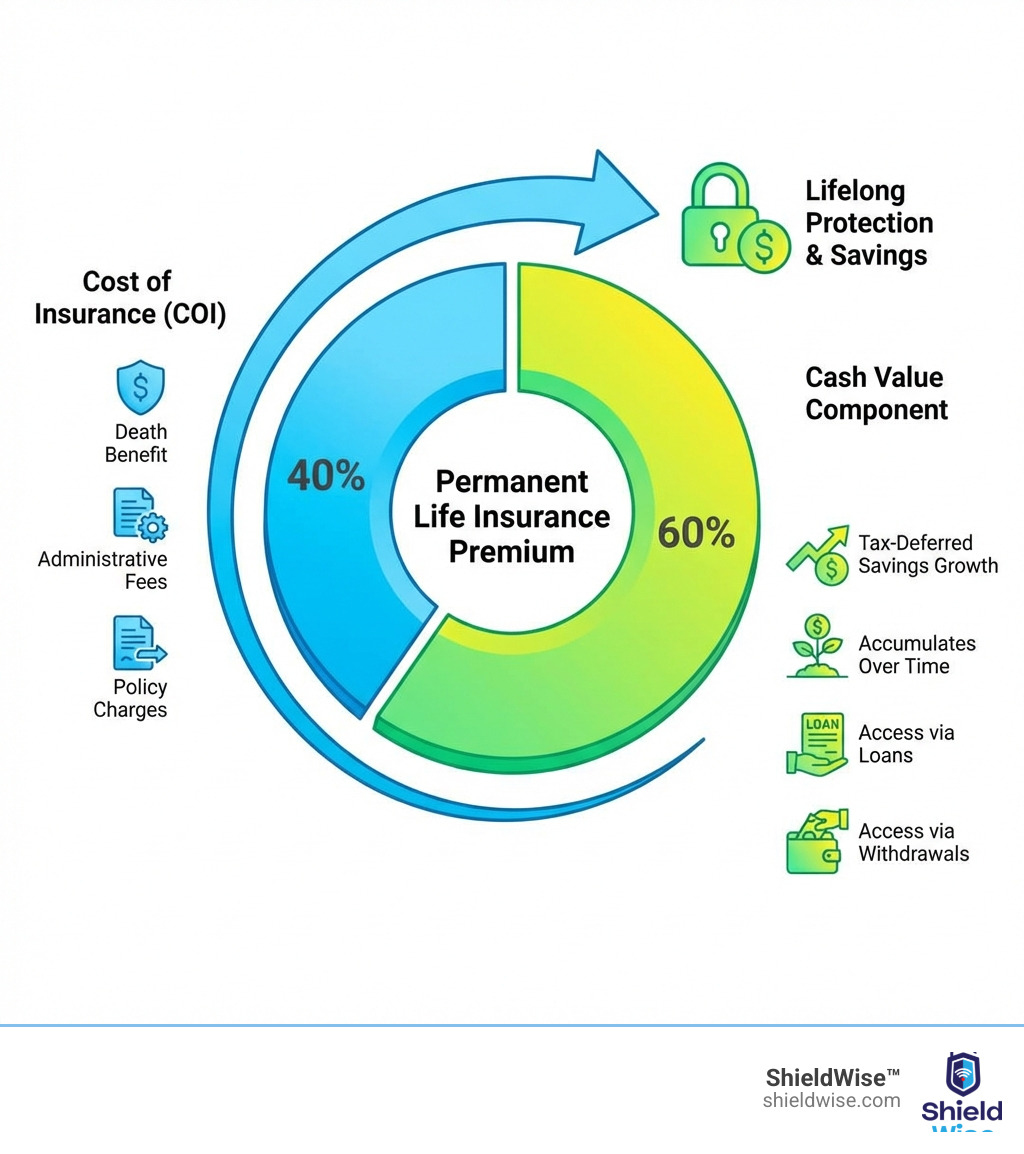
The heart of any permanent life insurance policy lies in its cash value component. This is the savings element that grows over time, tax-deferred, and can be accessed during your lifetime. The fundamental difference in how this cash value grows is precisely what sets an Indexed Universal Life (IUL) policy apart from a Whole Life policy. Understanding these mechanics is crucial when comparing indexed universal life cash value versus whole life.
Whole Life: The Path of Predictability
Whole life insurance is the grand-daddy of permanent life insurance, known for its unwavering stability. Its cash value growth operates on a guaranteed, fixed interest rate, typically set by the insurer between 2% and 4% annually. This rate is locked in from day one, providing a clear and predictable growth trajectory.
The cash value in a whole life policy grows steadily because it’s invested in the insurer’s general account, which is composed of conservative, high-quality investments. This approach minimizes risk and ensures the guarantees can be met. Think of it like a sturdy oak tree, growing slowly but surely, year after year.
A significant advantage of whole life policies, particularly those offered by mutual insurance companies, is the potential for non-guaranteed dividends. These dividends are essentially a return of excess premium if the insurer performs better than expected. While not guaranteed, they can improve the overall returns and can be used in several ways: taken as cash, used to reduce premiums, or even used to purchase additional “paid-up” insurance, further increasing the death benefit and cash value. This blend of guaranteed growth and potential dividends makes whole life an attractive option for those who prioritize stability and predictable returns, even if it means giving up some of the higher growth potential found elsewhere. For more on this, check out our guide on whether Cash Value Life Insurance: Is It Right for You?.
Indexed Universal Life (IUL): The Path of Potential
Indexed Universal Life (IUL) offers a different approach to cash value growth, aiming for a balance between market participation and protection. Instead of a fixed interest rate, your IUL cash value growth is linked to the performance of a specific market index, such as the S&P 500.
It’s important to clarify: your money isn’t directly invested in the stock market with an IUL. Instead, the interest credited to your cash value is based on the index’s performance. This provides the potential for higher returns than a traditional whole life policy, without exposing your principal to market losses.
IUL policies come with a few key features that govern this growth:
- Caps: These are the maximum interest rates your cash value can earn in a given year, even if the underlying index performs exceptionally well. For example, if the index grows by 15% but your policy has a 10% cap, your cash value will only be credited with 10% interest.
- Floors: This is the guaranteed minimum interest rate, often 0% or 1%. This floor protects your cash value from market downturns. If the index drops by 10%, your cash value simply earns the floor rate (e.g., 0%), meaning you don’t lose money due to market performance.
- Participation Rates: This determines what percentage of the index’s gains your policy will be credited with, up to the cap. For instance, a 75% participation rate means if the index gains 10%, you’d be credited with 7.5% (assuming it’s below the cap).
This structure allows IUL policies to offer higher growth potential during bull markets while safeguarding your cash value during bear markets. It’s like having a safety net while still being able to reach for the stars. For a deeper dive into these mechanics, explore How Cash Value Works in Indexed Universal Life.
Indexed Universal Life Cash Value Versus Whole Life: A Head-to-Head Comparison
When we line up indexed universal life cash value versus whole life, it’s clear we’re looking at two distinct philosophies for building wealth within a life insurance wrapper. Let’s compare them side-by-side to highlight their key differences in premiums, risk, and management.

| Feature | Whole Life | Indexed Universal Life (IUL) |
|---|---|---|
| Premium Flexibility | Fixed, level premiums; must be paid consistently | Flexible premiums; can adjust payments, skip if cash value allows |
| Cash Value Growth | Guaranteed, fixed rate (e.g., 2-4%); potential non-guaranteed dividends | Market index-linked (e.g., S&P 500); subject to caps, floors (e.g., 0%), participation rates |
| Risk Level | Very low; no market risk; predictable | Moderate; market exposure (upside potential), but protected from losses by floor |
| Death Benefit Flexibility | Fixed and guaranteed | Adjustable (can increase or decrease) |
| Management Complexity | Low; “set-it-and-forget-it” | Moderate to High; requires monitoring index performance, policy charges, and potential premium adjustments |
| Initial Cost | Generally higher for the same face value initially | Can be lower initially but variable over time |
| Opportunity Cost | Potential for lower returns compared to market-linked options | Potential for capped returns missing full market upside; fees can erode growth |
Premiums and Costs: Flexibility vs. Fixity
One of the most significant distinctions between indexed universal life cash value versus whole life lies in their premium structures.
Whole life policies are characterized by fixed, level premiums that remain the same throughout the life of the policy. This predictability is a major advantage for many, as you always know what your financial commitment will be. However, these fixed premiums are generally higher than the initial premiums for an IUL policy with the same death benefit, reflecting the guarantees provided. This higher initial cost is a trade-off for long-term stability.
IUL policies, on the other hand, offer flexible premiums. You can adjust your payments, within certain limits, or even skip them entirely if your cash value is sufficient to cover the policy’s internal costs. This flexibility can be appealing if your income fluctuates or if you want to contribute more in good years to accelerate cash value growth. However, this flexibility comes with a caveat: the cost of insurance (COI) within an IUL policy tends to increase with age. If your cash value doesn’t grow as projected, or if you underpay your premiums, you might find yourself needing to pay higher premiums later on to prevent the policy from lapsing. This potential for rising costs can be a disadvantage if not managed carefully. Understanding these dynamics is key to comparing IUL vs. Whole Life Insurance: Key Differences Explained.
Risk and Reward: The Fundamental Trade-Off
The core of the indexed universal life cash value versus whole life debate often boils down to risk and reward.
Whole life insurance offers a very low-risk profile. Its cash value growth is guaranteed, insulated from market volatility. This predictability means you won’t experience the exhilarating highs of a booming market, but you also won’t suffer the terrifying lows of a market crash. The “opportunity cost” here is that you might miss out on potentially higher returns that market-linked products could offer. However, for those who value peace of mind and guaranteed outcomes above all else, this low-risk, guaranteed return structure is a significant advantage.
IUL policies present a moderate risk, designed to capture some of the market’s upside while providing downside protection. The 0% floor is a powerful feature, ensuring that your cash value will not decrease due to negative index performance. This means you participate in market gains (up to a cap) but are shielded from market losses. While this offers more growth potential than whole life, it’s not without its own set of considerations. If the market consistently hits your cap, you won’t fully participate in larger gains. Conversely, if the market remains flat or performs poorly, your cash value might only grow by the floor rate (e.g., 0%), and the internal fees and charges could still erode its value. For more insights into how this balance works, check out our resource on More info about IUL basics.
Policy Management: Simplicity vs. Active Involvement
The level of management required is another key differentiator when considering indexed universal life cash value versus whole life.
Whole life insurance is often described as a “set-it-and-forget-it” policy. Once you establish your premiums and death benefit, your policy generally requires minimal active management. You pay your fixed premiums, and the cash value grows steadily according to its guaranteed rate. This simplicity appeals to individuals who prefer a hands-off approach to their financial products.
IUL policies, conversely, demand a more active involvement from the policyholder. While not as hands-on as managing a stock portfolio, you’ll need to monitor its performance, understand how the chosen index is performing, and be aware of your policy’s caps, floors, and participation rates. The flexibility to adjust premiums also means you need to ensure the policy remains adequately funded to avoid potential issues like lapsing or needing to significantly increase payments later. Choosing index strategies and understanding their impact on your cash value requires a certain level of engagement. This complexity means IUL might not be for everyone, but for those willing to engage, it offers greater control and potential for optimized growth. Explore more about Universal Life Cash Value and Flexibility.
Who Is Each Policy Best For?
Choosing between indexed universal life cash value versus whole life isn’t about which policy is inherently “better,” but rather which one aligns best with your personal financial philosophy, goals, and risk tolerance. We often find that different life stages and financial objectives naturally lead individuals towards one over the other.

The Ideal Candidate for Whole Life Insurance
Whole life insurance is typically the most suitable choice for individuals who prioritize certainty and predictability above all else. If you are risk-averse and value guaranteed outcomes, whole life is likely your preferred option.
This policy is ideal for:
- Conservative Planners: Those who want to know exactly what their premiums will be, how their cash value will grow, and what their death benefit will be, without worrying about market fluctuations.
- Individuals with Long-Term Financial Obligations: If you have dependents, a spouse, or other financial responsibilities that require lifelong protection and a guaranteed payout, whole life provides that unwavering security.
- Estate Planning: For individuals focused on leaving a predictable legacy or covering estate taxes, the guaranteed death benefit of whole life is invaluable.
- Those Seeking Stability: If you prefer a “set-it-and-forget-it” financial product that requires minimal management, whole life offers peace of mind.
The steady, guaranteed growth of whole life cash value means you can confidently project its future value, making it an excellent tool for long-term financial planning where stability is paramount.
The Ideal Candidate for Indexed Universal Life (IUL) Insurance
IUL insurance appeals to a different type of individual—one who is comfortable with a bit more complexity and seeks the potential for higher returns, balanced with downside protection.
This policy is often best for:
- Growth-Oriented Investors with a Safety Net: If you’re generally comfortable with market-linked growth but want the reassurance of a 0% floor to protect against losses, IUL strikes a compelling balance.
- Financially Savvy Individuals: Those who are willing to monitor their policy’s performance, understand caps and participation rates, and potentially adjust premiums to optimize growth.
- Seeking Supplemental Retirement Income: IUL policies can be strategically designed to accumulate significant cash value, which can then be accessed tax-free through policy loans during retirement, especially if other retirement accounts are maxed out. Our guide on Indexed Universal Life for Retirement digs into this potential.
- Individuals Desiring Premium Flexibility: If your income is variable or you anticipate needing to adjust premium payments at different stages of life, IUL’s flexibility can be a major advantage.
IUL offers the dynamic potential to grow your cash value faster than a traditional whole life policy during strong market periods, making it an attractive option for those looking to maximize their policy’s living benefits.
Accessing and Using Your Cash Value
One of the most appealing aspects of permanent life insurance, whether whole life or IUL, is the ability to access your accumulated cash value during your lifetime. This can provide a valuable financial resource for various needs, from unexpected expenses to retirement income. However, understanding the implications of accessing this value is critical when comparing indexed universal life cash value versus whole life.
Policy Loans and Withdrawals: Impact on Your Coverage
Both whole life and IUL policies allow you to access your cash value primarily through loans or withdrawals.
- Policy Loans: You can borrow against your cash value, and these loans are generally tax-free. The cash value itself acts as collateral. While you typically don’t have to repay the loan on a fixed schedule, any outstanding loan balance, plus accrued interest, will reduce the death benefit paid to your beneficiaries. If the loan interest accrues to the point where it exceeds the cash value, it can lead to policy lapse, which would have tax implications. It’s like borrowing from yourself, but there’s a cost and a potential impact on your loved ones’ future financial security. Understanding How IUL Loans Work is crucial for managing this.
- Withdrawals: You can also make partial withdrawals from your cash value. These withdrawals are typically tax-free up to your basis (the amount you’ve paid in premiums). However, withdrawals directly reduce your policy’s cash value and, consequently, the death benefit. If you withdraw too much, it could impact the policy’s longevity or even lead to lapse.
Using your cash value impacts the policy’s overall health and the death benefit. Careful planning and understanding the terms of your specific policy are essential to avoid unintended consequences, such as policy lapse or a significantly reduced payout for your beneficiaries.
Navigating Market Downturns: Indexed universal life cash value versus whole life
The way each policy type handles market downturns is a defining characteristic of indexed universal life cash value versus whole life.
For Whole Life policies, market downturns generally have no direct impact on your cash value growth. Because the growth is based on a fixed, guaranteed interest rate, your cash value continues to accumulate steadily, regardless of how the stock market performs. This makes whole life an incredibly stable asset during volatile economic periods, offering a predictable haven for your savings.
For Indexed Universal Life (IUL) policies, the impact of market downturns is mitigated by the “floor” feature. As we discussed, if the linked market index performs negatively, your cash value is typically credited with a 0% interest rate. This means you won’t lose money due to market losses, which is a significant advantage over direct market investments. However, it also means your cash value won’t grow during those down years. While the 0% floor protects your principal, the policy’s internal fees and the cost of insurance continue to be deducted, potentially eroding the overall cash value if there’s no growth to offset these charges. This highlights the importance of monitoring your IUL policy, especially during prolonged periods of flat or negative market performance.
This graphic illustrates how IUL aims to capture upside potential (up to a cap) while protecting against market losses (with a floor), offering a unique blend of growth and security compared to the consistent, albeit lower, growth of whole life.
Frequently Asked Questions about IUL vs. Whole Life
When clients approach us at ShieldWise, they often have similar questions about indexed universal life cash value versus whole life. Let’s tackle some of the most common ones.
Is indexed universal life insurance riskier than whole life?
Yes, in a general sense, IUL carries more risk than whole life insurance. The primary reason is that IUL’s cash value growth is linked to market index performance, making it inherently more variable. While the 0% floor protects against market losses, the actual growth is not guaranteed and can fluctuate significantly year to year, depending on the index’s performance and the policy’s caps and participation rates.
Whole life, conversely, offers guaranteed cash value growth at a fixed rate, insulated from market volatility. Its premiums and death benefit are also guaranteed, making it a much more predictable and less risky option. The “risk” in whole life is primarily the opportunity cost of potentially lower returns compared to market-linked alternatives.
IUL also introduces a “complexity risk” and a “premium risk.” Its structure requires more understanding and monitoring, and the flexible premiums, while an advantage, can also lead to issues if the policy is underfunded or if market performance doesn’t meet expectations, potentially requiring higher premium payments later to keep the policy in force.
Can you lose money with an IUL policy?
You cannot lose money in an IUL policy due to market downturns because of the guaranteed 0% (or sometimes slightly higher) floor. If the linked index performs negatively, your cash value simply receives the floor rate, meaning it won’t decrease from market performance.
However, it’s crucial to understand that you can still lose cash value in an IUL policy if you’re not careful. This typically happens due to:
- Policy Fees and Charges: IUL policies have internal costs, such as administrative fees, mortality charges (cost of insurance), and expense loads, which are deducted from your cash value. If the market performance is flat (earning only the floor rate) or if you underpay your premiums, these fees can erode your cash value over time.
- Insufficient Funding: If you don’t pay enough premiums to cover the increasing cost of insurance and other fees, especially as you age, your cash value can deplete, eventually leading to policy lapse.
- Withdrawals/Loans: Taking excessive withdrawals or loans that are not repaid can also reduce your cash value and impact the policy’s longevity.
So, while the market won’t directly cause your IUL cash value to drop below what you’ve accumulated, poor management or insufficient funding can. For a complete understanding, refer to our What is an IUL? Complete Guide.
Which policy is better for retirement income planning?
Both IUL and whole life can be effective tools for retirement income planning, but they serve different risk appetites and goals.
IUL for Retirement Income: If you have a higher risk tolerance and are seeking potentially higher growth to generate a larger supplemental retirement income, IUL might be more appealing. The market-linked growth, combined with the 0% floor, offers the potential for faster cash value accumulation during your working years. This accumulated cash value can then be accessed tax-free through policy loans in retirement, providing a flexible income stream. This strategy can be particularly attractive if you’ve already maxed out other tax-advantaged retirement accounts.
Whole Life for Retirement Income: For those who prioritize predictability and guaranteed income, whole life is often the better choice. The steady, guaranteed cash value growth allows for precise planning of future income streams. You can project exactly how much cash value will be available at a certain age, and then access it through loans or withdrawals. This stability provides immense peace of mind, especially for retirees who cannot afford market volatility. While the growth potential may be lower than a well-performing IUL, the certainty can be invaluable.
The “better” policy depends on your individual financial situation, risk tolerance, and how much certainty you need in your retirement income. Some individuals even choose a combination, using whole life for a guaranteed base and IUL for additional, market-linked growth potential.
Conclusion: Making the Right Choice for Your Financial Future
Navigating permanent life insurance can feel like trying to choose between a tortoise and a hare – steady and guaranteed, or potentially faster with some inherent variability. When weighing indexed universal life cash value versus whole life, we see a clear trade-off: the predictable, guaranteed growth and fixed premiums of whole life versus the market-linked potential and premium flexibility of IUL.
Whole life insurance offers unparalleled stability, making it ideal for those who value guarantees, predictable long-term planning, and a “set-it-and-forget-it” approach. Its cash value grows steadily, untouched by market downturns, and provides a reliable source for loans or a guaranteed death benefit.
IUL, on the other hand, is designed for individuals seeking higher cash value growth potential, linked to market indices, while still offering protection from market losses through its floor. Its flexibility in premiums and death benefits allows for adaptation to changing life circumstances, and it can be a powerful tool for supplemental retirement income for those comfortable with active monitoring and some market-related variability.
At ShieldWise, we understand that your financial future is unique. There’s no one-size-fits-all answer. We believe in empowering you with clear, jargon-free guidance to understand these complex products. By considering your personal financial goals, risk tolerance, and desire for flexibility, you can make an informed decision that secures the right coverage for you and your family.
Ready to explore your options and find the perfect fit for your long-term strategy? Explore Universal Life Insurance options with ShieldWise today.