
Why Universal Life Insurance to Protect Children Future Is One of the Smartest Financial Moves You Can Make
Universal life insurance to protect children future is a strategy that gives your child both lifelong coverage and a growing pool of tax-advantaged cash — starting from as early as a few days old.
If you’re trying to decide quickly, here’s what you need to know:
How Universal Life Insurance Protects Your Child’s Future:
| Benefit | What It Means for Your Child |
|---|---|
| Lifelong coverage | Protection that never expires, even if health changes |
| Locked-in low premiums | Cheapest rates available — locked in at birth |
| Tax-deferred cash value | Money grows without annual tax drag |
| Tax-free access | Loans and withdrawals can be taken tax-free |
| Flexible use of funds | College, home, business, retirement — no restrictions |
| Guaranteed insurability | Health problems later won’t affect coverage |
Most parents think about college savings accounts or term life insurance when planning for their kids. But those tools have real limits — term coverage expires, and 529 plans restrict how you can spend the money.
Universal life insurance — especially an Indexed Universal Life (IUL) policy — does something different. It combines a permanent death benefit with a cash value account that grows linked to a market index like the S&P 500, but with a floor that prevents losses in down years. That combination makes it a flexible, multi-purpose financial tool that can serve your child from birth all the way through retirement.
The earlier you start, the more powerful it becomes. A policy opened at birth benefits from decades of compounding — and insurance costs for infants are the lowest they’ll ever be.
At ShieldWise™, our team — including licensed life and health insurance producer Savannah Schipman — brings hands-on experience helping families evaluate universal life insurance to protect children future without the sales pressure or confusing jargon. In this guide, we’ll walk you through exactly how these policies work, what they cost, and whether one makes sense for your family.
Quick universal life insurance to protect children future definitions:
Understanding Indexed Universal Life (IUL) for Kids

When we talk about using universal life insurance to protect children future, we are usually talking about a specific type called Indexed Universal Life (IUL). Think of an IUL as a hybrid: it’s part life insurance and part “opportunity fund.”
Unlike traditional whole life insurance, which has fixed growth rates, an IUL allows the cash value to grow based on the performance of a stock market index, such as the S&P 500. This gives your child’s policy the potential for much higher returns over the long haul.
But here is the best part for cautious parents: you aren’t actually “in” the market. Your money is protected by a “floor”—usually 0%. If the market crashes 20%, your child’s account simply stays flat for that year instead of losing value. On the flip side, there is usually a “cap” (a maximum gain) or a participation rate that determines how much of the market’s upside you capture. To get a better handle on the basics, check out our guide on What is IUL and see exactly How Does IUL Work.
How Cash Value Accumulates Over Time
The magic of an IUL lies in its premium allocation. When you pay into the policy, a portion covers the cost of insurance (which is incredibly cheap for a healthy child), and the rest goes into the cash value account.
This cash value grows tax-deferred. In finance, “tax-deferred” is a fancy way of saying the IRS doesn’t take a cut of your gains every year, allowing your money to compound much faster. Over 18, 30, or 65 years, that difference is massive. You can learn more about this engine in our deep dive on How Cash Value Works in Indexed Universal Life.
The Role of Market Indices and Protection
By linking growth to an index like the S&P 500, we give children a seat at the table of the American economy. However, we also provide them with a safety net. Most IULs utilize a “Zero-percent floor,” ensuring that even in the worst economic years, the principal remains intact. This balance of growth and safety is why many families find it superior to a standard savings account, which often fails to keep up with inflation. For a clearer picture of these mechanics, see our article on Demystifying Universal Life Your Policy Your Way.
Why Use Universal Life Insurance to Protect Children Future
The primary reason to use universal life insurance to protect children future isn’t actually the death benefit—though that provides peace of mind for funeral costs or family support. The real “why” is the living benefits.
Locking in Low Rates and Health Status
Insurance is cheapest when you are young and healthy. By starting a policy for an infant or toddler, you lock in the lowest possible mortality costs. Furthermore, you guarantee their future insurability. If a child develops a health condition like diabetes or asthma later in life, they already have a policy in place that can never be taken away. This is a gift of security that lasts a lifetime. Explore why this is so vital in our guide to Universal Life for Families and Protection and see how it fits IUL for Young Families and Parents.
Building a Versatile Financial Safety Net
An IUL isn’t just a “death” policy; it’s a “life” policy. The cash value can be accessed via policy loans for emergencies, often with better terms than a bank. This creates a private reserve that the child can use for anything from medical bills to unexpected life hurdles. This versatility is a hallmark of Universal Life Cash Value and Flexibility.
IUL as a Versatile Alternative for Children’s Financial Futures
When we compare IULs to other options, the differences become clear. A 529 plan is great for college, but what if your child gets a full scholarship? Or decides to start a business instead? With a 529, you might face penalties for non-educational withdrawals. With an IUL, there are no such “use it or lose it” rules.
| Feature | IUL for Kids | 529 College Plan | Traditional Savings |
|---|---|---|---|
| Market Growth | Yes (Linked) | Yes | No (Low Interest) |
| Downside Floor | Yes (0% Floor) | No | Yes |
| Tax-Free Access | Yes (via loans) | Only for Education | No (Interest Taxed) |
| FAFSA Impact | None (Hidden Asset) | High (Counted) | High (Counted) |
| Flexible Use | Anything | Education Only | Anything |
According to an article from Forbes, many Americans drastically overestimate the cost of life insurance. In reality, a child’s policy can be started for a fraction of what most people spend on a monthly streaming habit. Understanding the Universal Life Term Versus Permanent debate is key to seeing why the permanent nature of IUL is so valuable for kids.
Funding Education with Universal Life Insurance
While a 529 is the “standard” choice, universal life insurance to protect children future offers a unique edge for college. Cash value in a life insurance policy is generally not reported as an asset on the FAFSA (Free Application for Federal Student Aid). This means your child could have a six-figure “college fund” in an IUL that doesn’t disqualify them from financial aid. You can take tax-advantaged loans from the policy to pay for tuition, books, or housing. For more on this, read our IUL Basics Education Complete Guide.
IUL’s Unique Ownership and Control Features
As the parent, you own the policy while the child is a minor. This gives you total control over the funds. You decide when they are ready to take over the policy—usually at age 18 or 21. This prevents a teenager from spending their future “first home fund” on a flashy car the moment they reach legal age.
Strategic Milestones: From College to Retirement
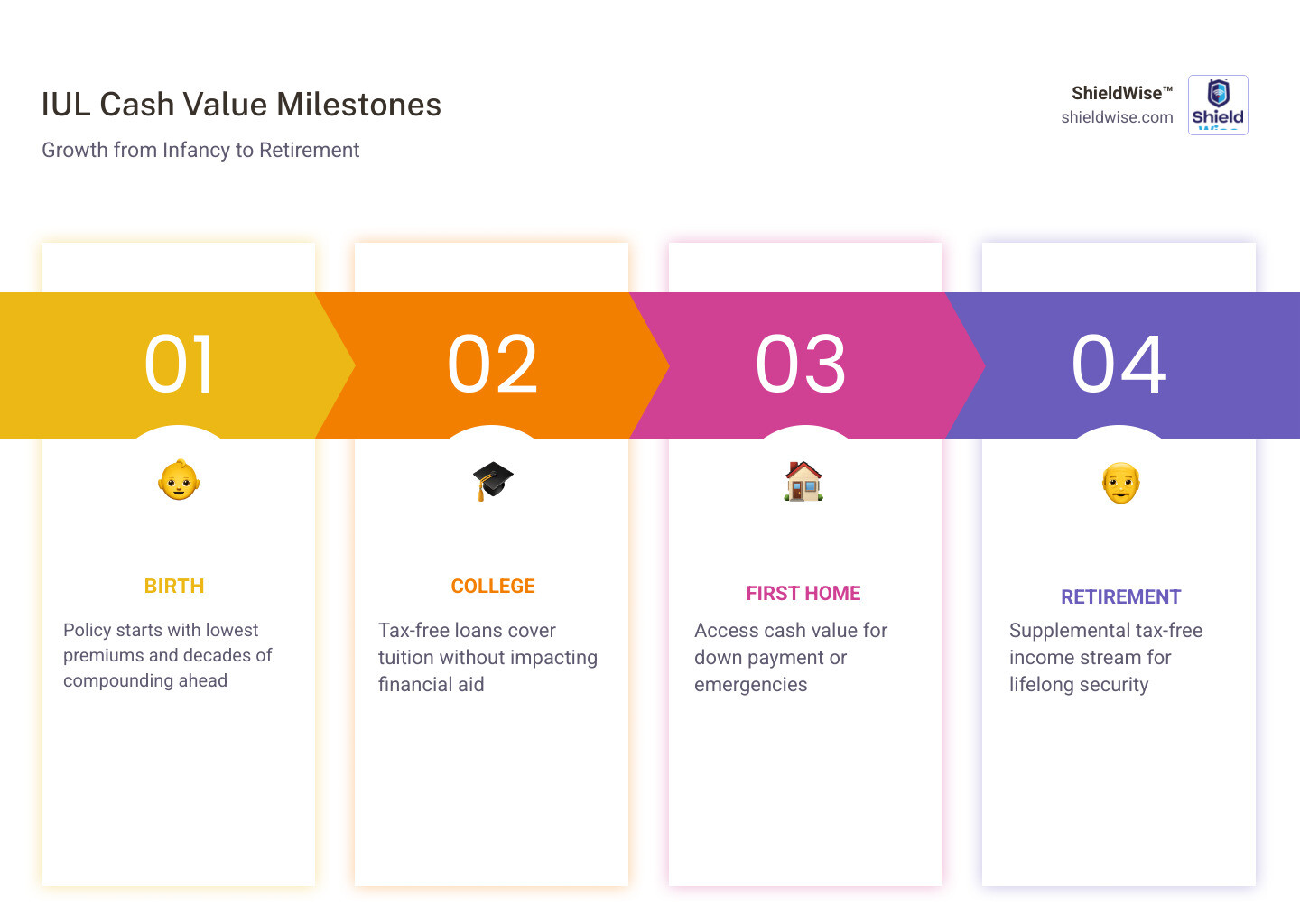
The true power of universal life insurance to protect children future is that it grows with them.
- At Age 18-22: Use cash value for college tuition or a study abroad program.
- At Age 25-30: Take a policy loan for a down payment on a first home.
- At Age 35: Use the funds to start a business or cover wedding costs.
- At Age 65: The remaining cash value can provide a tax-free stream of supplemental retirement income.
This is the ultimate way of Using Life Insurance in Retirement Planning. Because the child started at age 0, they have 65 years of compounding working for them. A modest $100 or $200 a month can legitimately turn into a million-dollar head start. You can see the mechanics of this in How IUL Loans Work.
The Long-Term Value of Universal Life Insurance to Protect Children Future
By the time your child reaches retirement, the policy you started for them as a baby could be their largest financial asset. This creates a legacy of “generational wealth.” They can eventually name their own children as beneficiaries, passing on the death benefit tax-free, just as you did for them. This is why we often discuss Indexed Universal Life for Retirement even when the “client” is still in diapers.
Managing Policy Risks and Fees
We believe in being transparent. IULs are not “free” money. They have costs, including the cost of insurance and administrative fees. In the early years (usually the first 10 years), there are “surrender charges” if you cancel the policy. It is a long-term play, not a get-rich-quick scheme. If you stop paying premiums too early, the policy could lapse. That’s why we emphasize working with an expert to structure the policy correctly. Check out our What is an IUL Complete Guide for a full breakdown of these considerations.
How to Set Up and Manage Your Child’s Policy
Setting up a policy is simpler than most parents realize. Because children are generally healthy, “simplified underwriting” is often available, meaning no medical exams or blood draws—just a few health questions.
Steps to Purchase and Transfer Ownership
- Determine the Goal: Are you focused on college funding, a retirement nest egg, or just basic protection?
- Choose a Carrier: We help you compare the top-rated carriers in Illinois to find the best caps and participation rates.
- Apply: You’ll need the child’s basic info and social security number.
- Fund the Policy: Decide on a monthly or annual premium that fits your budget.
- Transfer: When the child reaches the age of majority (18 or 21 in Illinois), you can transfer ownership to them, or keep it yourself until they are older.
For a step-by-step walkthrough, see our Universal Life Insurance Guide 2026 or Consult with a Licensed Policy Engineer to get a personalized illustration.
Frequently Asked Questions about Child IUL
When is the best time to purchase an IUL for a child?
The best time is “yesterday,” but the second best time is today. Most companies allow you to start a policy when the infant is just 14 or 15 days old. Starting early maximizes the time for compound growth and locks in the lowest possible insurance costs.
Can the cash value be used for non-educational expenses?
Absolutely. Unlike a 529 plan, there are no restrictions. Whether your child wants to buy a house, start a tech company, or travel the world, the cash value is theirs to use via tax-free policy loans.
What happens to the policy when the child reaches adulthood?
You have options. You can transfer ownership to the child, and they can take over the premium payments. Or, if the policy is “max-funded,” it might be able to pay for itself using the internal cash value growth, meaning your child gets a “paid-up” policy for life.
Conclusion
At ShieldWise™, we believe that universal life insurance to protect children future is one of the most selfless and strategic gifts a parent can provide. It’s more than just a piece of paper; it’s a financial foundation that provides security, flexibility, and a massive head start in a world that is becoming increasingly expensive.
Whether you are in Chicago, Springfield, or anywhere else in Illinois, our mission is to provide you with clear, jargon-free guidance so you can make the best decision for your family. Don’t leave your child’s dreams to chance. Secure their legacy today.
Explore more in our Category Universal Life Insurance or get a personalized quote to see the numbers for your child.