
Why Most Business Owners Are Missing a Powerful Financial Tool
How to structure IUL for business planning is one of the most overlooked questions in small business finance — and getting it right can mean the difference between a business that protects its owners and one that leaves them exposed.
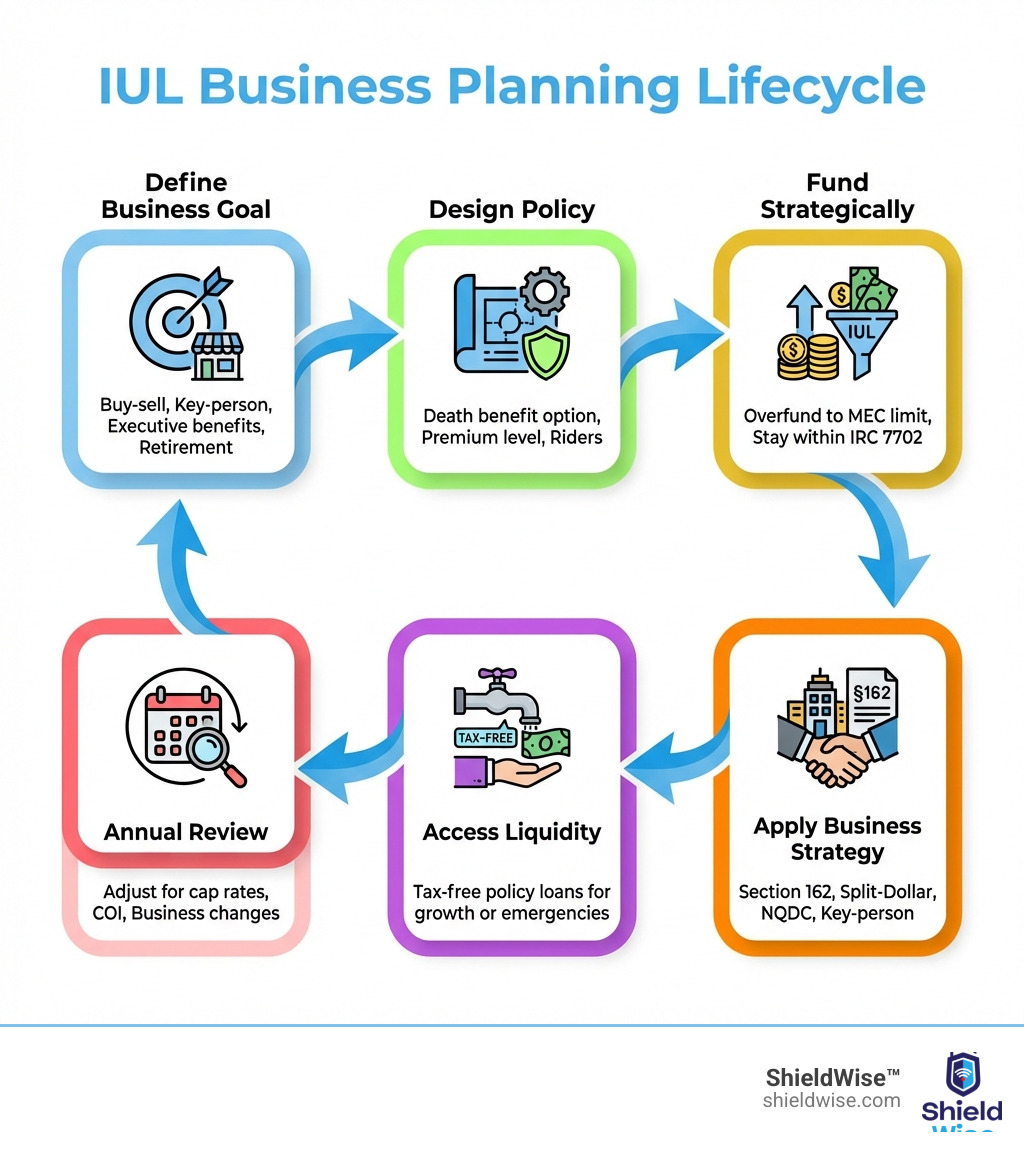
Here is a quick overview of how to structure an IUL for business planning:
- Define your goal — Buy-sell funding, key-person protection, executive benefits, or tax-advantaged retirement savings
- Choose the right death benefit option — Level (Option A) or increasing (Option B), depending on your cash value vs. protection priority
- Overfund strategically — Maximize premium contributions up to IRS limits (IRC 7702) without triggering MEC status
- Layer in business-specific strategies — Such as Section 162 Executive Bonus plans, Split-Dollar arrangements, or Non-Qualified Deferred Compensation
- Use policy loans for liquidity — Access cash value tax-free to fund expansions, cover emergencies, or smooth cash flow
- Review annually — Adjust for market conditions, cap rate changes, and evolving business needs
Most business owners think of life insurance as something personal — a safety net for their family. But a well-structured Indexed Universal Life (IUL) policy can do much more. It can fund a buyout when a partner dies unexpectedly. It can protect the business if a key employee is suddenly gone. And it can serve as a tax-advantaged savings vehicle when traditional retirement accounts hit their limits.
The challenge is that IUL policies are flexible by design — which means they can be set up in ways that either maximize their value or quietly underperform for years.
At ShieldWise™, we specialize in helping business owners and mid-career professionals cut through the complexity of products like IUL, drawing on hands-on insurance industry experience to explain exactly how to structure IUL for business planning in plain, actionable terms. Let’s walk through every core strategy, step by step.
Why Business Owners Choose Indexed Universal Life (IUL)
When we talk to entrepreneurs in Illinois about their financial toolkit, many are surprised to learn that life insurance can be a high-value, underused wealth-building tool. But what is IUL? At its core, Indexed Universal Life is a form of permanent coverage that offers more than just a death benefit.
The “magic” of IUL lies in its cash value component. Unlike a standard policy, an IUL allows you to link your cash value growth to a market index (like the S&P 500). However, you aren’t actually in the market. This distinction is vital because it provides a 0% floor—meaning if the market crashes, your account doesn’t lose value due to market performance. You get the upside of the market, usually up to a certain cap rate, without the gut-wrenching downside.
How Does IUL Work? It combines the flexibility of universal life (adjustable premiums and death benefits) with the growth potential of an index. For a business owner, this means:
- Asset Protection: In many states, including Illinois, life insurance cash values often enjoy significant protection from creditors.
- Tax-Deferred Growth: Your cash value grows without the IRS taking a cut every year.
- Liquidity: You can access your funds via policy loans to reinvest in your business.
For a deeper dive into the mechanics, check out our IUL Basics Education Complete Guide.
How to Structure IUL for Business Planning: Core Strategies
Structuring a policy correctly requires moving beyond “family protection” and looking at the business as an entity. One of the most critical uses for an IUL is funding a Buy-Sell Agreement.
If you have partners, what happens if one of you passes away? Without a plan, the deceased partner’s spouse might suddenly become your new, unwanted business partner. Or, the family might demand a buyout the business can’t afford, leading to liquidation. A properly structured IUL provides the immediate liquidity needed to buy out those shares.
There are two main ways to set this up:
- Cross-Purchase: Each partner owns an IUL policy on the other partners. When one dies, the survivors use the death benefit to buy the shares.
- Entity-Purchase (Stock Redemption): The business itself owns the policies on each owner and uses the proceeds to redeem the deceased owner’s interest.
According to our Universal Life Insurance Guide 2026, IUL is often preferred for these agreements because of the cash value accumulation, which can be used for a “living buyout” if a partner simply wants to retire.
Protecting Operations with Key-Person IUL Structuring
Every business has that one person—the “rainmaker” or the technical genius—whose absence would cause the company to stumble. This is your “human capital.” According to International Accounting Standards (IAS 38), intangible assets like specialized knowledge are core to business value.
Key-Person Insurance structured through an IUL works like this:
- The business owns the policy and pays the premiums.
- The key employee is the insured.
- If that employee passes away, the business receives the tax-free death benefit to cover recruitment costs, revenue replacement, or to pay off business debts.
If the employee stays healthy and eventually retires, the business can even use the accumulated cash value as part of a retirement package or to “buy back” the policy for the employee as a bonus.
| Feature | Buy-Sell Agreement IUL | Key-Person IUL |
|---|---|---|
| Primary Goal | Ownership transition | Operational stability & loss mitigation |
| Policy Owner | Partners or the Business | The Business |
| Beneficiary | Surviving partners or Business | The Business |
| Benefit Use | Purchasing shares/equity | Replacing lost revenue/finding a successor |
Attracting Talent via Executive Bonus and Split-Dollar Plans
In a competitive market, “golden handcuffs” are essential. You can use IUL to create selective benefit plans that don’t have to follow the strict “all-employee” rules of a 401(k).
- Section 162 Executive Bonus: The business pays the premiums on an IUL owned by the executive. The premiums are tax-deductible for the business (as compensation) and the executive gets a high-value asset.
- Split-Dollar Plans: The business and the employee “split” the policy’s costs and benefits. It’s a sophisticated way to provide massive value while the business eventually recovers its premium costs from the death benefit or cash value.
Using life insurance in this way is a staple in Life Insurance in Retirement Planning, providing executives with a tax-free income stream in the future.

Technical Steps to Structure IUL for Business Planning
Designing the policy is where the rubber meets the road. You can’t just pick a policy off the shelf; you have to engineer it.
First, you must choose the Death Benefit Option:
- Option A (Level): The death benefit stays the same. As cash value grows, the “net amount at risk” for the insurance company drops. This is usually cheaper and better for long-term cash accumulation.
- Option B (Increasing): The death benefit is the face amount plus the cash value. This is great for buy-sell agreements where the business value is expected to grow over time.
For more details, see our What is an IUL Complete Guide.
Optimizing Cash Value: How to Structure IUL for Business Planning Growth
If your goal is wealth building, you want to overfund the policy. This means putting in the maximum amount of money allowed while keeping the death benefit (the “insurance” part) as low as possible.
Why? Because the lower the death benefit, the lower the internal costs (Cost of Insurance or COI), leaving more of your premium to grow in the indexed account. However, you must stay within the limits of IRC Section 7702. If you put in too much too fast, the policy becomes a Modified Endowment Contract (MEC), and you lose the tax-free status of your loans.
Understanding How Cash Value Works in Indexed Universal Life is the key to maximizing your internal rate of return.
Strategic Funding: How to Structure IUL for Business Planning Liquidity
One of the biggest advantages for a business owner is the ability to be your own banker. How IUL Loans Work is through a process called “arbitrage.”
When you take a loan from your policy, your cash value doesn’t actually leave the account. It stays there, continuing to earn indexed interest. Meanwhile, the insurance company charges you a loan interest rate. If your earned interest (say 7%) is higher than the loan rate (say 4%), you are actually making a 3% profit on the money you’ve borrowed to expand your business!
To ensure this works long-term, we often use Monte Carlo simulations to stress-test the policy against decades of market volatility. This ensures that even in “flat” market years, the policy remains sustainable.
Avoiding Pitfalls and Ensuring Compliance
IUL is a powerful tool, but it isn’t a “set it and forget it” strategy. There are several risks to watch out for:
- Surrender Charges: If you cancel the policy in the first 10-15 years, the company will keep a large chunk of the cash value. This is a long-term play.
- Caps and Participation Rates: The insurance company can change these. If the Cap Rate drops too low, your growth slows down.
- Policy Lapse: if you underfund the policy and the cost of insurance rises as you get older, the policy could eat itself and lapse, potentially triggering a massive tax bill.
This is why annual reviews are non-negotiable. You need to look at the actual performance versus the original illustration. Working with someone who has a fiduciary duty—meaning they are legally required to act in your best interest—is essential. We also recommend this for IUL for Young Families and Parents who are starting their wealth journey early.
Frequently Asked Questions about IUL Business Structuring
Can IUL premiums be deducted as a business expense?
Generally, no. If the business is the beneficiary of the policy (which it usually is in key-person or buy-sell setups), the premiums are not tax-deductible. However, the death benefit is received income tax-free. In an Executive Bonus (Section 162) plan, the premiums are deductible as compensation, but the employee must report them as taxable income.
What happens to the IUL policy if the business is sold?
This is a common concern. Usually, the policy can be transferred. If it’s a key-person policy, the business can sell the policy to the insured employee, or it can be included as an asset in the business sale. Because the policy is permanent, it maintains its value regardless of the corporate structure above it.
Conclusion
Structuring an IUL for business planning is about more than just buying a policy; it’s about creating a financial foundation that provides protection today and wealth tomorrow. Whether you are looking to secure a partnership, retain top talent, or build a tax-advantaged “opportunity fund” for your next expansion, the right structure is everything.
At ShieldWise™, we are dedicated to helping Illinois business owners navigate these waters with clarity and confidence. Don’t leave your business continuity to chance or settle for a one-size-fits-all insurance plan.
Ready to see how a custom-designed IUL can fit into your business plan?
- Learn about Universal Life Cash Value and Flexibility
- See how to use Indexed Universal Life for Retirement
- Explore ShieldWise Universal Life Options and get your jargon-free quote today.