
Why Understanding the Difference Matters
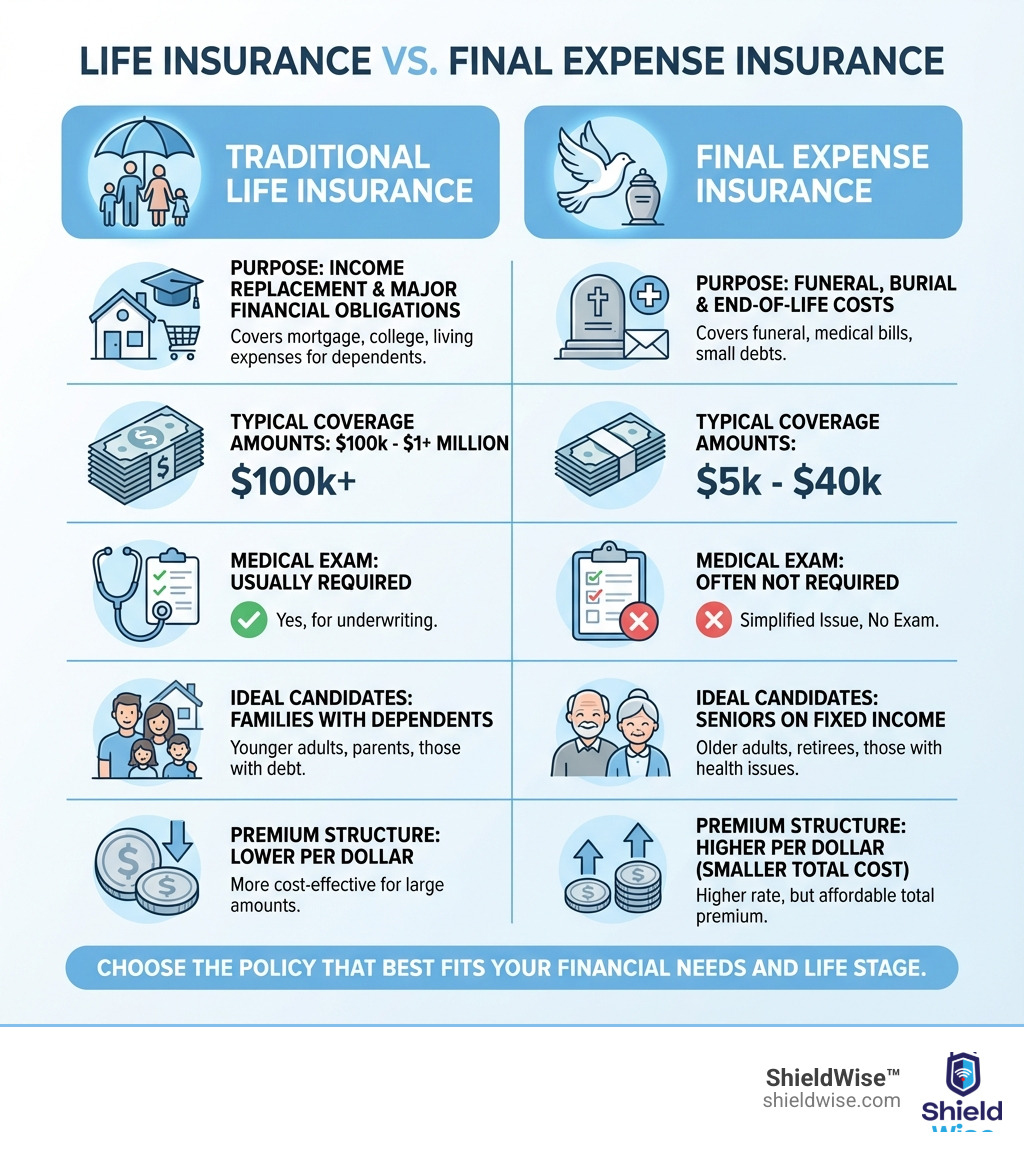
The difference between final expense and life insurance comes down to purpose and scale. Traditional life insurance is designed to replace income and cover major financial obligations like a mortgage or children’s college expenses—with death benefits typically ranging from $100,000 to over $1 million. Final expense insurance, on the other hand, is a smaller, permanent policy specifically meant to cover end-of-life costs like funeral expenses, medical bills, and small debts—usually between $5,000 and $40,000.
Quick Comparison:
| Feature | Traditional Life Insurance | Final Expense Insurance |
|---|---|---|
| Primary Purpose | Income replacement, long-term financial support | Cover funeral, burial, and end-of-life costs |
| Coverage Amount | $100,000 to $1+ million | $5,000 to $40,000 |
| Medical Exam | Usually required | Often not required |
| Best For | Families with dependents, mortgages, or major debts | Seniors on fixed incomes, those with health issues |
| Premium Cost | Lower per dollar of coverage | Higher per dollar, but smaller total premiums |
If you’re nearing retirement, on a fixed income, or simply want to make sure your family isn’t stuck with funeral bills, final expense insurance may be the simpler, more affordable choice. If you have young children, a mortgage, or other dependents counting on your income, traditional life insurance offers the larger safety net you need.
At ShieldWise, we’ve spent years helping families and retirees understand the difference between final expense and life insurance so they can choose coverage that fits their real needs—without the jargon or sales pressure. Our goal is to give you clear, honest guidance so you can protect the people you care about most.
What is Traditional Life Insurance?
Traditional life insurance provides substantial financial protection for your loved ones over the long term. Its primary purpose is income replacement, ensuring that if you pass away, your family can maintain their standard of living and meet significant financial obligations. If you’re a primary breadwinner with a mortgage or children to support, a sudden loss of your income would be devastating. Traditional life insurance fills that void.
The death benefit, often in the hundreds of thousands or even millions of dollars, is paid to your beneficiaries to use for a multitude of purposes, such as:
- Replacing lost income: To cover daily living expenses.
- Paying off large debts: Including a mortgage, car loans, or other personal debts.
- Funding college tuition: To ensure your children’s educational goals are met.
- Covering childcare costs: If a surviving parent needs to enter or re-enter the workforce.
- Leaving a financial legacy: Providing an inheritance for your loved ones.
The large scale of coverage is what sets traditional life insurance apart. It’s designed for major “what if” scenarios where a significant financial gap needs to be filled.
Types of Traditional Life Insurance Policies
There are several main types of traditional life insurance:
- Term Life Insurance: This affordable option provides coverage for a specific period, or “term,” such as 10, 20, or 30 years. If you pass away during the term, your beneficiaries receive the death benefit. It does not build cash value and is ideal for covering financial obligations that have an end date, like a mortgage or the years your children are dependent.
- Whole Life Insurance: This is a permanent policy that provides coverage for your entire life, as long as premiums are paid. A key feature is its ability to build cash value over time on a tax-deferred basis. You can borrow against or withdraw this cash value, though doing so can reduce the death benefit. Premiums are higher than term life because of the lifelong coverage and cash value component.
- Universal Life Insurance (UL): Another form of permanent insurance, UL offers more flexibility than whole life, allowing you to adjust your premiums and death benefit. It also builds cash value. Variations like Indexed Universal Life (IUL) and Variable Universal Life (VUL) tie cash value growth to market indices or investments, adding a layer of complexity.
Qualification and Underwriting
Because these policies involve substantial death benefits, the qualification process is rigorous. Most policies require a medical exam, including blood and urine samples, to assess your health and lifestyle risks. The insurer will also review your medical and family health history. This comprehensive underwriting process helps determine your risk profile, which directly impacts your premium costs.
Who is Traditional Life Insurance For?
Traditional life insurance is an excellent choice for individuals with:
- Dependents: A spouse, children, or other relatives who rely on your income.
- Significant debts: A mortgage or large loans you don’t want to leave to your family.
- Long-term financial goals: Such as funding a child’s education or leaving an inheritance.
- A desire for cash value growth: Permanent policies can be a valuable asset for future needs or using life insurance in retirement planning.
It’s about providing a robust financial safety net to ensure life’s major responsibilities are covered, even if you’re gone.
What is Final Expense Insurance?

Final expense insurance serves a very specific and important purpose. While traditional life insurance covers the large, long-term financial picture, final expense insurance focuses on the immediate costs that arise at the end of life. Its primary goal is to cover these end of life expenses, ensuring your loved ones aren’t burdened with financial stress during a time of grief.
What are Final Expenses?
The term “final expenses” encompasses a range of costs that can quickly add up. These typically include:
- Funeral and burial costs: This is often the largest component. According to the National Funeral Directors Association, the median cost of a funeral with burial can easily exceed $9,000, and these costs have risen significantly over the past few decades.
- Cremation services: This includes the cost of the service, an urn, and a potential memorial.
- Medical bills: Unpaid expenses from a final illness or hospital stay can accumulate quickly.
- Small debts: This could include outstanding credit card balances or small personal loans. Many Americans die in debt, and a final expense policy can help cover these remaining balances.
A Type of Whole Life Insurance: What is Burial Insurance?
Final expense insurance is a type of whole life insurance. This means it’s a permanent policy that remains active for your entire life as long as you pay the premiums, and it often builds a small cash value over time.
You might also hear it called “burial insurance” or “funeral insurance.” These terms are synonymous and refer to the same type of policy designed for end-of-life costs. Our Burial Insurance Complete Guide explores this in more detail.
Smaller Death Benefits and Simplified Qualification
Final expense policies have much smaller death benefits than traditional life insurance, typically ranging from $5,000 to $40,000. This amount corresponds to its purpose of covering specific, immediate costs rather than replacing income.
A key appeal, especially for seniors, is the simplified qualification process. Many policies are “simplified issue,” requiring only a few health questions on the application instead of a medical exam. For those with significant health issues, “guaranteed issue” policies are available, which ask no health questions and guarantee approval. This easier final expense health eligibility makes coverage accessible to many who might not qualify for traditional life insurance.
Who is Final Expense Insurance For?
Final expense insurance is an ideal solution for:
- Seniors on fixed incomes: It’s an affordable way to cover funeral costs without burdening family. We have resources for final expense insurance for seniors on a fixed income.
- Individuals with pre-existing health conditions: Simplified underwriting makes it easier to get approved.
- Anyone who wants to ensure their funeral costs are covered: It provides a dedicated fund for immediate expenses.
- Those who want peace of mind: Knowing your final wishes won’t create a financial strain on your family is a powerful comfort.
Final expense insurance offers a practical way to handle the inevitable, allowing your family to focus on grieving rather than financial worries.
Key Differences Between Final Expense and Life Insurance
Understanding the core distinctions between these two types of insurance is crucial for making an informed decision. While both provide a death benefit, their objectives, scale, and accessibility vary significantly. Let’s break down the main points of comparison.
Here’s a comprehensive table summarizing the key differences:
| Feature | Traditional Life Insurance | Final Expense Insurance (Burial Insurance) |
|---|---|---|
| Primary Purpose | Income replacement, long-term financial security for dependents, covering large debts (mortgage, education, business loans), wealth transfer, estate planning. | Covering immediate end-of-life costs such as funeral, burial/cremation expenses, outstanding medical bills, and small debts, relieving family of financial burden during grief. |
| Policy Types | Term Life, Whole Life, Universal Life (UL), Indexed Universal Life (IUL), Variable Universal Life (VUL). | Typically a simplified issue or guaranteed issue whole life policy. |
| Coverage Amount | High, typically ranging from $100,000 to several million dollars. Designed to replace significant income or cover substantial financial obligations. | Low, typically ranging from $5,000 to $40,000 (though some may go slightly higher). Designed to cover specific, smaller expenses. |
| Premium Structure | Generally lower per dollar of coverage due to comprehensive underwriting. Premiums can be level (whole life) or increase with age (term renewal). | Generally higher per dollar of coverage due to simplified/guaranteed underwriting. Premiums are typically level and fixed for life. |
| Underwriting | Comprehensive, often requires a full medical exam, blood/urine tests, review of medical history, family history, and lifestyle questions. Can be fully underwritten, simplified, or guaranteed issue depending on the policy type. | Simplified issue (health questions, no medical exam) or guaranteed issue (no health questions, guaranteed acceptance). Less stringent, making it accessible for older or less healthy applicants. |
| Qualification | More difficult for older individuals or those with significant health issues. | Easier to qualify for, even with pre-existing conditions, making it suitable for seniors or those declined traditional policies. |
| Cash Value | Permanent policies (Whole Life, UL, IUL, VUL) build cash value over time, which can be borrowed against or withdrawn. Term life does not. | As a type of whole life, it builds a small cash value over time, which can be accessed, though the primary focus is the death benefit. |
| Payout Speed | Can sometimes take weeks or months due to more complex claims processing. | Often processed faster, sometimes within 24-48 hours of approved claims, due to smaller benefit amounts and simpler policies. |
| Ideal Candidate | Individuals with dependents, a mortgage, significant debts, or a desire to leave a large legacy. Younger, healthier individuals seeking substantial coverage. | Seniors, individuals on a fixed income, those with health issues, or anyone primarily concerned with covering funeral and immediate end-of-life costs without burdening family. |
| Policy Goals | Long-term financial stability, wealth protection, income replacement, estate planning. | Immediate financial relief for end-of-life expenses, peace of mind for policyholder and family. |
This table highlights the fundamental difference between final expense and life insurance. While both are valuable tools, they serve distinct financial needs and cater to different life stages and health profiles.
Coverage & Cost: The Financial Difference Between Final Expense and Life Insurance
The financial distinction is clear in the coverage amounts and premium structure. Traditional life insurance offers large death benefits ($100,000+) to replace income or cover major debts. On a per-dollar basis, it’s more affordable due to thorough medical underwriting.
Final expense insurance provides smaller benefits ($5,000 to $40,000) for end-of-life costs. While the premium costs are higher per dollar of coverage due to simplified underwriting, the total monthly payments are small and manageable. This makes it highly accessible, especially for seniors on a fixed income. To find the best fit, it’s wise to compare final expense quotes from various providers.
Qualification & Payout: The Underwriting Difference Between Final Expense and Life Insurance

The approval process also varies significantly. Traditional life insurance typically requires a full medical exam and a detailed health review. In contrast, final expense insurance is known for simplified underwriting, usually requiring just a few health questions. For those with serious health conditions, guaranteed issue policies are available that ask no health questions and guarantee acceptance. We also offer options for life insurance for seniors no waiting period depending on health status.
This accessibility extends to the payout. Final expense claims are often processed faster—sometimes within 24-48 hours—providing quick relief for families facing immediate funeral costs. Larger traditional life claims may take longer to process due to their complexity.
How to Choose the Right Policy for Your Needs
Deciding between traditional life insurance and final expense insurance, or even considering both, depends entirely on your unique circumstances and financial goals. There’s no one-size-fits-all answer, but by asking yourself a few key questions, you can steer the options effectively.
Here are the crucial factors to consider:
- Your age and health:
- Younger and healthier individuals: Generally, you’ll qualify for more affordable traditional life insurance with higher coverage amounts.
- Seniors or those with health conditions: Final expense insurance often provides a more accessible and affordable option, as it typically doesn’t require a medical exam and focuses on smaller coverage amounts. For those over 85, specific options like life insurance over 85 no medical exam might be necessary.
- Dependents and financial responsibilities:
- If you have dependents (spouse, children, elderly parents) who rely on your income, traditional life insurance is likely essential. It provides the substantial funds needed to replace your income and ensure their long-term financial security.
- If you have no dependents or your dependents are financially independent, your primary concern might shift to covering your final expenses, making final expense insurance a strong contender.
- Debt size (mortgage vs. credit cards):
- Large debts like a mortgage: Traditional life insurance is the appropriate choice to ensure these significant obligations are paid off, protecting your family’s assets.
- Smaller debts like credit card balances or medical bills: Final expense insurance can adequately cover these, preventing them from burdening your estate or family.
- Estate planning goals:
- Leaving a large inheritance or covering estate taxes: A substantial traditional life insurance policy would be more suitable.
- Simply ensuring end-of-life costs are covered: Final expense insurance meets this goal directly and efficiently. For a comprehensive overview of planning, check out our end of life planning checklist for seniors and families.
Can an Individual Have Both Life Insurance and Final Expense Insurance?
Absolutely! It’s entirely possible, and sometimes beneficial, to have both types of policies. For example, you might have a large traditional life insurance policy to provide long-term income replacement for your family and a smaller final expense policy specifically earmarked for funeral costs. This strategy ensures that immediate end-of-life expenses are handled quickly, without needing to tap into the larger life insurance payout, which might be intended for other long-term financial needs.
The goal is to secure peace of mind for both you and your loved ones. By carefully assessing your needs and understanding the difference between final expense and life insurance, you can make a choice that truly protects your family’s future. If you’re wondering “how much life insurance do you need?” it’s a good idea to factor in all these considerations.
Frequently Asked Questions about Life and Final Expense Insurance
We understand that navigating insurance can bring up many questions. Here, we address some of the most common queries we receive about final expense and life insurance.
What is the difference between burial insurance and final expense insurance?
This is a fantastic question, and one we hear often! The simple answer is: there isn’t a difference. The terms “burial insurance” and “final expense insurance” are essentially synonymous. They both refer to the same type of small, permanent whole life insurance policy designed specifically to cover end-of-life costs.
Whether you call it burial insurance, final expense insurance, or even funeral insurance, the purpose remains the same: to provide a designated sum of money to your beneficiaries to help them manage funeral, cremation, medical, and other immediate expenses that arise after your passing. If you’d like a deep dive, our Burial Insurance Complete Guide has all the details.
Is final expense insurance necessary if I already have life insurance?
This depends heavily on the type and amount of life insurance you already possess, as well as your specific goals.
- If you have a term life insurance policy: Term life insurance only covers you for a specific period. If that term expires before you pass away, you will no longer have coverage. In this scenario, a final expense policy could be a very wise addition to ensure your end-of-life costs are covered, regardless of when you pass.
- If you have a permanent life insurance policy (e.g., whole life or universal life) with a substantial death benefit: You might find that adding a separate final expense policy is redundant. Your existing policy’s death benefit could certainly cover funeral costs and much more. However, some people still choose a small final expense policy for a specific reason: they want a dedicated, quick-payout fund for immediate expenses, allowing their larger policy’s benefit to be used for long-term financial support or inheritance without delay.
- If your existing life insurance policy’s death benefit is small: Perhaps you have an old group policy from an employer, or a policy that has significantly decreased in value. In this case, a final expense policy could serve as crucial supplemental coverage to ensure all end-of-life costs are met.
It’s all about assessing your existing coverage and determining if it adequately addresses your desire to cover final expenses without burdening your family.
What happens to any leftover money from a final expense policy?
This is a common and important concern, and it highlights a key advantage of final expense insurance. When a claim is approved, the death benefit from a final expense policy is paid directly to your designated beneficiary (or beneficiaries). It is not paid directly to a funeral home.
This means your beneficiary has full discretion over how the money is used. While the primary intention is to cover funeral and other final expenses, if those costs are less than the death benefit received, the leftover funds become part of your beneficiary’s assets. They can use this money for anything they need or wish, whether it’s paying off other debts, contributing to their own savings, or simply using it for their financial well-being.
This flexibility is a significant benefit, providing peace of mind that your family will not only be able to cover your final arrangements but also have a little extra support during a difficult time.
Conclusion: Securing Peace of Mind for Your Loved Ones
Navigating life insurance can feel complex, but understanding the fundamental difference between final expense and life insurance doesn’t have to be. We’ve seen that traditional life insurance is your robust shield for the “what if” scenarios – protecting your family from significant income loss and major financial burdens. Final expense insurance, on the other hand, is your compassionate plan for the “when” – ensuring that the immediate, inevitable costs of saying goodbye are handled with dignity and ease.
Both serve the invaluable purpose of protecting your loved ones from financial strain during a challenging time. For those with dependents, a mortgage, or long-term financial goals, traditional life insurance offers the broad, deep coverage needed. For seniors, individuals with health concerns, or anyone primarily focused on covering funeral and immediate end-of-life costs, final expense insurance provides an accessible, affordable, and straightforward solution.
Making an informed choice now is one of the most thoughtful gifts you can leave your family. It’s about protecting them from financial worry, allowing them to grieve without added stress, and honoring your legacy. At ShieldWise, we’re dedicated to providing clear, jargon-free guidance to help you compare plans from trusted carriers, get instant online quotes, and secure the right coverage.
Don’t leave your loved ones guessing or burdened. Take the first step towards securing their peace of mind today. Learn more about final expense insurance and explore your options.