
Why Understanding Medicare’s Monthly Costs Matters
Your monthly Medicare bill depends on the coverage you choose, any income-related adjustments or penalties, and financial assistance. The federal amounts below are for 2026, checked October 13, 2026. They are not a forecast of next year’s costs.
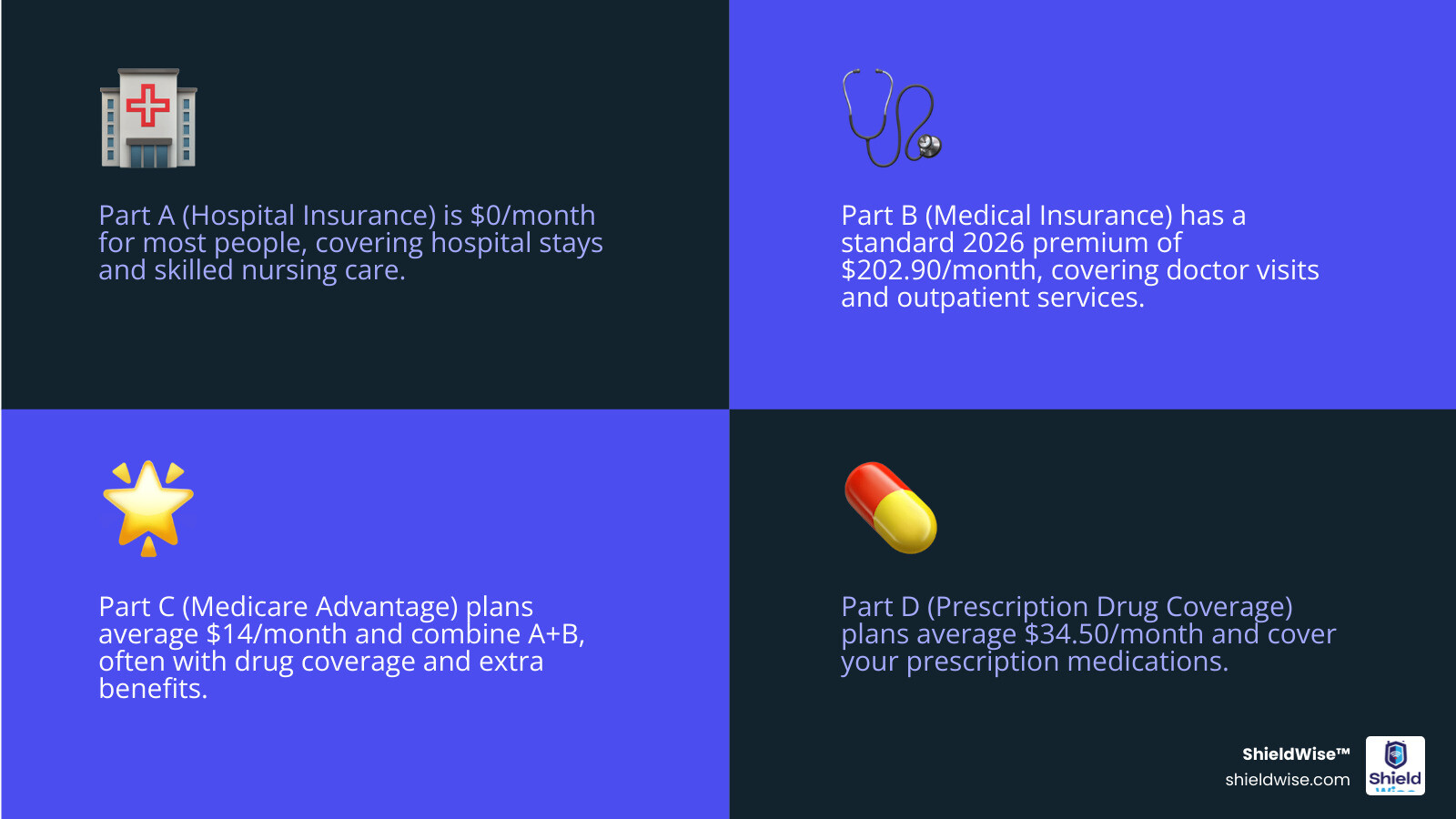
| Coverage | Monthly premium in 2026 | Budget note |
|---|---|---|
| Part A | $0 for most eligible people; $311 or $565 if purchased | Hospital cost sharing is separate |
| Part B | $202.90 standard premium | Income adjustments and penalties may apply; assistance may help pay |
| Medicare Advantage (Part C) | Depends on the plan | Keep paying Part B; some plans have a $0 additional premium |
| Part D | Depends on the plan | Drug coverage may be included in an Advantage plan; check income adjustments |
| Medigap | Depends on the policy and applicant | Works with Original Medicare; obtain an actual quote |
Build your own total: Add your actual Part A and Part B premiums, applicable private-plan or Medigap premiums, and any adjustments or penalties. Avoid adding a stand-alone Part D premium automatically when drug coverage is already included in your Medicare Advantage plan. Budget separately for care and prescriptions.
Whether you’re approaching 65 or already enrolled, you’ve probably noticed the flood of mail, phone calls, and confusing plan options. One week you’re told Part A is free—the next you’re reading about thousand-dollar deductibles. A neighbor swears by Medicare Advantage, while your sister insists on Medigap. And just when you think you’ve figured it out, someone mentions IRMAA surcharges.
Comparing Medicare options involves several different bills and benefit rules. Separating recurring premiums from costs when you use care makes the comparison easier.
The standard Part B premium is a useful starting point. Your own bill can differ because of income, enrollment history, assistance or other applicable rules.
Premiums do not include every expense. The Part B deductible is annual, but the Part A inpatient deductible applies per benefit period and can occur more than once in a year.
This guide explains the main 2026 amounts and how to compare them with a plan’s premium, cost sharing and coverage rules.
Use this information to organize a budget, then confirm the amounts in your Medicare notices, Social Security determination and chosen plan documents.
Understanding the Parts: How Much Does Medicare Cost Per Month?

Medicare is divided into several parts, each covering different services and coming with its own cost structure. Understanding these parts is the first step to figuring out how much Medicare costs per month. Let’s break down the different components of Medicare and their associated monthly expenses for 2026.
| Coverage | 2026 deductible or limit | How it applies |
|---|---|---|
| Part A inpatient hospital | $1,736 deductible | Each benefit period |
| Part B | $283 deductible | Each calendar year under Original Medicare |
| Part D | Defined standard deductible $615; plan terms may differ | Check the drug plan’s deductible and formulary |
| Part D covered drugs | $2,100 out-of-pocket threshold | Qualifying covered Part D drug spending; premiums and noncovered drugs are separate |
See CMS’s 2026 Part A and B amounts and the 2026 standard Part D benefit. These are published 2026 figures. For general enrollment context, read our turning 65 guide.
Premium-Free Part A vs. Paid Coverage
Most people qualify for premium-free Part A based on their own or a spouse’s Medicare-covered work history. Medicare and Social Security determine eligibility; other eligibility situations can also apply. A $0 premium does not mean every hospital service is free.
For eligible people who buy Part A in 2026, the monthly premium is $311 or $565, depending on qualifying work history. Confirm eligibility and the amount with Social Security.
The Standard Part B Monthly Premium
Part B covers outpatient medical care and other covered services. Its standard monthly premium is $202.90 in 2026. An individual’s bill can include an income-related adjustment or late enrollment penalty.
Your Part B premium is typically deducted directly from your Social Security benefit payments. If you’re not receiving Social Security benefits yet, you’ll receive a bill directly from Medicare. It’s important to factor this into your monthly budget, as it’s a foundational cost for your medical insurance. To explore your full range of coverage options under Medicare, our Guide to Understanding Medicare Coverage Options can provide valuable insights.
Calculating Your Monthly Medicare Part B Premium
Use your actual Part B notice rather than assume every enrollee pays the standard amount. Record any assistance and adjustments separately so you can understand changes in your bill.
How Income Affects How Much Medicare Costs Per Month
Social Security generally uses tax information from two years earlier to determine the income-related monthly adjustment amount, or IRMAA. For 2026, that generally means tax year 2024, though an older return may be used if newer information is unavailable.
For this purpose, modified adjusted gross income is adjusted gross income plus tax-exempt interest income. Avoid assuming that every payment from a particular account or insurance product is excluded. Check the tax treatment of your situation with a qualified adviser.
In 2026, the standard income thresholds are $109,000 for an individual return and $218,000 for a joint return. Full Part B coverage has income-related additions ranging from $81.20 to $487 per month above the standard premium. The highest total Part B premium is $689.90, not a $689.90 surcharge. Married people filing separately can have different brackets; consult the official CMS table.
Part D has a separate income adjustment: $14.50 to $91 per month in 2026 for the applicable higher-income brackets, in addition to the drug-plan premium. These amounts are not Part B surcharges. See Social Security’s explanation.
Requesting an IRMAA reduction or appealing a decision
If a qualifying life event reduces your income, you can ask Social Security to use more recent information. This request is different from appealing a determination you believe is incorrect.
The SSA-44 form and instructions describe events such as:
- Marriage, divorce or annulment, or a spouse’s death.
- Work stoppage or reduction by you or your spouse.
- Qualifying loss of income-producing property or pension income.
- A qualifying employer settlement payment.
Read the event definitions and evidence requirements before requesting a new determination. A voluntary property sale or any settlement payment does not automatically qualify. Follow your Social Security notice if you instead wish to appeal, and use the appropriate correction process for inaccurate tax information.
Budgeting for Medicare Advantage and Part D Drug Plans
Beyond Original Medicare (Parts A and B), you have choices for additional coverage that can significantly impact how much Medicare costs per month. These options are offered by private insurance companies and include Medicare Advantage plans (Part C) and stand-alone Part D prescription drug plans.
Plan premiums and national averages
Medicare Advantage is a private-plan alternative for receiving Part A and Part B benefits, usually with drug coverage. CMS’s pre-year estimate for the national average additional plan premium was $14 in 2026. That is not a quote or the full Medicare bill: Part B premiums continue. Check the plan’s actual premium, network, referrals, drug coverage and cost sharing.
CMS projected a $34.50 national average premium for stand-alone Part D plans in 2026. Your plan’s premium can differ substantially. With Original Medicare, consider whether you need a stand-alone plan or already have other creditable drug coverage. The CMS national estimates are context, not a personalized budget.
It’s important to consider that while some plans may have low or even $0 premiums, they might have higher deductibles, copayments, or coinsurance for services and prescriptions. Also, Medicare Advantage plans often have network restrictions, meaning you’ll need to use doctors and hospitals within the plan’s network.
How Much Does Medicare Cost Per Month with Medigap?
If you choose Original Medicare (Parts A and B), you might find yourself facing significant out-of-pocket costs like deductibles, coinsurance, and copayments. This is where Medigap, or Medicare Supplement Insurance, comes into play. Medigap policies are sold by private insurance companies and are designed to help pay some of these “gaps” in Original Medicare coverage.
Standardized Medigap policies with the same letter generally have the same basic benefits; Massachusetts, Minnesota and Wisconsin use different standardization. Premiums vary by company, location, age and other factors. Compare like-for-like policies and obtain current quotes for your circumstances. See Medicare’s Medigap basics.
Since Medigap premiums can be a substantial part of your monthly healthcare budget, compare policies from different companies. While they offer standardized benefits, the price for those benefits is not standardized. We have a dedicated resource to help you understand these options: Medicare Supplement and Medigap.
Costs beyond premiums: deductibles, coinsurance and penalties
Deductibles, copayments and coinsurance are additional budget items. Late enrollment penalties can also raise premiums when no exception applies.
Let’s look at the costs associated with a hospital stay under Medicare Part A for 2026:
- Inpatient hospital, Original Medicare Part A: The 2026 deductible is $1,736 per benefit period. After it is paid, days 1–60 have $0 daily hospital coinsurance; days 61–90 cost $434 per day. Available lifetime reserve days cost $868 per day; costs after available covered days are your responsibility.
- Covered skilled nursing care: In 2026, days 1–20 have $0 daily coinsurance, days 21–100 cost $217 per day, and later days are not covered by this benefit. Eligibility and coverage requirements apply; this is not general long-term custodial care coverage.
Under Original Medicare Part B, after the $283 annual deductible in 2026, you generally pay 20% of the Medicare-approved amount for covered services when the provider accepts assignment. Services and exceptions vary. Check Medicare’s cost information before planning a procedure.
The Impact of Late Enrollment Penalties
Enrollment timing affects premiums. The applicable exception and the type of other coverage matter; do not treat Part B and Part D rules as interchangeable.
- Part B: A penalty can add 10% for each full 12-month period of delay when no exception applies. Qualifying current-employment group health coverage can support a Special Enrollment Period. Retiree coverage or COBRA is not automatically the same protection.
- Part D: Going 63 days or more without Part D or other creditable prescription coverage after the applicable initial period can cause a penalty. For 2026, the calculation uses 1% of the $38.99 national base beneficiary premium for each full uncovered month, rounded to the nearest $0.10. Extra Help and other applicable exceptions matter.
Check Medicare’s penalty rules and enrollment periods, then confirm your own deadline. Keep drug-creditable-coverage notices; they do not by themselves establish a Part B enrollment exception.
Out-of-Pocket Maximums and Caps
Original Medicare has no general annual out-of-pocket ceiling for Part A and Part B. Medicare Advantage medical limits, selected Medigap limits and the Part D drug threshold apply to different costs.
- Medicare Advantage: Check the plan’s stated medical out-of-pocket maximum, including any separate in-network and combined limits. Do not assume a single dollar amount applies to every plan or to premiums, prescription drugs and uncovered services.
- Medigap K and L: In 2026, the yearly limits are $8,000 and $4,000. The plan pays 100% of covered services for the remainder of the year after both the applicable limit and the annual Part B deductible are met. See the official benefit comparison.
- Part D: The 2026 threshold is $2,100 for qualifying out-of-pocket costs for covered Part D drugs. After it is reached, you do not pay cost sharing for covered Part D drugs for the rest of that calendar year. Premiums, noncovered drugs and Part B drugs are separate.
Keep the different medical and prescription cost limits separate when comparing plans, and budget for premiums and services that fall outside those limits.
Ways to Lower Your Monthly Medicare Expenses
Even with all the costs associated with Medicare, there are programs and strategies available to help reduce your monthly expenses, especially if you have a limited income. Understanding these options can significantly impact how much Medicare costs per month for you.
The Medicare Prescription Payment Plan
The Medicare Prescription Payment Plan lets participants spread covered Part D out-of-pocket costs over the calendar year. It changes payment timing, not the total drug cost. Bills may vary as new prescriptions are filled. Contact your drug plan about participation and whether this fits your budget.
Dual Eligibility and Medicaid
People with limited income and resources may qualify for assistance. Help with Medicare premiums does not necessarily mean the same coverage or eligibility as full Medicaid benefits.
- Extra Help: Can reduce Part D premiums, deductibles and other drug costs for qualifying people. See Medicare’s drug-cost assistance page.
- Medicare Savings Programs: The state determines eligibility. QMB helps with eligible premiums and Medicare-covered cost sharing; SLMB and QI help with Part B premiums. QDWI can help qualifying working people with disabilities pay Part A premiums. Benefits and eligibility differ by program.
Use the official Medicare Savings Programs page to find the state application route and current requirements. State rules may allow eligibility above the displayed federal income or resource limits.
These programs are vital for ensuring that low-income seniors in Illinois can access the healthcare they need without facing impossible financial burdens. For more information on navigating these options, especially for those on a fixed income, check out our guide on the Best Insurance Options for Seniors on Medicare and Fixed Income.
Frequently Asked Questions about Medicare Costs
Navigating Medicare costs can bring up many questions. Here, we address some of the most common ones to help you better understand how much Medicare costs per month.
Is Medicare Part A always free?
No. Many people qualify for premium-free Part A, but eligible people who purchase it pay $311 or $565 monthly in 2026. Medicare-covered work history and other eligibility rules determine the amount. Cost sharing can apply even with a $0 premium.
Can my Medicare Part B premium change every year?
Yes. The standard premium is set annually; it is $202.90 in 2026. An individual bill can also change because of an income adjustment, enrollment penalty, assistance or other applicable rules. Use the notice for the year you are budgeting.
Does my income from ten years ago affect my current premium?
IRMAA generally uses tax information from two years earlier, so 2026 usually uses tax year 2024. If that return is unavailable, older information may be used. Medicare-covered work history for Part A eligibility is a separate question.
Conclusion
Start your budget with actual premiums from federal notices and chosen plans. Then account for deductibles, cost sharing, coverage limits and care that is not covered. A national average does not determine your personal annual cost.
Recheck amounts for each coverage year and compare both benefits and costs before changing plans. The official Medicare and Social Security sources linked here can help you verify the numbers.
For enrollment timing, continue with our Medicare enrollment timeline. Confirm any deadline with Medicare or Social Security for your own coverage situation.