
Understanding the True Cost of Medicare Beyond Your Monthly Premium
A medicare out of pocket costs guide is essential for anyone approaching 65 or already enrolled in Medicare. While you may know your monthly premium, the real question is: what will you actually pay when you need care?
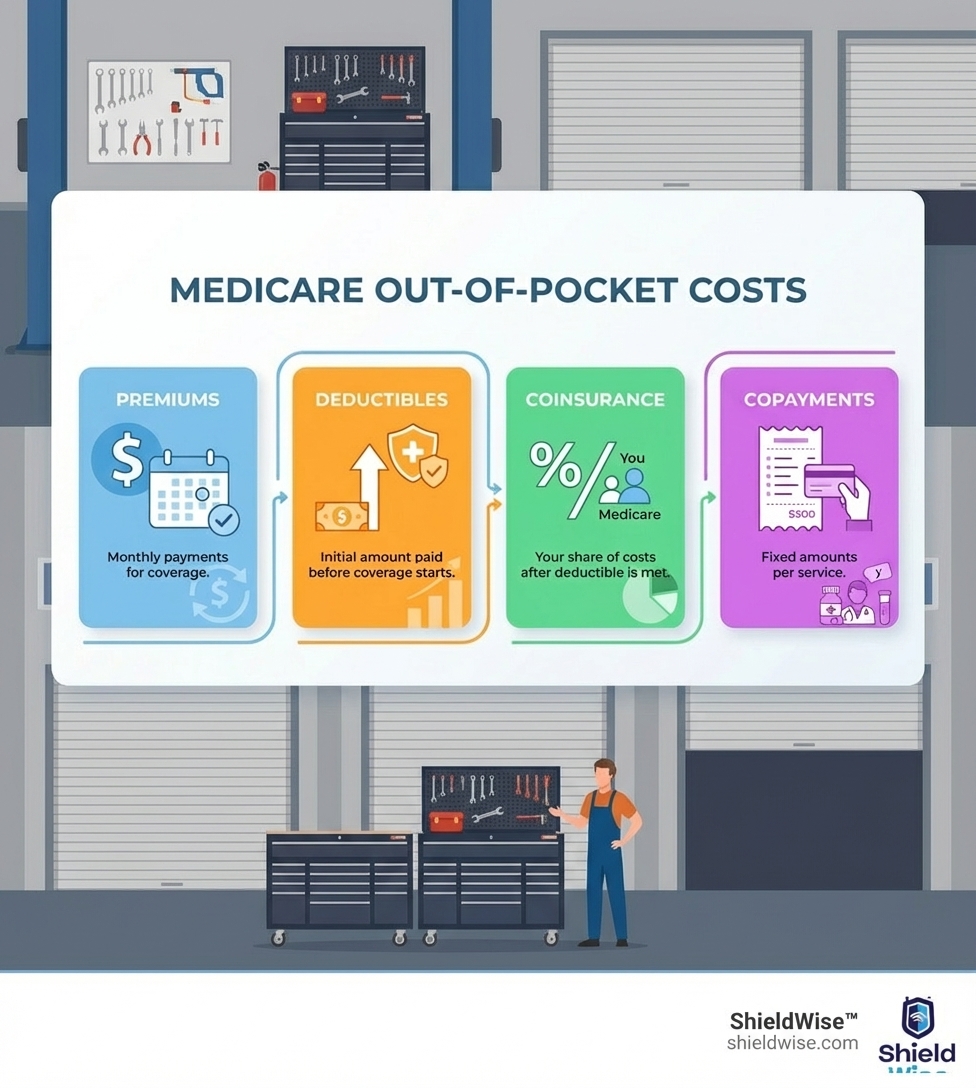
Here are the four main types of Medicare out-of-pocket costs you’ll encounter:
- Premiums – Monthly payments for coverage (Part B standard premium is $185 in 2025)
- Deductibles – What you pay before Medicare starts covering services ($1,676 for Part A, $257 for Part B in 2025)
- Coinsurance – Your share of costs after meeting the deductible (typically 20% for Part B services)
- Copayments – Fixed amounts for specific services (common in Medicare Advantage plans)
If you’re like most retirees on a fixed income, you’ve probably received countless Medicare mailings and phone calls. The information is overwhelming, and the fear of making a costly mistake is real.
Here’s what many people don’t realize: Original Medicare has no yearly limit on what you pay out-of-pocket. That 20% coinsurance can add up quickly if you have a serious health issue or hospital stay. A $50,000 hospital bill means you’re responsible for $10,000 after your deductible.
The good news? You have options to protect yourself. Medicare Advantage plans include out-of-pocket maximums (capped at $9,250 in 2026). Medigap policies can cover many of those gaps. And if you’re on a tight budget, programs like Extra Help and Medicare Savings Programs exist specifically to reduce your costs.
Understanding these costs upfront helps you avoid financial surprises and choose the coverage that fits your budget and health needs.
Decoding Medicare’s Core Costs
When we talk about what you “really pay” with Medicare, we’re diving into cost-sharing. These are the expenses you’re responsible for, even after you’ve enrolled and started paying your premiums. Think of it as your share of the medical bill, and understanding each component is crucial for building a solid healthcare budget. These costs can change annually, so it’s always wise to stay informed.

Monthly Premiums: The Starting Point
Your premium is the amount you pay, usually monthly, just to have coverage. It’s like a membership fee for your health insurance.
- Medicare Part A Premium: For most of us, Part A (Hospital Insurance) is premium-free. This is because we, or our spouse, paid Medicare taxes through employment for at least 10 years (40 quarters). However, if you don’t meet this requirement, you might have to buy Part A. In 2025, this premium can be up to $518 per month, or $285 if you worked 30-39 quarters. In 2024, these amounts were $505 and $278, respectively.
- Medicare Part B Premium: Part B (Medical Insurance) always has a monthly premium. The standard Part B monthly premium in 2024 was $174.70. For 2025, it’s projected to be $185. This covers doctor visits, outpatient care, and preventive services.
- Medicare Part D Premiums: If you choose to enroll in a stand-alone Part D (prescription drug) plan, you’ll pay a separate monthly premium. These vary widely depending on the plan and the drugs it covers. The average stand-alone Part D plan premium is projected to be $34.50 in 2026.
- Medicare Advantage (Part C) Premiums: Many Medicare Advantage plans also have a monthly premium, in addition to your Part B premium. In 2026, the average monthly Medicare Advantage/Part C premium is projected to be $14.00, down from $16.40 in 2025. Some plans even offer a $0 premium, though you’ll still pay your Part B premium.
Deductibles: Your Initial Share
Before your Medicare plan starts paying its share, you typically have to meet a deductible. This is the amount you pay out-of-pocket first.
- Medicare Part A Deductible: This deductible applies per “benefit period” for inpatient hospital stays. A benefit period begins the day you’re admitted as an inpatient and ends after 60 consecutive days without inpatient hospital or skilled nursing facility care. In 2024, the Part A deductible was $1,632 per benefit period. For 2025, it’s $1,676 per benefit period. This means if you have multiple hospital stays within a year that are separated by more than 60 days, you could pay this deductible more than once.
- Medicare Part B Deductible: This is an annual deductible. Once you meet it, Original Medicare generally starts paying its share. In 2024, the Part B deductible was $240. For 2025, it’s $257.
- Medicare Part D Deductible: Most Part D plans have an annual deductible, which you pay before your plan begins to cover your prescription drug costs. In 2024, Part D deductibles could be no more than $545 per year. For 2025, the Part D deductible is set for $590.
Coinsurance and Copayments: Paying for Services
Once you’ve paid your deductible, you’re not usually off the hook entirely. You’ll then pay either coinsurance or a copayment for covered services.
- Part B Coinsurance: With Original Medicare Part B, once you meet your annual deductible, you typically pay 20% of the Medicare-approved amount for most doctor services, outpatient therapy, and durable medical equipment. There’s no annual limit on this 20% coinsurance, which is why a medicare out of pocket costs guide is so important.
- Part A Hospital Coinsurance: After your Part A deductible, you pay $0 for days 1-60 of an inpatient hospital stay. However, for days 61-90, you’ll pay coinsurance ($408 per day in 2024, $419 per day in 2025). If your stay extends beyond 90 days, you start using your “lifetime reserve days,” which also have a daily coinsurance ($816 per day in 2024, $838 per day in 2025). You have 60 lifetime reserve days in total.
- Part A Skilled Nursing Facility (SNF) Coinsurance: If you require a skilled nursing facility stay (after a qualifying hospital stay), you pay $0 for days 1-20. For days 21-100, you’ll pay coinsurance ($204 per day in 2024, $209.50 per day in 2025). After day 100, you’re responsible for all costs.
- Medicare Advantage Copayments: Medicare Advantage plans often use copayments instead of coinsurance for many services. A copayment is a fixed amount you pay for a service, like $10 for a doctor’s visit or $50 for an emergency room visit. These amounts vary by plan.
How Your Income Affects Your Costs (IRMAA)
If you have a higher income, you might pay more for your Medicare Parts B and D premiums. This is known as the Income-Related Monthly Adjustment Amount (IRMAA).
Medicare looks at your modified adjusted gross income from two years prior to determine if you owe an IRMAA. For example, your 2025 IRMAA would be based on your 2023 income. These adjustments can significantly increase your monthly premiums. For 2025, the standard Part B premium is $185, but if your income (single filer) was above $103,000 in 2023, your premium would be higher. Similarly, Part D plans also have an IRMAA for higher-income individuals.
For more detailed information on Medicare, we encourage you to explore our resources on More info about Medicare.
Original Medicare vs. Medicare Advantage: A Cost Comparison
Choosing between Original Medicare and Medicare Advantage (Part C) is one of the most significant decisions you’ll make regarding your healthcare coverage, and it has a direct impact on your potential out-of-pocket expenses. Each option has a different structure for how you pay for care.

Out-of-Pocket Costs with Original Medicare (Part A & Part B)
Original Medicare provides comprehensive hospital and medical coverage, but it’s important to understand its cost structure.
- No Out-of-Pocket Maximum: This is a critical distinction. Unlike most private insurance plans, Original Medicare (Part A and Part B) does not have an annual limit on what you might pay out-of-pocket. This means if you have extensive medical needs, that 20% Part B coinsurance could theoretically lead to very high expenses.
- Part A Hospital Costs: As we discussed, you’ll pay a deductible per benefit period ($1,676 in 2025), and then daily coinsurance for longer hospital or skilled nursing facility stays. For example, for days 61-90 in a hospital, you’ll pay $419 per day in 2025, and $209.50 per day for days 21-100 in a skilled nursing facility in 2025. For full details on coverage for skilled nursing facility care, visit Skilled nursing facility care details.
- Part B 20% Coinsurance: After meeting your annual Part B deductible ($257 in 2025), you generally pay 20% of the Medicare-approved amount for most doctor services and outpatient care.
- Freedom to Choose Doctors: A major advantage of Original Medicare is the freedom to see any doctor, hospital, or provider nationwide that accepts Medicare. There are no network restrictions to worry about, which can be particularly appealing if you travel or have specialists across different health systems.
Out-of-Pocket Costs with Medicare Advantage (Part C)
Medicare Advantage plans, offered by private insurance companies approved by Medicare, cover everything Original Medicare does and often include extra benefits. Their cost structure is typically different.
- Maximum Out-of-Pocket (MOOP) Limit: This is a key feature of Medicare Advantage plans. The Centers for Medicare & Medicaid Services (CMS) sets an annual limit on how much you can pay for covered services in a year. Once you reach this limit, your plan pays 100% of your covered medical costs for the rest of the year. For 2024, the MOOP for in-network costs was $8,850. For 2026, the out-of-pocket maximum for Part C plans is projected to be $9,250. Prescription drug costs generally do not count towards this MOOP. Learn more about Understanding the MOOP limit.
- Copayments for Services: Instead of the 20% coinsurance of Original Medicare, Medicare Advantage plans usually charge fixed copayments for services like doctor visits, specialist visits, and hospital stays. These can be easier to budget for.
- Network Restrictions (HMO, PPO): Most Medicare Advantage plans operate with networks. With an HMO (Health Maintenance Organization) plan, you generally need to use doctors and hospitals within the plan’s network, and you might need a referral to see a specialist. PPO (Preferred Provider Organization) plans offer more flexibility, allowing you to see out-of-network providers for a higher cost.
- Extra Benefits: Many Medicare Advantage plans offer benefits Original Medicare doesn’t cover, such as routine dental care, vision exams and glasses, hearing aids, and fitness programs. While these benefits can save you money on these services, they don’t count towards your MOOP.
TABLE: Comparing Original Medicare vs. Medicare Advantage Costs
| Feature | Original Medicare (Part A & B) | Medicare Advantage (Part C) |
|---|---|---|
| Premiums | Part B premium (e.g., $185/month in 2025); Part A often free. | Part B premium + plan premium (some are $0). Average MA premium projected $14.00/month in 2026. |
| Deductibles | Part A deductible (per benefit period); Part B deductible (annual). | Varies by plan; some plans have $0 deductible for certain services, others mirror Original Medicare. |
| Cost-sharing | Part A coinsurance for extended stays; Part B 20% coinsurance. | Copayments for most services (e.g., $10-$50 for doctor visits); Varies by plan. |
| Out-of-Pocket Limit | NONE | YES (e.g., $8,850 in 2024, projected $9,250 in 2026 for in-network). |
| Provider Network | Any doctor/hospital accepting Medicare nationwide. | Often restricted to a network (HMO, PPO); higher costs or no coverage for out-of-network. |
| Prescription Drugs | Not covered. Requires separate Part D plan. | Most plans include prescription drug coverage (MAPD). |
A Complete Medicare Out-of-Pocket Costs Guide for Prescriptions (Part D)
Prescription drug costs are a major concern for many of us, and Medicare Part D is designed to help. However, understanding its cost structure is essential, as it can be quite complex.
Understanding Your Part D Drug Costs
Your out-of-pocket costs for Part D will depend on your specific plan, the drugs you take, and which pharmacy you use.
- Monthly Premiums: You pay a monthly premium for your Part D plan, which varies significantly between providers and plans. The average stand-alone Part D plan total premium is projected to be $34.50 in 2026.
- Annual Deductible: Most Part D plans have an annual deductible that you must pay before your plan starts to cover your drug costs. In 2025, the Part D deductible is set for $590. In 2024, deductibles could be no more than $545 per year.
- Copayments and Coinsurance: After you meet your deductible, you’ll pay a copayment (a fixed amount) or coinsurance (a percentage of the drug cost) for your prescriptions. These costs vary based on the drug’s tier.
- Drug Tiers and Formulary: Each Part D plan has a “formulary,” which is a list of covered drugs. Drugs are usually grouped into tiers, with lower tiers having lower copayments (e.g., generics) and higher tiers having higher copayments or coinsurance (e.g., specialty drugs).
- For more projected costs, including Part D, you can refer to Projected 2026 Medicare costs.
The End of the “Donut Hole” and the New $2,000 Cap
Historically, Part D included a “coverage gap” or “donut hole,” where beneficiaries paid a higher percentage for their drugs after reaching a certain spending limit but before reaching catastrophic coverage. This often created significant financial hardship; as many as 20% of Medicare beneficiaries struggled to afford their medications during this gap. For more on this, see Research on drug cost hardship.
The good news? Thanks to the Inflation Reduction Act, the Part D donut hole is being eliminated in 2025. This simplifies things considerably.
- $2,000 Out-of-Pocket Cap in 2025: Starting in 2025, there will be a $2,000 annual cap on out-of-pocket spending for Part D drugs. This means that once your total out-of-pocket costs for covered prescription drugs (including your deductible, copayments, and coinsurance) reach $2,000, you won’t pay anything further for covered drugs for the rest of the year. This cap will increase slightly to $2,100 in 2026. This is a monumental change that provides significant financial protection for those with high prescription drug costs.
- What Counts Toward the Cap: Your deductible, copayments, and coinsurance for covered drugs count towards this cap. Your monthly Part D premiums do not.
Strategies to Manage and Reduce Your Medicare Expenses
Understanding your potential out-of-pocket costs is the first step. The next is to actively seek ways to manage and, where possible, reduce them. A comprehensive medicare out of pocket costs guide wouldn’t be complete without actionable strategies.
How Medigap Plans Limit Your Out-of-Pocket Costs
Medicare Supplement Insurance, also known as Medigap, is private insurance that helps pay some of the healthcare costs that Original Medicare doesn’t cover, like copayments, coinsurance, and deductibles.
- Standardized Plans: Medigap policies are standardized across the country (though not all plans are available in all states), identified by letters A through N. Each plan letter offers the same basic benefits, regardless of the insurance company selling it.
- Covers Deductibles and Coinsurance: Depending on the plan you choose, Medigap can cover your Part A deductible, Part B deductible, Part A coinsurance for hospital and skilled nursing facility stays, and the Part B 20% coinsurance. This significantly reduces your financial risk with Original Medicare. For instance, Medigap coverage will pay some or all of the 20% coinsurance for Part B services. To help you compare options, refer to How to compare Medigap policies.
- Plan K & L Out-of-Pocket Limits: While most Medigap plans don’t have an annual out-of-pocket maximum (because they cover most of what Original Medicare leaves), Plans K and L do. For example, in 2026, the out-of-pocket maximum for Medigap Plan K is $8,000, and for Plan L, it’s $4,000. Once you reach these limits, the plan pays 100% of your costs for approved services for the rest of the year.
- No Drug Coverage: Medigap policies do not cover prescription drugs. If you have Original Medicare and a Medigap policy, you’ll need to enroll in a separate Part D plan for drug coverage.
A Key Part of Your Medicare Out-of-Pocket Costs Guide: Avoiding Penalties
Late enrollment penalties can significantly increase your Medicare costs for the rest of your life. It’s crucial to enroll when you’re first eligible or have creditable coverage.
- Part B Late Enrollment Penalty: If you don’t sign up for Part B when you’re first eligible and don’t have other creditable health coverage (like through an employer), you could face a penalty. Your monthly Part B premium may increase by 10% for each full 12-month period you could have had Part B but didn’t sign up. This is a lifelong penalty.
- Part D Late Enrollment Penalty: Similarly, if you don’t join a Part D plan when you’re first eligible or go 63 days or more without creditable prescription drug coverage, you may have to pay a late enrollment penalty. This penalty is added to your monthly premium and is calculated as 1% of the “national base beneficiary premium” (which was $34.70 in 2024, $36.78 in 2025) multiplied by the number of full, uncovered months you didn’t have Part D or creditable coverage. This, too, is a lifelong penalty.
- Creditable Coverage: If you have health coverage from an employer or union that’s considered “creditable” (meaning it’s expected to pay, on average, at least as much as Medicare’s standard prescription drug coverage), you won’t incur a late enrollment penalty if you delay Part D enrollment.
- Special Enrollment Periods: There are specific situations, like losing employer-sponsored coverage, that allow you to enroll in Medicare or change plans without penalty outside of the standard enrollment periods.
For more detailed guidance on avoiding these extra costs, visit How to avoid penalties.
Finding Help with Your Medicare Costs
If you’re concerned about your Medicare out-of-pocket costs, several resources and programs can provide assistance.
- Medicare Savings Programs (MSPs): These state-run programs can help low-income individuals pay for Medicare Part A and/or Part B premiums, deductibles, and coinsurance.
- Extra Help (Low-Income Subsidy – LIS): This federal program helps people with limited income and resources pay for their Medicare Part D prescription drug costs, including premiums, deductibles, and copayments.
- State Health Insurance Assistance Programs (SHIP): SHIPs offer free, unbiased counseling and assistance to Medicare beneficiaries and their families. They can help you understand your options, compare plans, and find financial assistance programs.
- My Care, My Choice: For residents of Illinois (and California, Michigan, and Ohio) who are eligible for both Medicare and Medicaid (dual-eligible), My Care, My Choice is an online decision support tool that can help you understand your coverage options.
- Medicare.gov and 1-800-MEDICARE: These are your official go-to resources. You can visit Medicare.gov to compare plans, find information, or start a live chat. You can also call 1-800-MEDICARE (1-800-633-4227) to talk with a customer support representative about your Medicare questions and concerns.
- Medicaid: If you have very limited income and resources, you might qualify for Medicaid, which can cover many of your healthcare costs, including those not covered by Medicare.
For those just starting their Medicare journey, understanding the fundamentals is key. Our Medicare Basics for new enrollees article can provide a great starting point.
Frequently Asked Questions about Medicare Costs
We often hear similar questions from individuals navigating their Medicare journey. Here, we address some of the most common concerns regarding out-of-pocket expenses.
Is there a yearly limit on my out-of-pocket costs with Original Medicare?
No, with Original Medicare (Part A and Part B), there is no yearly limit on your out-of-pocket expenses. This is a critical point that many people find surprising. While Part A has deductibles per benefit period and daily coinsurance for extended stays, and Part B has an annual deductible followed by 20% coinsurance, these costs can accumulate indefinitely if you have significant medical needs. This lack of a cap is why many beneficiaries choose to purchase supplemental coverage like a Medigap policy or enroll in a Medicare Advantage plan, both of which typically offer an out-of-pocket maximum to protect against catastrophic costs. Without such supplemental coverage, you face unlimited financial risk for that 20% coinsurance.
What services are generally not covered by Medicare?
While Medicare provides broad coverage, it’s important to know what it generally doesn’t cover, as these can become significant out-of-pocket expenses. Services typically not covered by Original Medicare include:
- Long-term care: Such as nursing home care for custodial care (help with daily activities like bathing and dressing).
- Routine dental care: This includes most dental procedures, dentures, and routine check-ups.
- Routine eye exams: And most eyeglasses or contact lenses.
- Hearing aids: And exams for fitting them.
- Cosmetic surgery: Unless it’s deemed medically necessary due to injury or congenital anomaly.
- Acupuncture: Unless it’s for chronic low back pain.
- Private-duty nursing.
Many Medicare Advantage plans, however, do offer some coverage for routine dental, vision, and hearing services as part of their extra benefits. For a comprehensive list, you can check What’s not covered by Medicare?.
How often do Medicare costs change?
Medicare costs, including premiums, deductibles, and coinsurance amounts, typically change annually. Each fall, the Centers for Medicare & Medicaid Services (CMS) announces the updated figures for the upcoming calendar year. These changes reflect adjustments in healthcare costs and other economic factors. This is why staying informed with a current medicare out of pocket costs guide is so important, as the numbers we’ve discussed for 2024, 2025, and 2026 are subject to these annual revisions.
Conclusion: Taking Control of Your Healthcare Budget
Navigating Medicare’s out-of-pocket costs can feel like a complex puzzle, but with the right information, you can piece it together. We’ve seen that your actual expenses go far beyond just your monthly premium, encompassing deductibles, copayments, and coinsurance, all of which can vary significantly depending on your chosen plan and your healthcare needs.
Understanding these key cost factors – from Part A and B basics to the nuances of Part D and the differences between Original Medicare and Medicare Advantage – is the first crucial step. Remember the importance of out-of-pocket maximums in Medicare Advantage plans and the financial protection offered by Medigap policies. Don’t forget the lifelong impact of avoiding late enrollment penalties and the availability of programs like Extra Help and SHIPs if you need financial assistance.
You have options, and understanding your coverage is the first step to managing your healthcare budget effectively and gaining peace of mind. ShieldWise™ is here to help you compare plans to find the right fit for your needs and budget, ensuring you’re prepared for whatever your health journey brings.