
Why Planning for Retirement Income Matters More Than Ever
IUL for retirement income is a strategy that uses Indexed Universal Life insurance policies to create tax-advantaged cash value growth and provide flexible income during your retirement years.
Quick Answer: How IUL Works for Retirement Income
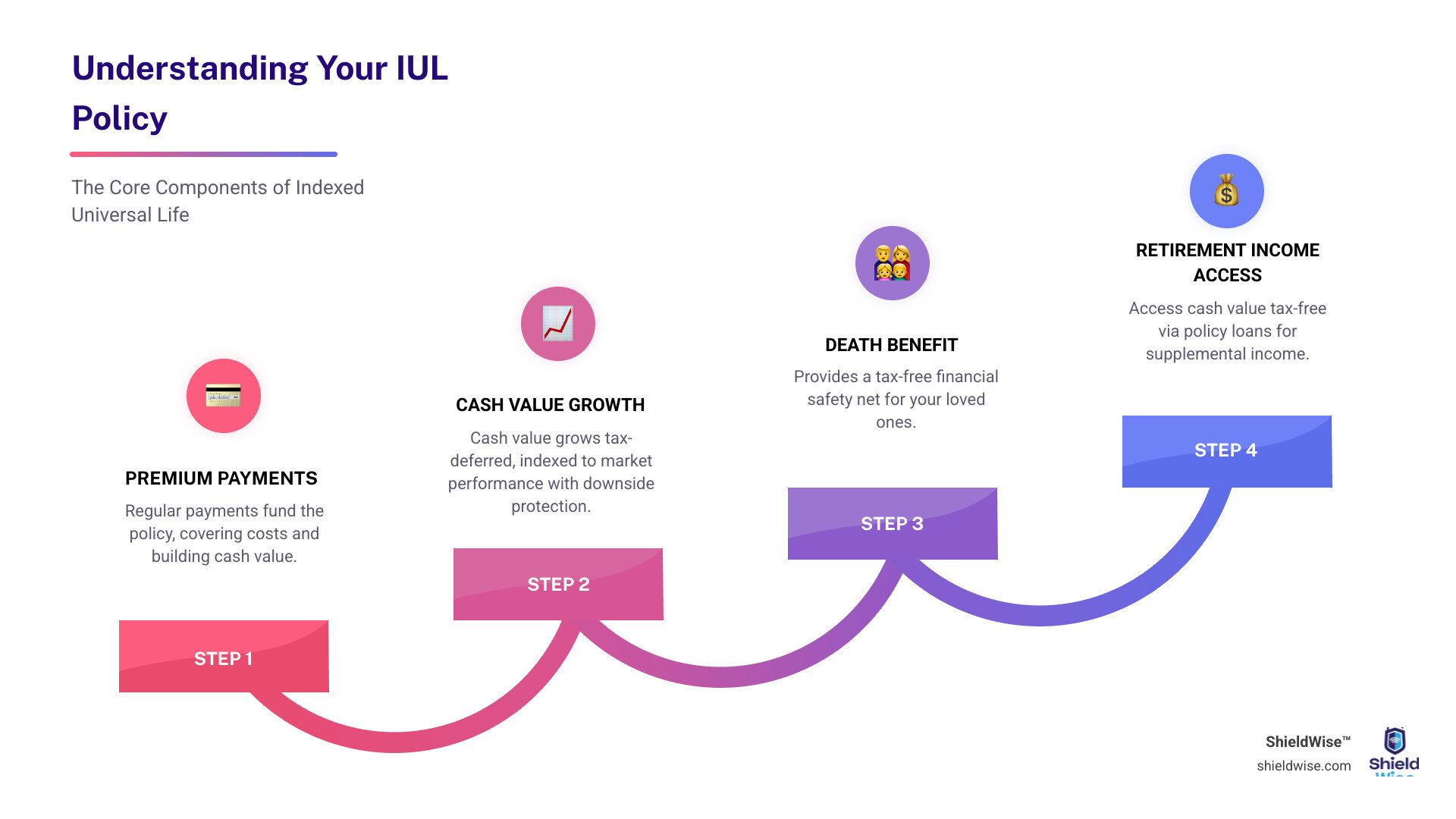
- Premium payments build cash value inside a permanent life insurance policy
- Cash value grows based on the performance of a market index (like the S&P 500)
- Downside protection typically includes a 0% floor so you don’t lose money in down markets
- Upside potential is capped, limiting gains but providing stability
- Tax-free access to cash value through policy loans for retirement income
- Death benefit provides a legacy for your family
Over 40% of Americans fear running out of money in retirement more than they fear death itself. That’s not surprising when you consider the challenges facing today’s retirees: traditional pensions have largely disappeared, Social Security replaces only about 40% of pre-retirement income, and people are living longer than ever before.
Market volatility adds another layer of worry. A 50% loss in the S&P 500 from late 2007 to March 2009 wiped out trillions of dollars in retirement savings. Many people who planned to retire during that period had to keep working because their nest eggs had been cut in half.
The inflation challenge compounds these concerns. With the average inflation rate hovering around 3% over the last century, the purchasing power of your retirement savings steadily erodes. What costs $100 today will cost about $181 in 20 years at that rate.
This is where an IUL policy can play a role as a supplemental retirement income tool. It’s not a replacement for your 401(k) or IRA, but rather an additional strategy that offers unique benefits: tax-deferred growth, protection from market downturns, tax-free income access through loans, and no contribution limits.
Think of it as adding another income stream to your retirement plan—one that combines life insurance protection with the potential for cash value growth, while keeping your principal safe from market crashes.
What is an Indexed Universal Life (IUL) Policy?
An Indexed Universal Life (IUL) policy is a type of permanent life insurance that combines a death benefit with a cash value component. Unlike term life insurance, which covers you for a specific period, an IUL policy offers lifelong coverage. Its primary objective is to provide a death benefit to your beneficiaries, ensuring financial protection for your loved ones. Secondarily, it builds a cash value account that you can access during your lifetime.
One of the key features that makes IUL policies attractive for retirement planning is their flexibility. You have the ability to adjust your premium payments and even your death benefit over time, adapting the policy to your changing financial situation. This flexibility, coupled with the cash value component, allows IULs to serve not just as a life insurance policy, but also as a potential tool for supplemental income and estate planning.
To dive deeper into the mechanics, you can explore How Does IUL Work?.
How Cash Value Grows: The “Indexed” Component
What truly sets an IUL apart is how its cash value grows—this is where the “indexed” part comes in. Instead of earning a fixed interest rate or directly investing in the stock market, the cash value growth in an IUL policy is linked to the performance of a specific market index, such as the S&P 500.
You’re not directly invested in the market. Instead, the interest credited to your policy’s cash value is based on the index’s performance. This unique structure offers a crucial advantage: downside protection. Most IUL policies include a “0% floor,” meaning your cash value won’t lose value due to negative market performance. If the market index drops, your cash value simply earns 0% for that period, keeping your principal safe. No more white-knuckle rides during market downturns!
However, this protection comes with a trade-off on the upside. IUL policies typically have “caps” or “participation rates” that limit how much interest your cash value can earn, even if the market index performs exceptionally well. For example, if the market is up 12% but your policy has a 10% cap, you’ll only earn 10%. If there’s also an 80% participation rate, you’d only earn 8% of the 10% capped gain (8%). These caps and participation rates can vary by policy and insurer.
Many IULs also feature an “annual reset,” which means that each year, your gains (up to the cap) are locked in, and your policy starts fresh for the next year. This allows you to capture upside without losing the principal from previous gains, even if the market declines in a subsequent year.
Key Benefits of Using an IUL for Retirement Income
When strategically designed, an IUL policy offers several compelling benefits that can make it a valuable component of your retirement income plan:
Tax-Deferred Growth: The cash value in your IUL policy grows tax-deferred, meaning you don’t pay taxes on the earnings each year. This allows your money to compound faster, as you’re essentially earning returns on your returns without annual tax drag. You’ll only pay taxes when you access the money, and even then, there are tax-efficient strategies.
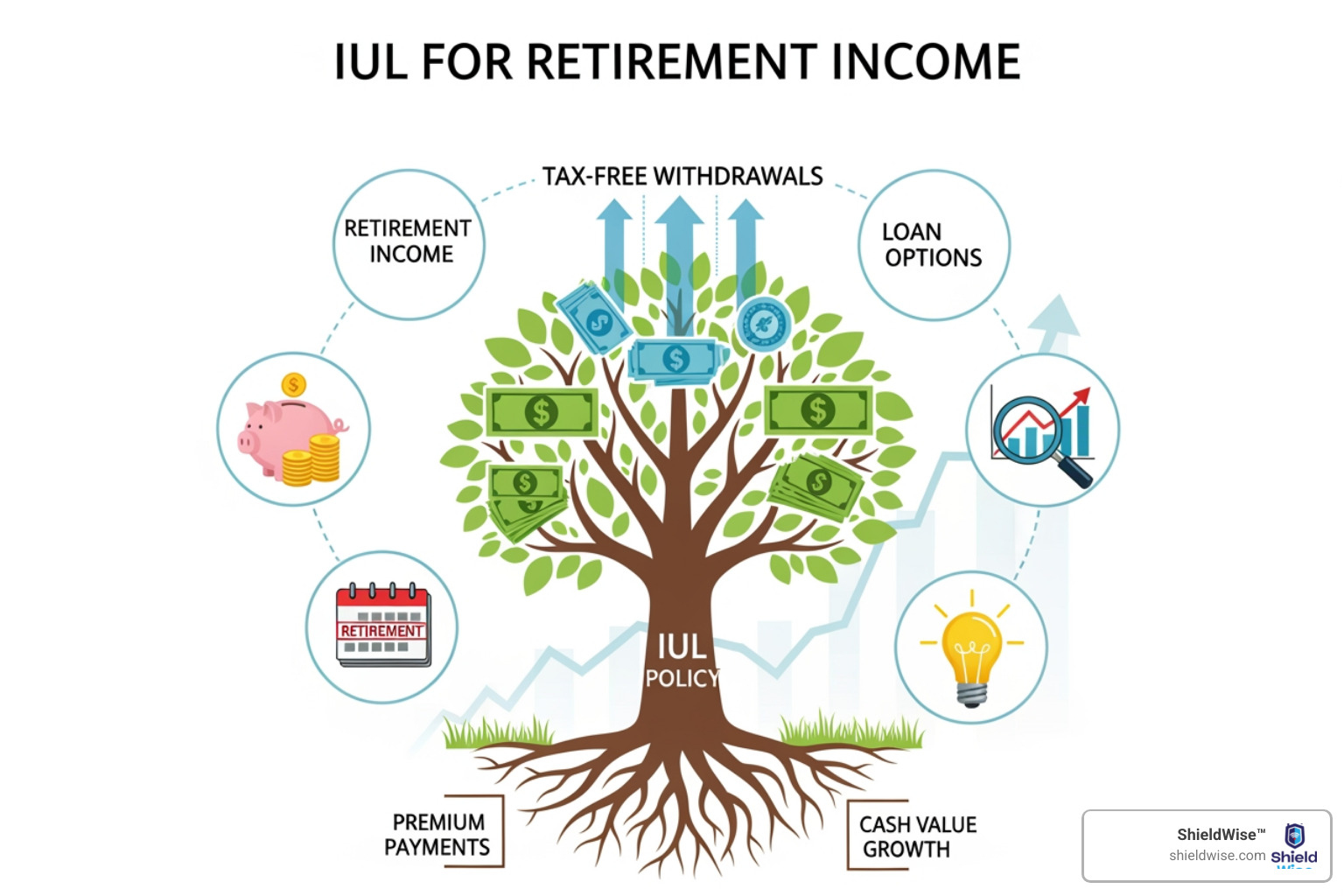
Tax-Free Access via Loans: One of the most attractive features for retirement income is the ability to access your cash value through policy loans. Withdrawals from the cash value are typically considered loans against your death benefit, which are not taxed as income, as long as the policy remains in force and is properly structured. This can provide a truly tax-efficient source of income during your retirement years.
Downside Market Protection: As we discussed, the 0% floor is a game-changer. During market crashes, like the 50% loss in the S&P 500 in 2007-2009, your IUL’s cash value is protected from those losses. This means your retirement income strategy won’t be derailed by a sudden market downturn, helping to mitigate “sequence of returns risk”—the danger that negative returns early in retirement can disproportionately harm your long-term financial security.
No Contribution Limits: Unlike 401(k)s and IRAs, which have annual contribution limits (for 2024, a 401(k) is capped at $23,000 for individuals under 50, plus a $7,500 catch-up for those 50 and older), IUL policies have no government-imposed contribution limits. This makes them an attractive option for high-income earners who have already maxed out their other tax-advantaged retirement accounts.
Addressing Inflation: With long-term average returns typically in the 5–7% range (after costs), IUL policies can offer growth potential that often outpaces the average inflation rate, which has hovered around 3% over the last century. This helps your retirement savings maintain their purchasing power over time.
Potential Asset Protection: In some states, the cash value of life insurance policies may offer a degree of protection from creditors, adding another layer of security to your retirement nest egg.
No Required Minimum Distributions (RMDs): Unlike traditional IRAs and 401(k)s, IUL policies are not subject to RMDs, which typically begin at age 73. This gives you more control over when and how you access your money, allowing for greater tax planning flexibility in retirement.
IUL and Retirement Planning: A Comparison Perspective
When considering IUL for retirement income, it’s crucial to understand that it’s not a standalone solution, nor is it a direct replacement for traditional retirement vehicles like 401(k)s or IRAs. Instead, we view IUL as a powerful complementary tool that can diversify your retirement income streams and improve your overall financial security. There’s no single “best” solution for everyone; the right approach involves a blend of strategies custom to your unique situation.
IUL policies are primarily life insurance contracts with a savings component, whereas 401(k)s and IRAs are dedicated retirement savings accounts. Most financial experts agree that these products are not direct substitutes, but rather serve different, yet potentially complementary, purposes within a comprehensive retirement plan.
Comparing IUL Features with Common Retirement Planning Considerations
To help you understand how an IUL fits into the broader retirement landscape, let’s look at some key features compared to common retirement planning considerations.
| Feature | Indexed Universal Life (IUL) | Other Retirement Vehicles (e.g., 401(k), IRA) |
|---|---|---|
| Primary Purpose | Death benefit, cash value growth, supplemental income | Retirement savings |
| Contribution Limits | No IRS limits | Annual IRS limits apply |
| Tax on Contributions | After-tax | Pre-tax (Traditional) or After-tax (Roth) |
| Tax on Growth | Tax-deferred | Tax-deferred (Traditional) or Tax-free (Roth) |
| Tax on Distributions | Generally tax-free via policy loans (if properly managed) | Taxable as ordinary income (Traditional) or Tax-free (Roth) |
| Market Risk Exposure | Indirect index-linked growth with 0% floor and caps | Direct market exposure (potential for full loss/gain) |
| Death Benefit | Tax-free to beneficiaries | Taxable to beneficiaries (for Traditional accounts) |
| Liquidity/Access | Accessible via loans/withdrawals, no age penalties | Penalties for withdrawals before age 59½ |
| Required Distributions | No RMDs | RMDs typically begin at age 73 |
| Fees | Extensive (COI, admin, surrender, rider, etc.) | Investment, admin, recordkeeping fees |
IUL and Tax-Advantaged Accounts
For most people, maximizing contributions to employer-sponsored 401(k)s, especially if there’s an employer match, and IRAs (Traditional or Roth) should be a priority. These accounts are often simpler, have lower costs, and are specifically designed for retirement savings.
However, once you’ve maxed out those options, an IUL can step in as another tax-advantaged way to build long-term value. Since IULs have no IRS contribution limits, they offer a place for high-income earners to save beyond what traditional plans allow. Your IUL premiums are paid with after-tax dollars, but the cash value grows tax-deferred, similar to a Traditional IRA or 401(k).
A significant advantage of IULs is the absence of Required Minimum Distributions (RMDs). Unlike traditional retirement accounts, which force you to start taking distributions at age 73 (as of 2023), an IUL allows you to maintain control over your money, giving you greater flexibility in your retirement tax planning. This means you can decide when and how to access your funds, potentially optimizing your overall tax strategy in retirement.
IUL and Lifetime Income Planning
The unique structure of an IUL policy makes it a flexible tool for lifetime income planning. The accumulated cash value can serve as a supplemental income stream during your retirement years. We often recommend utilizing policy loans for tax-efficient distributions. As long as the policy remains in force and is structured correctly, these loans are generally tax-free, providing a reliable source of income without triggering a tax bill.
Beyond income, an IUL also provides a death benefit, which can be a cornerstone of your legacy planning. This tax-free benefit ensures that your loved ones are financially protected, even after you’ve used the cash value for your retirement income. We’ve seen examples where the death benefit remains substantial (e.g., $400,000 or more) even after years of income distributions.
The flexibility and control offered by an IUL are key. You’re not locked into rigid withdrawal schedules, and you can adjust your income streams as your needs change. While IULs do have fees, we at ShieldWise™ are committed to providing clear, jargon-free guidance so you understand all costs involved, ensuring transparency as you build your retirement roadmap.
How to Structure an IUL for Retirement Income
Effectively leveraging an IUL for retirement income requires strategic planning and a long-term perspective. This isn’t a “set it and forget it” product; it demands careful policy design and ongoing management. Working with a qualified financial professional is crucial to ensure your IUL is structured to maximize cash value accumulation and provide the income you envision.
Funding Your Policy for Maximum Growth
The foundation of a successful IUL for retirement income strategy lies in how you fund the policy:
Start Early: The earlier you begin, the more time your cash value has to grow through compounding. Time is your greatest ally in building a robust cash value.
Overfunding the Policy: Within IRS guidelines, we often recommend “overfunding” your policy. This means contributing more than the minimum required premium to cover the cost of insurance. The excess funds go directly into building your cash value, accelerating its growth.
Minimum vs. Maximum Premiums: While IULs offer flexible premiums, consistently paying towards the higher end of the permissible range (the “maximum” premium allowed by IRS rules for that death benefit amount) will build cash value faster. However, stay within IRS funding rules to avoid your policy becoming a Modified Endowment Contract (MEC).
Modified Endowment Contract (MEC) Avoidance: If you put too much money into an IUL too quickly, it can become a MEC. This designation causes the policy to lose some of its favorable tax benefits, meaning withdrawals could be taxed like ordinary income. A knowledgeable professional will help you steer these rules to ensure your IUL retains its tax advantages.
By consistently funding your policy and adhering to proper design, you build a strong cash value foundation, which is essential for future income generation.
Strategic Withdrawals: Creating Your IUL for Retirement Income Stream
Once your IUL’s cash value has grown sufficiently, you can begin to access it to create a supplemental income stream during retirement. This is typically done through two main methods: policy loans or withdrawals.
Policy Loans vs. Withdrawals: For tax-efficient distributions, policy loans are generally preferred. As mentioned, these are usually tax-free, provided the policy remains in force. Withdrawals, on the other hand, reduce your death benefit dollar-for-dollar and may be taxable if they exceed the premiums you’ve paid into the policy. Your financial professional can help you structure these distributions to minimize tax implications and preserve policy health.
Using IUL as a Volatility Buffer: Imagine a market downturn where your investment portfolio is struggling. Instead of selling off assets at a loss, you can tap into your IUL’s cash value via loans for your retirement income. This allows your other investments time to recover, acting as a “volatility buffer” and preventing your overall retirement plan from being derailed by a market crash.

Who is an IUL Best Suited For?
An IUL is a sophisticated financial tool, and it’s not the right fit for everyone. We find it works best for individuals who:
- Are High-Income Earners: If you’re already maximizing contributions to your 401(k) and IRAs but still have additional funds you want to save in a tax-advantaged way, an IUL can be an excellent option due to its lack of contribution limits.
- Have Long-Term Financial Goals: IULs are designed for long-term growth and protection. If you need short-term liquidity or are looking for quick gains, an IUL is likely not the best choice. It works best for those who can commit to funding the policy for at least 10-15 years, if not longer.
- Need Life Insurance Protection: Since an IUL is first and foremost a life insurance policy, it’s ideal for those who have a need for a death benefit to protect their family or leave a legacy.
- Desire Tax Diversification: For those in higher tax brackets or concerned about future tax rates, the ability to access income tax-free through policy loans offers valuable tax diversification in retirement.
- Want Downside Protection from Market Volatility: If the idea of market crashes eroding your retirement savings keeps you up at night, the 0% floor feature of an IUL can provide significant peace of mind.
- Are Comfortable with Complexity and Active Management: IULs are more complex than simpler investment accounts or term life insurance. They require understanding their mechanics and periodic reviews with a professional to ensure they stay on track.
Risks and Common Misconceptions
While IUL for retirement income offers compelling benefits, it’s crucial to approach it with a balanced perspective. It’s not a magic bullet, and understanding its trade-offs is essential. Transparency is key, and we want to ensure you’re fully informed about both the potential advantages and the inherent complexities.
Potential Risks and Drawbacks
Complexity: IUL policies are intricate financial instruments. They involve various moving parts, including indexing strategies, caps, floors, participation rates, and internal fees, which can be challenging to understand without expert guidance.
Fees and Costs: IULs come with various fees, which can be extensive. These typically include administrative fees, mortality and expense charges (the cost of insurance), rider fees, and potential surrender charges if you cancel the policy early. These costs, especially in the early years, can significantly eat into your cash value growth, reducing your overall return.
Surrender Charges: If you decide to cancel your IUL policy within the initial years (often 10-15 years), you may incur substantial surrender charges, which can result in you receiving less cash value than you paid in premiums.
Caps Limiting Gains: While the 0% floor protects against losses, the caps and participation rates limit your upside potential. You won’t fully participate in strong market rallies, which means your IUL’s growth will likely be less than direct market investments during bull markets.
Policy Lapse Risk: IULs require ongoing management. If your cash value doesn’t grow as expected (e.g., due to low market performance or high fees) and you stop paying sufficient premiums, your policy could lapse. This would result in the loss of your death benefit and potential tax consequences on any cash value previously withdrawn or loaned.
Illustrations are Not Guarantees: When you’re presented with an IUL illustration, it’s a projection based on assumptions, not a guarantee of future performance. Actual returns can vary significantly based on market conditions, the insurer’s crediting methods, and the policy’s internal costs.
Common Myths Debunked
There’s a lot of hype and misinformation surrounding IULs, particularly on social media. Let’s debunk a few common myths:
Myth: IUL is a direct stock market investment.
- Reality: It’s not. You don’t own stocks or mutual funds. Your cash value’s interest is linked to a market index, but you’re not directly invested. This is why you get downside protection but also capped upside.
Myth: IULs are “fee-free.”
- Reality: Absolutely not. IULs have various fees and charges, including the cost of insurance, administrative fees, and potentially surrender charges. These fees are explicitly outlined in your policy documents and can significantly impact your cash value growth.
Myth: It’s “your own private bank.”
- Reality: While IULs offer flexible access to cash value through loans, comparing it to your own bank is an oversimplification. IULs lack the immediate liquidity of a bank account, are not FDIC insured, and accessing funds can take longer. Furthermore, if not managed correctly, policy loans can reduce your death benefit or even cause the policy to lapse. It’s a life insurance contract, not a checking account.
Frequently Asked Questions about IUL for Retirement
Can I lose money in an IUL policy?
While your IUL policy typically includes a 0% floor, protecting your cash value from direct losses due to market downturns, it’s still possible for your cash value to decrease or underperform. Policy fees and charges (like the cost of insurance, administrative fees, and rider costs) are deducted from your cash value. If market performance is consistently low (earning 0% interest) and these fees continue, they can erode your cash value, especially in the early years. It’s also not FDIC insured like a bank account.
How soon can I access the cash value in an IUL?
Cash value generally becomes accessible after the first few years of the policy, typically once enough value has accumulated to cover initial costs and charges. However, accessing funds too early, especially during the surrender period (often the first 10-15 years), can trigger substantial surrender charges. The actual accessibility and the amount available depend heavily on how the policy is funded and managed. IULs are designed for long-term accumulation, so it’s generally not a product for short-term liquidity needs.
What happens if I stop paying my IUL premiums?
One of the benefits of IUL is premium flexibility. If your policy has accumulated sufficient cash value, it can be used to cover the ongoing costs of insurance and keep the policy in force, even if you stop making premium payments for a period. However, if the cash value isn’t enough to cover these costs, or if you consistently underpay, the policy could lapse. A lapse means you lose your life insurance coverage, and any outstanding policy loans could become taxable, leading to unexpected tax consequences. It’s essential to monitor your policy’s health and consult with your advisor if you anticipate needing to stop or reduce premiums.
Secure Your Financial Future
As we’ve explored, IUL for retirement income can be a powerful tool for building a more resilient and tax-efficient retirement plan. It offers a unique blend of lifelong protection, tax-deferred growth with downside market protection, and the flexibility to access tax-free income when you need it most. By diversifying your income streams and leveraging its unique features, an IUL can help address concerns like inflation and the fear of outliving your savings.
However, an IUL is a sophisticated product that requires careful consideration and expert guidance. It’s not a one-size-fits-all solution, and its effectiveness hinges on proper structuring, consistent funding, and ongoing management.
At ShieldWise™, we believe in clear, jargon-free guidance. We’re here to help you explore whether an IUL policy aligns with your unique financial goals and circumstances. We can help you compare plans from trusted carriers and provide the insights you need to make an informed decision for your financial freedom.