
Understanding Indexed Universal Life for Retirement
Indexed universal life for retirement has become a popular topic among retirees and those planning ahead, but understanding what it actually offers can feel overwhelming. If you’re on a fixed income or managing finances for aging parents, the insurance industry’s jargon can make even simple concepts seem complicated.
Here’s what you need to know:
- IUL is permanent life insurance with a cash value component that grows based on stock market index performance
- Your money is protected from market losses with a 0% floor, meaning you won’t lose principal when markets drop
- You can access cash value tax-free through policy loans in retirement, without required minimum distributions
- It supplements other retirement income like Social Security and pensions, not replaces them
- Growth potential is capped (typically 8-10%), so you won’t capture full market gains
The appeal is straightforward: protection when markets crash (like the 50% S&P 500 drop from 2007 to 2009), plus the chance to grow savings when markets rise. For someone worried about making a fixed income stretch, that downside protection matters.
But IUL policies come with costs, complexity, and trade-offs. Understanding how they work, who they’re really designed for, and how they compare to simpler options is essential before making any decisions.
This guide breaks down indexed universal life insurance in plain English, explaining exactly how it can supplement retirement income, what it costs, and whether it makes sense for your situation.
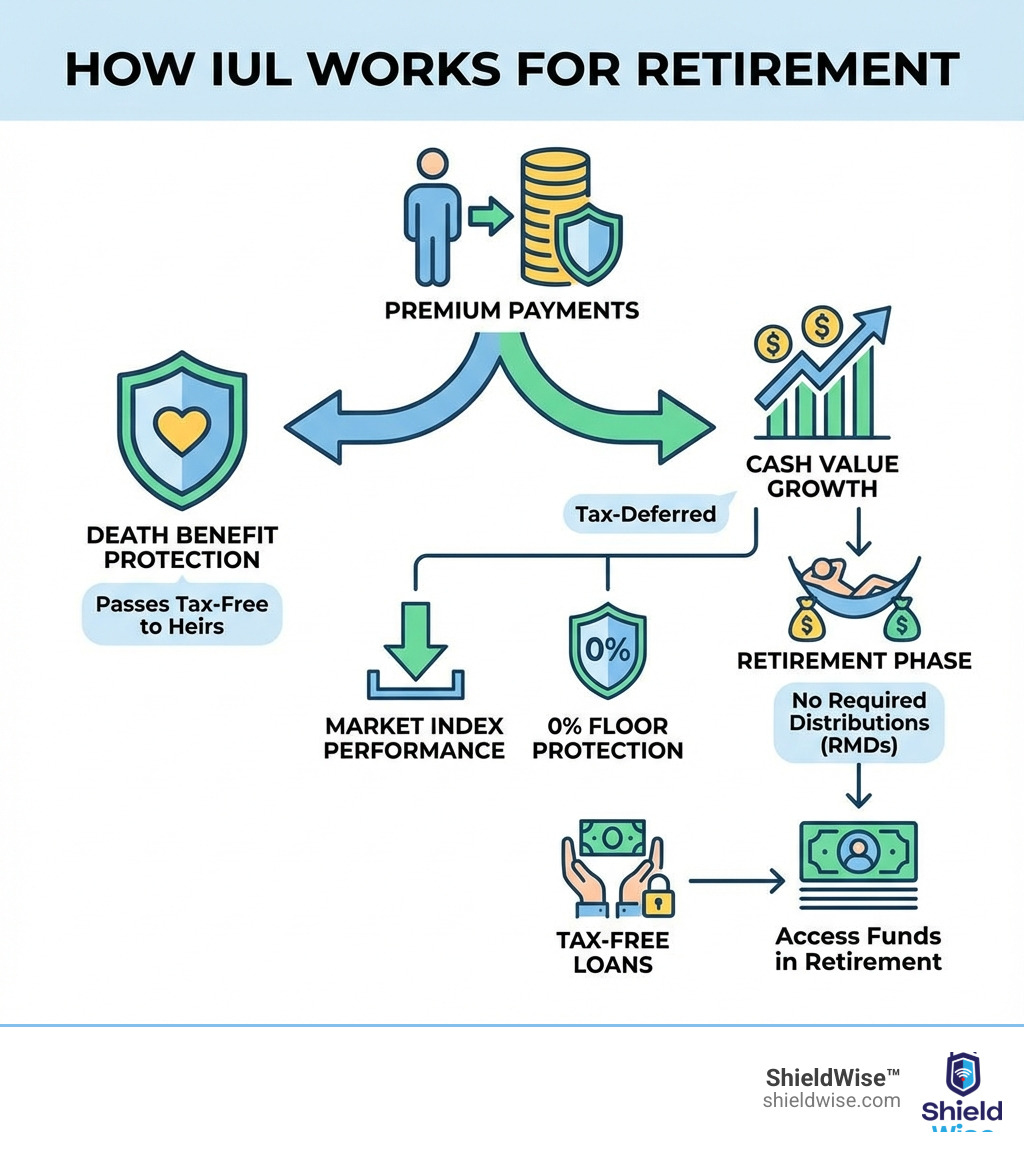
What is Indexed Universal Life (IUL) Insurance?
At its core, Indexed Universal Life (IUL) insurance is a type of permanent life insurance. This means it’s designed to cover you for your entire life, as long as premiums are paid, unlike term life insurance which covers you for a specific period. But an IUL is more than just a death benefit; it’s a sophisticated financial tool with two main components: a death benefit and a cash value component.
The death benefit is the primary reason most people purchase life insurance – it provides a tax-free lump sum to your beneficiaries upon your passing. This ensures your loved ones are financially protected, covering expenses like funeral costs, outstanding debts, or providing ongoing income.
The cash value component is where IUL truly distinguishes itself. This is a savings-like account within your policy that can grow over time on a tax-deferred basis. It offers a unique blend of protection and potential for accumulation, making it an interesting consideration for long-term financial planning, including retirement.
To understand more about the fundamentals, check out our guide on What is IUL?.
How Does an IUL Policy Work?
An IUL policy works by taking your premium payments and allocating them to different parts of the policy. A portion of your premium goes towards covering the cost of insurance (COI), administrative fees, and other charges. The remaining portion is then allocated to your policy’s cash value account.
This cash value account is where the magic happens. Its growth is linked to the performance of a specific stock market index, such as the S&P 500. This is called “index crediting.” However, it’s crucial to understand that you are not directly investing in the stock market. Instead, your cash value earns interest based on how well the chosen index performs, but with some protective guardrails in place.
We like to think of it as dipping your toes in the market’s pool without diving headfirst into the deep end. You get to enjoy some of the potential upside, but with built-in safeguards against significant losses. For a deeper dive into the mechanics, explore How does IUL work?.
How the Cash Value Grows: Caps, Floors, and Participation Rates
The growth of your IUL’s cash value is market-linked, but it comes with a unique set of rules designed to offer both potential upside and crucial downside protection. These rules include “floors,” “caps,” and “participation rates.”
Let’s start with the most comforting feature: the 0% floor. This means that your cash value will not go down due to a negative market return. If the linked index has a terrible year, your cash value simply earns 0% for that period, protecting your principal from market losses. This is a significant advantage, especially when we recall tumultuous times like the 50% loss in the S&P 500 from late 2007 to March 2009, or the biggest annual drop in the Dow Jones Industrial (DJI) Index of -52.67%. Imagine weathering such storms without seeing your retirement savings wiped out! The 0% floor is a key reason why some investors remained insulated from the financial carnage of market crashes.
However, this downside protection comes with a trade-off: caps and participation rates limit your potential upside.
- Caps: A cap is the maximum percentage of interest your cash value can earn in a given year, regardless of how high the linked index performs. For example, if the index surges by 12% but your policy has a 10% cap, you’ll only earn 10%. Caps typically range between 8% and 10%.
- Participation Rates: A participation rate determines what percentage of the index’s gain (up to the cap) your policy will be credited. If the index gains 8% and your policy has a 50% participation rate, your cash value will only be credited with 4% (50% of 8%). If the benchmark returns 8% and the participation rate is 50%, the account will earn 4%.
Many IUL policies also feature an annual reset. This means that at the end of each policy year, your cash value locks in any gains (up to the cap) and then starts fresh for the next year. This is beneficial because any losses in a given year are reset to zero due to the floor, without negatively impacting future growth calculations from a lower starting point. This feature helps mitigate the dreaded “sequence of returns risk,” which is the danger that the timing of withdrawals from a retirement account will have a negative impact on the overall rate of return available.
IUL and Your Retirement Savings Strategy
When we think about retirement, we usually picture 401(k)s, IRAs, and perhaps a comfortable pension. But what if there was another tool that could complement these traditional options, offering unique benefits and addressing some common retirement concerns? That’s where indexed universal life for retirement comes into play. It’s not designed to replace your primary retirement vehicles, but rather to serve as a powerful supplement, adding layers of flexibility, tax advantages, and protection.

Key Features of IUL for Retirement Savings
IUL policies offer several distinct features that make them attractive for enhancing a retirement savings strategy:
- No IRS Contribution Limits: Unlike 401(k)s and IRAs, which have strict annual contribution limits (e.g., $23,000 for a 401(k) in 2024, plus catch-up contributions), IUL policies generally have no such government-imposed caps. This means high-income earners or those who have maxed out other tax-advantaged accounts can continue to save and accumulate cash value in a tax-deferred environment.
- Flexible Premium Payments: Life happens, and your financial situation can change. IUL policies often offer flexibility in how much and when you pay your premiums. As long as there’s enough cash value to cover the policy’s costs, you can adjust your payments. This can be a huge relief if you encounter unexpected expenses or if your income fluctuates. You can pay more early on to build cash value faster or reduce payments during leaner times.
- Tax-Advantaged Growth: The cash value within an IUL policy grows tax-deferred. This means you don’t pay taxes on the interest earned each year, allowing your money to compound more efficiently over time. When you access these funds later in retirement, they can often be taken out tax-free through policy loans, a significant advantage over many other retirement income sources.
- Protection from Market Downturns: As we discussed, the 0% floor is a game-changer. While traditional investment accounts are fully exposed to market volatility, potentially wiping out years of gains during a downturn (remember the 2007-2009 crisis?), an IUL protects your cash value from such direct losses. This provides peace of mind and helps preserve your retirement nest egg, ensuring you don’t have to sell assets at a loss during a market slump.
Accessing Your Cash Value in Retirement
One of the most compelling aspects of using indexed universal life for retirement is the ability to access your accumulated cash value in a tax-efficient manner. Instead of withdrawals, which can sometimes reduce the death benefit or incur taxes if they exceed your premium payments, many retirees choose to take tax-free policy loans.
How IUL Loans Work: When you take a loan from your IUL, you’re essentially borrowing money from the insurance company, using your policy’s cash value as collateral. Your cash value continues to grow as if no loan was taken, and you typically pay interest on the loan. As long as the policy remains in force, these loans are generally tax-free. This provides a flexible source of supplemental income during retirement, allowing you to bypass ordinary income taxes. For a detailed explanation of how these loans function, explore How IUL Loans Work.
Another significant benefit is the absence of Required Minimum Distributions (RMDs). Unlike traditional 401(k)s and IRAs, which mandate that you start taking taxable withdrawals at age 73 (as of 2023), IUL policies have no such requirements. This gives you greater control over when and how you access your retirement funds, allowing for more strategic tax planning in your later years.
Here’s a quick comparison of IUL features for retirement income:
| Feature | IUL for Retirement | Traditional 401(k)/IRA |
|---|---|---|
| Contributions | No IRS limits; flexible payments | IRS limits apply; often fixed/employer-matched |
| Growth | Tax-deferred; market-linked with caps/floors | Tax-deferred (Traditional); Tax-free (Roth); market-risk |
| Withdrawals | Tax-free loans (typically); tax-free up to basis | Taxable (Traditional); Tax-free (Roth); penalties before 59.5 |
| RMDs | No RMDs | Required at age 73 (Traditional); Roth IRAs exempt |
How IUL Complements Your Retirement Strategy
We see indexed universal life for retirement not as a standalone solution, but as a robust complement to your existing retirement plans.
- Supplemental Income: IUL can provide an additional stream of tax-free income during retirement, helping to fill gaps left by Social Security, pensions, or other investment accounts, especially during market downturns when you might not want to sell off other assets.
- Tax Diversification: A well-rounded retirement plan often includes a mix of taxable, tax-deferred, and tax-free income sources. IUL, with its potential for tax-free loans, can act as a powerful tax-free bucket, giving you more flexibility to manage your tax burden in retirement.
- Estate Planning Benefits: Beyond retirement income, an IUL policy provides a death benefit that is typically paid out income tax-free to your beneficiaries. This can be a significant part of your legacy planning, ensuring wealth transfer to the next generation or supporting causes you care about. Even after taking loans for retirement income, a substantial death benefit can remain. This makes IUL a versatile tool for both living benefits and protecting your family’s future. You can learn more about this category of products at Category: Universal Life Insurance.
The Pros and Cons of Using Indexed Universal Life for Retirement
Like any financial tool, IUL policies come with their own set of advantages and disadvantages. It’s crucial to understand both sides before deciding if this strategy aligns with your retirement goals.

Key Benefits of Using Indexed Universal Life for Retirement
We’ve touched on many of these already, but let’s consolidate the compelling reasons why many consider indexed universal life for retirement:
- Tax-Advantaged Growth: Your cash value grows tax-deferred, meaning you don’t pay taxes on the annual gains. This allows for powerful compounding over decades.
- Tax-Free Retirement Income (Loans): The ability to access your cash value through policy loans, which are generally tax-free as long as the policy remains in force, is a major draw. This can provide a crucial income stream without adding to your taxable income in retirement.
- Death Benefit for Heirs: An IUL provides a substantial, income tax-free death benefit to your beneficiaries, offering financial security and peace of mind for your loved ones.
- Estate Planning: For those with estate planning needs, IUL can be an effective way to transfer wealth efficiently, often bypassing probate and providing liquidity for estate taxes or other expenses.
- Protection from Market Loss: The 0% floor guarantee means your cash value won’t decrease due to negative market returns. This protects your principal during volatile periods, a feature traditional investment accounts lack. We’ve seen the Dow Jones Industrial (DJI) Index drop by -52.67% in a single year, and the S&P 500 lose 50% from 2007-2009. An IUL shields you from these direct market losses.
- Flexibility in Premiums: As your financial situation evolves, you can often adjust your premium payments, within certain limits, making the policy adaptable to life’s changes.
- Mitigating Sequence of Returns Risk: This is a big one, especially for those nearing or in retirement. Sequence of returns risk is “the danger that the timing of withdrawals from a retirement account will have a negative impact on the overall rate of return available.” Because your IUL cash value is protected by a 0% floor, you can draw income from it during market downturns, allowing your other market-exposed investments to recover without being forced to sell them at a loss.
Potential Risks and Drawbacks of Using Indexed Universal Life for Retirement
While the benefits are attractive, it’s equally important to understand the potential downsides:
- Higher Costs and Fees: IUL policies are more complex than term life insurance and typically come with higher fees. These can include administrative fees, cost of insurance charges (which increase with age), and various rider fees. Sales commissions can also be steep, sometimes absorbing a large portion of your first year’s premium. These costs can eat into your cash value growth, especially in the early years.
- Surrender Charges: If you decide to cancel your policy in the early years, you may incur significant surrender charges, which can reduce the amount of cash value you receive. These charges typically decline over time but can be substantial initially.
- Complexity: IUL policies are not “set it and forget it” products. Understanding how index crediting, caps, floors, participation rates, and policy loans work requires some effort. Mismanaging the policy or not understanding its mechanics can lead to disappointing results.
- Capped Returns Limit Upside: While the 0% floor protects against losses, the caps and participation rates limit how much you can earn when the market performs exceptionally well. You won’t fully participate in bull market rallies. If the S&P 500 soars by 20%, your policy might still only credit 10% due to a cap. This means you trade unlimited upside for downside protection.
- Policy Lapse Risk: If your cash value doesn’t grow enough to cover the rising cost of insurance and other fees, or if you stop paying premiums without sufficient cash value, your policy could lapse. This means you could lose your coverage and any remaining cash value. Proper funding and monitoring are essential to prevent this.
For a more comprehensive look at the ups and downs, you can read More about IUL pros and cons.
Is an IUL the Right Fit for Your Retirement Strategy?
Deciding whether to incorporate indexed universal life for retirement into your financial plan is a personal decision that depends heavily on your individual financial goals, risk tolerance, and long-term commitment. It’s not a one-size-fits-all solution, and what works for one person might not be ideal for another.
Who is the Ideal Candidate for an IUL Policy?
We find that IUL policies tend to be a particularly good fit for specific profiles:
- High-Income Earners: If you’re already maximizing contributions to your 401(k)s, IRAs, and other tax-advantaged retirement accounts, an IUL can offer another avenue for tax-deferred growth without IRS contribution limits.
- Those Who Have Maxed Out Other Tax-Advantaged Accounts: For individuals who consistently hit the contribution limits on their traditional retirement vehicles, an IUL provides an additional way to save for retirement with tax benefits.
- Business Owners: Business owners often have unique financial planning needs, including succession planning and tax-efficient wealth accumulation. IULs can be structured to address these needs, offering both a death benefit and a flexible cash accumulation component.
- Those Seeking Tax Diversification: Building a retirement portfolio that includes a mix of taxable, tax-deferred, and potentially tax-free assets (like IUL cash value accessible via loans) can provide greater flexibility in managing your tax burden during retirement.
- Individuals with Estate Planning Needs: If leaving a substantial, tax-free legacy to your heirs is a priority, an IUL policy can be a highly effective tool for wealth transfer.
Key Considerations When Choosing a Policy
If you’re considering an IUL, approach it with diligence and a clear understanding of what you’re getting into. Here are some key considerations:
- Policy Illustrations: These are projections of how your policy might perform based on assumed interest rates, fees, and other factors. It’s crucial to remember that illustrations are estimates, not guarantees. We recommend looking at various scenarios, including conservative ones, and understanding the assumptions behind them.
- Carrier Financial Strength: You’re entering into a long-term contract, potentially spanning decades. We always advise checking the financial strength ratings of the insurance company. Look for highly-rated carriers to ensure they have the stability to fulfill their promises far into the future.
- Fees and Charges: Don’t shy away from asking for a clear breakdown of all fees and charges associated with the policy. Understand how these costs might impact your cash value growth over time. Transparency here is key.
- Indexing Options: Different IUL policies offer various indexing strategies and options. Some might link to the S&P 500, others to different indices or a combination. Understand how each option works, its caps, floors, and participation rates, and how it aligns with your risk comfort level.
For a comprehensive understanding, our What is an IUL? Complete Guide covers these details and more.
Frequently Asked Questions about IUL for Retirement
We know you’ve got questions, and we’re here to answer them clearly and simply.
Can you lose money in an IUL policy?
This is a common and excellent question. Thanks to the 0% floor protection, your cash value will not decrease due to negative market returns. If the linked index drops, your cash value simply earns 0% for that period. This is a significant safeguard against market downturns.
However, it’s important to understand that your cash value can still go down if it’s not adequately funded to cover the impact of fees and policy charges. These charges, which include the cost of insurance and administrative fees, are deducted from your cash value. If your cash value growth (even with a 0% floor) isn’t enough to offset these deductions, your cash value can erode. This also leads to the risk of lapse if the cash value falls too low to sustain the policy. So, while you’re protected from market losses, careful funding and monitoring are crucial to prevent other forms of “loss” within the policy.
How much income can I realistically expect from an IUL in retirement?
The amount of income you can realistically expect from an IUL in retirement depends on several factors:
- Funding Level and Duration: How much you consistently contribute and for how long you contribute significantly impacts the cash value accumulation. The more you put in over a longer period, the more potential income you can draw.
- Policy Performance: The actual performance of the linked index, within the caps and floors of your policy, will determine your growth. While illustrations show potential, actual returns can vary.
- Loan Structure and Repayment: The terms of your policy loans, including interest rates and whether you repay the loan principal or just the interest, will affect the longevity of your cash value and death benefit.
- Age at Retirement: The earlier you start and the longer you allow the cash value to grow before accessing it, the more substantial your income potential.
- Assumed Interest Rates: Illustrations are based on assumed interest rates. It’s wise to consider conservative projections, not just the most optimistic ones.
For example, a hypothetical 35-year-old man contributing $6,000 annually to an IUL policy with a $400,000 death benefit until age 70 could see his cash value grow to over $631,000. He might then be able to take $50,000 annually in supplemental retirement income from age 71 to 100, receiving almost $900,000 in tax-free income by age 90, while still leaving a death benefit of over $400,000. This is just an example, and individual results will vary.
Is an IUL better than other retirement savings options?
We don’t view an IUL as “better” than other retirement savings options like 401(k)s or IRAs; rather, it serves different purposes and can be a powerful supplement to your retirement plan.
- Not a Replacement: For most people, maximizing contributions to employer-sponsored 401(k)s (especially with employer matching!) and IRAs should be the priority. These accounts are often simpler, have lower fees, and are designed specifically for retirement savings.
- IUL as a Supplement: An IUL shines when it’s used to complement these traditional accounts. It offers unique benefits like tax-free access to cash value (via loans), protection from market losses, and no RMDs, which traditional accounts don’t. It’s particularly useful for those who have already maxed out their other tax-advantaged savings and are looking for additional avenues for tax diversification and wealth accumulation.
The best approach often involves a diversified strategy that leverages the strengths of multiple financial vehicles. For a detailed comparison, you can explore Comparing IULs to other strategies.
Secure Your Financial Future
Indexed universal life for retirement offers a unique blend of protection, growth potential, and tax advantages that can complement your overall savings plan. By understanding how it works, its benefits, and its potential drawbacks, you can make an informed decision about whether it fits into your long-term financial strategy. To explore your options and see how an IUL could work for you, compare plans from trusted carriers. ShieldWise™ makes it easy to get clear guidance and find the right fit for your goals.
Ready to see how an IUL can supplement your retirement? Explore how IUL works and compare your options.