
Why Retirement Planning Requires More Than Just Traditional Accounts
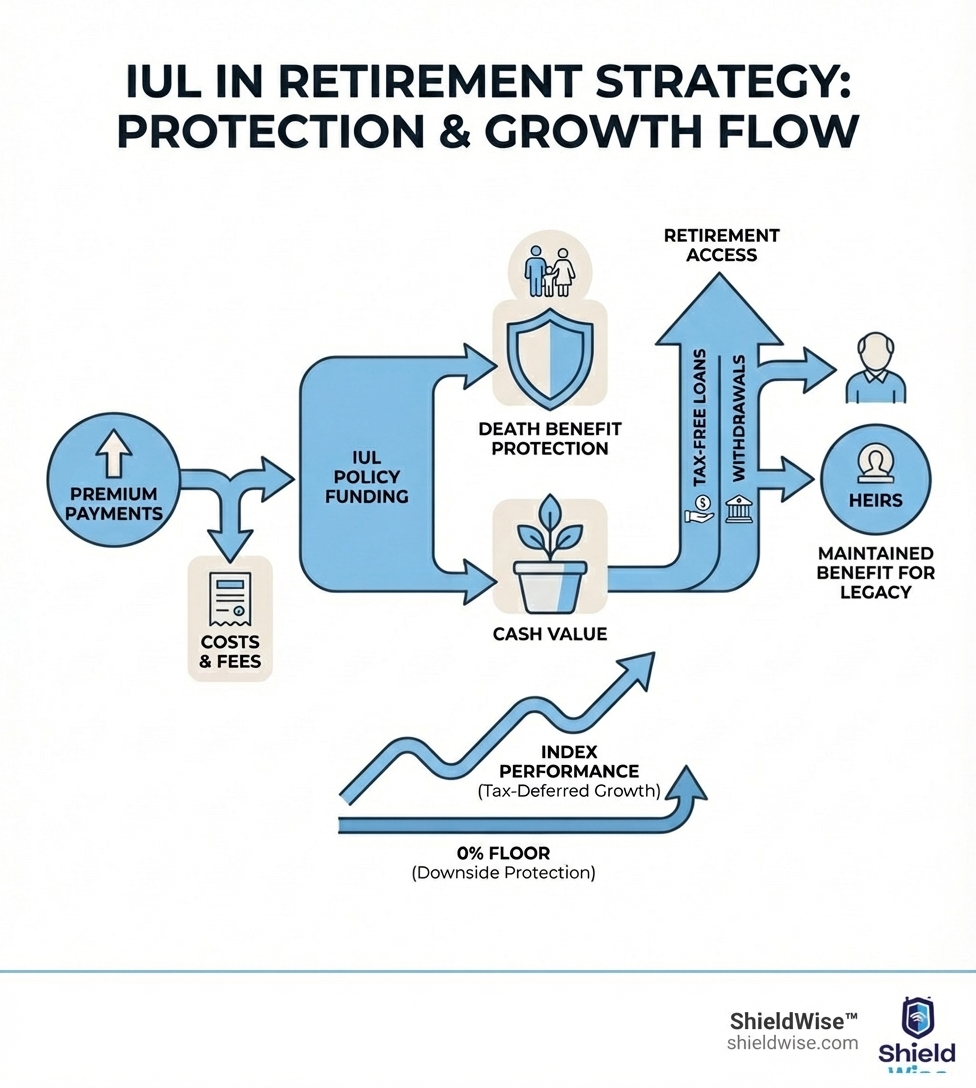
How IUL fits into retirement strategy is a question more Americans are asking as they search for ways to build a resilient, tax-efficient retirement plan. An Indexed Universal Life (IUL) insurance policy can serve as a versatile tool that combines permanent life insurance protection with a cash value component designed to grow based on market index performance—while protecting your principal from market losses through a guaranteed floor, typically set at 0%.
Here’s how IUL fits into retirement strategy at a glance:
- Tax-advantaged growth: Cash value grows tax-deferred, and you can access it through tax-free policy loans or withdrawals up to your basis
- Downside protection: A 0% floor shields your cash value from market downturns, reducing sequence of returns risk
- Flexible access: No contribution limits, no age-based withdrawal penalties, and no Required Minimum Distributions (RMDs)
- Estate planning: Provides a tax-free death benefit to beneficiaries while you build supplemental retirement income
- Portfolio diversification: Acts as a “volatility buffer” alongside traditional retirement accounts like 401(k)s and IRAs
Over 40% of Americans fear running out of money in retirement more than they fear death itself. With traditional pensions fading and market volatility unsettling, many retirees are searching for financial tools that offer both protection and growth potential. IUL has grown to represent 25% of the U.S. life insurance market in the first half of 2025, making it one of the fastest-growing retirement planning tools available.
Unlike traditional retirement accounts that expose you to full market risk and future tax uncertainty, an IUL policy offers a unique combination: your cash value participates in market gains (subject to caps) while being protected from market losses. This makes it particularly valuable for those who have already maxed out their 401(k) or IRA contributions and are looking for additional tax-advantaged growth opportunities.
IUL is not a replacement for traditional retirement savings. Instead, it works best as a complement to accounts like 401(k)s and IRAs—especially for high-income earners, business owners, or anyone seeking more control over their retirement income and taxes.
Understanding IUL: The Foundation of Your Strategy
When we talk about how IUL fits into retirement strategy, it’s essential to first understand what an Indexed Universal Life policy is and how its unique mechanics contribute to our long-term financial goals. Think of it as a financial chameleon, adapting to market conditions while offering a stable base.
What is an Indexed Universal Life (IUL) Policy?
An Indexed Universal Life (IUL) policy is a type of permanent life insurance that offers lifelong coverage and combines a death benefit with a cash value component. Unlike term life insurance, which only provides coverage for a specific period, an IUL is designed to last your entire life, as long as premiums are paid.
The “universal life” aspect means it offers flexibility in premium payments and death benefits, allowing us to adjust them as our life circumstances change. The “indexed” part is where it gets really interesting for retirement planning. A portion of the premiums we pay goes towards the cost of insurance, and the remainder is added to the policy’s cash value. This cash value grows on a tax-deferred basis, similar to an IRA or 401(k), and is linked to the performance of a specific market index, such as the S&P 500. It’s this dual nature—providing a death benefit while also accumulating wealth—that makes an IUL a powerful tool.
How IUL Generates Returns: Caps, Floors, and Participation Rates
The cash value component of an IUL policy doesn’t directly invest in the stock market. Instead, its growth is tied to the performance of a chosen market index through a crediting formula. This means we get the potential for market-linked growth without directly exposing our funds to market losses.
Here’s how it works:
- Market Index Linkage: The interest credited to our cash value is based on the performance of a specific market index, often the S&P 500. If the index performs well, our cash value can grow.
- Upside Potential: We participate in the gains of the market index, offering the potential for higher returns than traditional fixed-interest accounts.
- Downside Protection (The 0% Floor): This is a crucial feature for retirement planning. The “zero-floor” protection means that even if the linked market index has a negative return in a given year, our cash value will not lose money due to market performance. The interest credited will simply be 0%, protecting our principal from market downturns. This safety net is a game-changer for maintaining stability in our retirement savings.
- Caps Limit Gains: While we participate in market upside, there’s typically a cap, or an upper limit, on how much interest our policy can earn in a given year. For example, if the index grows by 15% but our policy has a 10% cap, we’ll be credited with 10% interest. This is the trade-off for the downside protection.
- Participation Rates: Some IUL policies also have a participation rate, which determines the percentage of the index’s gain that is credited to the policy. If the index gains 10% and our policy has an 80% participation rate, we’d be credited with 8% interest (before any caps).
- Annual Reset Feature: Many IUL policies have an annual reset feature. This means that at the end of each policy year, any gains are locked in, and the starting point for the next year’s index calculation is reset. This feature helps to secure gains and prevent them from being eroded by future market downturns.
Understanding these mechanics is key to seeing how IUL works to provide a balance of growth potential and security for our retirement funds.
The Core Benefits: Why IUL is a Powerful Retirement Tool

When we envision our retirement, we often picture a period of financial freedom and peace of mind. However, volatile markets and tax uncertainties can make that vision feel distant. This is where an IUL policy steps in, offering a unique blend of tax advantages, portfolio stability, and flexibility that can significantly strengthen our retirement blueprint.
Tax-Advantaged Income: How IUL fits into a retirement strategy for tax diversification
One of the most compelling aspects of how IUL fits into retirement strategy is its significant tax advantages, which allow us to create a diversified and tax-efficient income stream in retirement.
- Tax-Deferred Cash Value Growth: The cash value within an IUL policy grows tax-deferred. This means we don’t pay taxes on the interest or gains our policy earns each year. Taxes are only due if we make a withdrawal that exceeds our basis (the amount we’ve paid in premiums) or if the policy lapses. This allows our money to compound more effectively over time.
- Tax-Free Policy Loans: A powerful feature of IUL is the ability to access our cash value through policy loans. These loans are generally tax-free, provided the policy remains in force and does not become a Modified Endowment Contract (MEC). This can provide a tax-efficient source of retirement funds, supplementing our other income without increasing our taxable income. We can learn more about how IUL loans work.
- Tax-Free Withdrawals (up to basis): We can also take withdrawals from our cash value. These withdrawals are typically tax-free up to the amount we’ve paid in premiums (our cost basis). Beyond that, withdrawals may be taxable.
- No Required Minimum Distributions (RMDs): Unlike traditional qualified accounts such as a 401(k) or IRA, IUL policies do not have Required Minimum Distributions (RMDs). This means we have complete control over when and how much we withdraw, without being forced to take taxable income we might not need, potentially impacting our tax bracket or Social Security benefits.
These tax benefits make IUL an attractive option for creating a tax-free income stream in retirement, especially for those in higher tax brackets now or anticipating being in higher tax brackets later.
Portfolio Stability: How IUL fits into a retirement strategy to mitigate risk
Market volatility is a major concern for retirees, especially the dreaded “sequence of returns risk”—the danger that poor market performance early in retirement significantly depletes our savings and shortens our financial longevity. This is where IUL truly shines as a tool for stability.
- Mitigating Sequence of Returns Risk: IUL’s zero-floor protection directly addresses sequence of returns risk. If the market experiences a downturn in our early retirement years, our IUL cash value won’t suffer direct losses. This means we don’t have to sell depreciated assets from our IUL to cover living expenses, allowing other investments in our portfolio to recover. This stability helps to preserve our overall retirement savings and extend their lifespan.
- Volatility Buffer: Think of our IUL as a “volatility buffer” within our overall portfolio. During market downturns, we can tap into our IUL’s cash value via tax-free loans to cover expenses. This allows our other, more market-sensitive assets (like stocks in a 401(k) or brokerage account) to remain invested and recover when the market eventually rebounds. This strategic withdrawal approach can make a significant difference in the long-term health of our retirement funds.
- ‘Zero-Floor’ Protection Importance: The importance of the zero-floor protection cannot be overstated for retirement planning. It provides peace of mind, knowing that a portion of our retirement assets is shielded from market crashes, ensuring a more predictable growth path for that component of our wealth.
- Consistent Growth Potential: While IUL returns are capped, they offer consistent growth potential over the long term. Research indicates that long-term average returns for IULs are typically in the 5-7% range (after costs). This predictable growth, combined with downside protection, offers a stable foundation for our retirement income.
Flexibility and Legacy Planning
Beyond tax advantages and stability, IUL policies offer considerable flexibility and play a crucial role in our estate planning.
- Flexible Premium Payments: IUL policies allow for flexible premium payments. We can pay more or less than our target premium, as long as there’s enough cash value to cover policy costs. This flexibility can be invaluable during periods of fluctuating income or unexpected expenses, allowing us to adapt our contributions without lapsing the policy.
- Access to Funds Before Age 59.5: Unlike 401(k)s or IRAs, which often impose penalties for withdrawals before age 59.5, we can typically access our IUL cash value at any age through loans or withdrawals without penalties. This provides a liquid source of funds for pre-retirement needs like a down payment on a home, college tuition, or starting a business.
- No Contribution Limits: For high-income earners who have maxed out their traditional retirement accounts, IUL offers a way to continue saving on a tax-advantaged basis, as there are no IRS contribution limits for IUL policies.
- Tax-Free Death Benefit for Heirs: An IUL policy provides a tax-free death benefit to our beneficiaries. This means our loved ones receive a financial legacy free from income taxes, which can be used to cover estate taxes, outstanding debts, or simply provide financial security for their future. This makes IUL an excellent tool for estate planning, ensuring our wishes are carried out and our family is protected.
How IUL Fits Into Your Retirement Strategy: A Practical Blueprint

Now that we understand the foundational elements and core benefits, let’s explore how IUL fits into retirement strategy as a practical component of our overall financial plan. It’s not about replacing, but about enhancing and diversifying.
IUL and Traditional Retirement Accounts: Key Differences
It’s common to compare IUL with traditional retirement accounts like 401(k)s and IRAs. While all aim to help us save for retirement, their mechanisms and benefits differ significantly.
Here’s a breakdown of how an IUL complements these other vehicles:
- 401(k)s: These are employer-sponsored plans offering tax-deferred growth and often employer matching contributions. Contributions are limited, and withdrawals before 59.5 may incur penalties. A 401(k) is great for employer matches and initial tax deferral.
- IRAs: IRAs (individual retirement accounts) offer tax-deferred (Traditional) or tax-free (Roth) growth. They provide a wider range of investment options than most 401(k)s but also have contribution limits and penalties for early withdrawals.
- Roth IRAs: Roth IRAs offer tax-free growth and withdrawals, making them very popular. Contributions are made with after-tax dollars.
- IUL: Unlike these, IULs offer a death benefit, no contribution limits, protection from market volatility (0% floor), and tax-free access to cash value via loans.
IUL is not designed to replace these accounts, especially if we’re getting an employer match in our 401(k) (that’s “free money,” after all!). Instead, IUL serves as a powerful supplement. For those who have already maxed out their contributions to 401(k)s and IRAs, an IUL provides another avenue for tax-advantaged growth and income without the typical government-mandated limits or RMDs.
Integrating IUL into a Diversified Portfolio
Diversification is key to a robust retirement strategy. An IUL policy can act as a crucial piece of this puzzle, particularly as a conservative “bucket” within our overall financial plan.
- IUL as a Conservative “Bucket”: We can strategically use our IUL’s cash value to supplement income during market downturns. This allows our more aggressive, market-dependent investments (like those in our 401(k) or brokerage accounts) to remain invested and recover when the market rebounds, rather than being forced to sell them at a loss. This approach helps balance risk and reward across our entire portfolio.
- Example of How IUL Can Work: For example, consider a hypothetical scenario. A 35-year-old contributes $6,000 annually to an IUL policy with a $400,000 death benefit. By age 70, their cash accumulation value could exceed $631,000, with life insurance protection over $1 million. From age 71 to 100, they could potentially receive $50,000 annually in tax-free income. By age 90, nearly $900,000 in tax-free income could be received, with over $400,000 remaining as a death benefit for their heirs. This illustrates the long-term power of consistent funding and strategic use of an IUL.
How IUL Compares to Other Universal Life Insurance
While IUL is a type of universal life insurance, it has distinct features that set it apart from other variations. Understanding these differences helps us appreciate how IUL fits into retirement strategy uniquely.
- Traditional Universal Life (UL): This type of policy’s cash value grows at a fixed interest rate declared by the insurance company. It offers flexibility in premiums and death benefits but generally provides lower growth potential compared to IUL.
- Variable Universal Life (VUL): With VUL, the cash value is invested directly in subaccounts, similar to mutual funds. This offers higher growth potential but also comes with direct market risk, meaning we could lose principal if investments perform poorly.
- Guaranteed Universal Life (GUL): GUL policies prioritize a guaranteed death benefit for life, often with fixed premiums. While they offer predictability, their cash value accumulation is usually minimal, and they are not designed as a retirement income vehicle.
- IUL vs. Whole Life Insurance: Key Differences Explained: Whole life insurance offers fixed premiums and guaranteed cash value growth at a set rate, along with a guaranteed death benefit. It’s simpler and more predictable but less flexible and typically offers lower growth potential than an IUL. IUL provides more flexibility and market-linked growth potential with downside protection, making it more suitable for those seeking a retirement income vehicle.
For a comprehensive look at all the options, explore our Universal Life Insurance Category.
Navigating the Risks, Costs, and Common Misconceptions
No financial tool is without its nuances, and IUL is no exception. To truly understand how IUL fits into retirement strategy, we must also steer its potential risks, costs, and common misconceptions. This transparency ensures we make informed decisions.
Understanding the Potential Risks and Drawbacks
While IUL offers significant benefits, it’s crucial to be aware of its complexities and potential downsides:
- Complexity: IUL policies are more complex than simpler life insurance products or traditional retirement accounts. Understanding how caps, floors, participation rates, and various fees interact requires careful attention.
- Costs and Fees: IUL policies come with various costs and fees that can impact cash value growth, especially in the early years. These include:
- Administrative fees: Charges for managing the policy.
- Cost of insurance (COI): This covers the death benefit and typically increases with age.
- Surrender charges: Fees incurred if we cancel the policy within a certain period (often the first 10-15 years).
- Other fees: May include premium expense charges, rider fees, and sales commissions. These fees can eat into our cash value, especially if the policy isn’t funded adequately or managed properly.
- Policy Lapse Risk: If our premiums aren’t sufficient to cover the rising cost of insurance and other fees, our cash value could be depleted, leading to the policy lapsing. This means we lose coverage and could face tax consequences. Consistent funding and regular reviews are essential.
- Illustration Projections vs. Guarantees: Policy illustrations show projected cash value growth and death benefits based on certain assumptions about market performance and interest rates. It’s vital to remember these are projections, not guarantees. Actual performance may vary, particularly if market conditions are consistently poor or caps are adjusted by the insurer.
As with any financial product, it’s important to weigh these factors carefully. We encourage reviewing the Pros and Cons of Using an IUL Account for Retirement to ensure a balanced perspective.
Who is the Ideal Candidate for an IUL Policy?
Given its unique structure, an IUL policy isn’t for everyone. However, for certain individuals, how IUL fits into retirement strategy can be exceptionally beneficial:
- High-Income Earners: Those who have already maxed out contributions to traditional retirement accounts (401(k)s, IRAs) and are looking for additional tax-advantaged growth opportunities without contribution limits.
- Long-Term Perspective: Individuals who are committed to funding a policy for many years (decades, typically) to allow the cash value to accumulate significantly.
- Need for Life Insurance: People who need a permanent death benefit to protect their loved ones or for estate planning purposes, alongside wealth accumulation.
- Desire for Tax Diversification: Those who want to diversify their retirement income streams to include tax-free options, reducing their overall tax burden in retirement.
- Seeking Downside Protection: Individuals who are comfortable with market-linked growth but want protection against market losses through the 0% floor.
- Business Owners/Self-Employed: People with fluctuating incomes who appreciate the flexibility of premium payments.
Common Myths and Special Considerations
Let’s clear up some common misunderstandings about IULs:
- Myth: It’s a direct stock investment: Our IUL cash value is linked to a market index, not directly invested in it. This distinction is important because it’s how the 0% floor protection works. We don’t own shares; the insurance company credits interest based on the index’s performance.
- Myth: It’s too good to be true: The benefits of IUL, particularly tax-free income and downside protection, often sound incredibly appealing. However, these benefits come with trade-offs, such as caps on gains, fees, and the need for long-term commitment and proper management. It’s a powerful tool when understood and used correctly.
- Special Considerations (Portability & Tax Implications): For individuals with international ties or those who might relocate, IUL policies offer portability that traditional, country-specific retirement accounts might not. This can be beneficial for managing assets across borders. However, it’s crucial to understand that tax implications for life insurance policies can vary significantly depending on residency status and local tax laws. We always recommend consulting with a qualified financial advisor who understands both IULs and international tax considerations to ensure compliance and optimize benefits.
Frequently Asked Questions About Using IUL for Retirement
We often get asked specific questions about how IUL fits into retirement strategy. Let’s address some of the most common ones.
Can I lose money in an IUL?
While the cash value in an IUL policy is protected by a 0% floor from market losses, meaning it won’t decrease due to negative index performance, it is still possible for the net cash value to decrease due to policy fees and costs. In the early years, particularly, administrative fees, the cost of insurance, and any surrender charges can reduce the cash value, even if the index performs positively. If we decide to surrender the policy early, the surrender charges could mean we receive less than we’ve paid in premiums. So, while market downturns won’t directly deplete our cash value, other factors can.
How soon can I access the cash value in an IUL?
The cash value in an IUL policy generally becomes accessible after the first few years, once sufficient cash value has accumulated beyond the initial fees and charges. The exact timing and amount depend on how the policy is funded (the premiums we pay) and the policy’s specific terms. While we can access funds relatively early compared to traditional retirement accounts, it’s typically best to allow the policy to accumulate cash value for a longer period to maximize its growth potential and make policy loans more efficient. Access can be through loans or withdrawals.
What happens if I stop paying premiums?
One of the flexibilities of universal life insurance is that we’re not locked into fixed premiums. If we stop paying premiums, the policy can continue to stay in force as long as there is sufficient cash value to cover the ongoing cost of insurance and other fees. However, if the cash value is depleted, the policy will lapse. A lapse means we lose our life insurance coverage, and any outstanding policy loans could become immediately taxable. It’s crucial to monitor our policy’s performance and cash value to ensure it remains adequately funded, or to work with our advisor to make adjustments if our financial situation changes.
Conclusion: Building Your Resilient Retirement Blueprint
As we’ve explored, how IUL fits into retirement strategy is multifaceted and powerful. It’s not a silver bullet, nor is it a simple investment. Instead, an Indexed Universal Life policy is a sophisticated financial tool that, when properly understood and integrated, can significantly improve our retirement planning.
We’ve seen how IUL offers a unique combination of life insurance protection, market-linked growth with crucial downside protection, and unparalleled tax advantages. It provides tax-deferred cash value growth, the potential for tax-free retirement income through policy loans, and a tax-free death benefit for our heirs. Its flexibility in premiums and access to funds, coupled with its ability to mitigate sequence of returns risk, makes it an invaluable component of a diversified and resilient retirement portfolio.
For high-income earners, those who have maxed out other retirement accounts, or anyone seeking greater control and tax efficiency in their retirement income, an IUL can be a strategic asset.
At ShieldWise, we believe in empowering you with clear, jargon-free guidance to make informed decisions about your financial future. If you’re ready to explore how an IUL can fit into your personal retirement blueprint, we’re here to help. Take control of your retirement and build the secure future you deserve.