
Why Getting Life Insurance on a Fixed Income Is Easier Than You Think
How to get life insurance on a fixed income may feel like an impossible challenge when every dollar is already accounted for—but thousands of retirees and fixed-income households secure affordable coverage every year. Here’s the short answer:
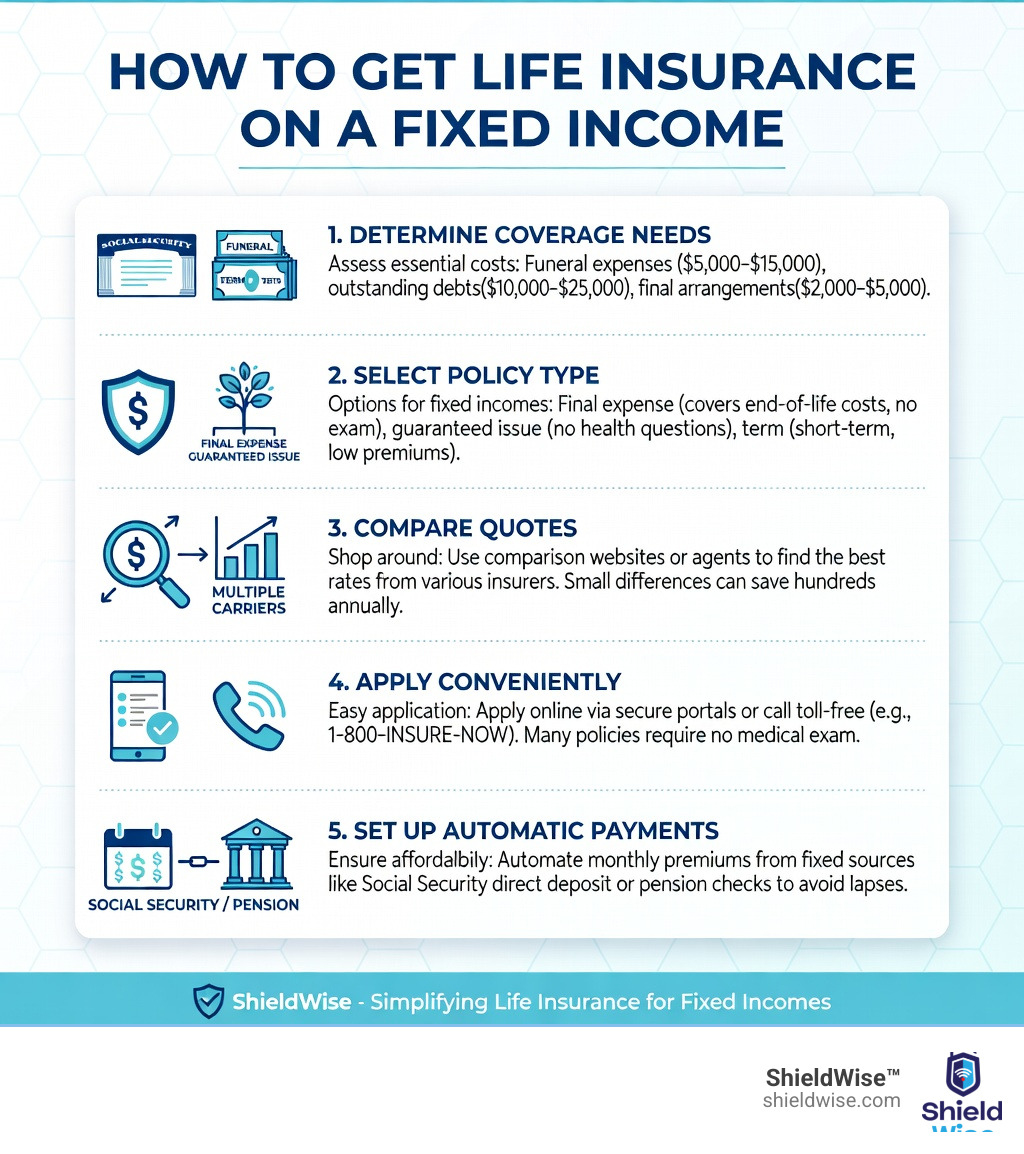
Quick Steps to Get Life Insurance on a Fixed Income:
- Choose the right policy type – Final expense, guaranteed issue, or simplified issue policies cost less and skip medical exams
- Start with small coverage amounts – $5,000 to $25,000 policies can cover funeral costs for $30–$150/month
- Compare multiple quotes – Rates vary widely between carriers for the same coverage
- Use automatic payments – Set up withdrawals from Social Security or pension to avoid missed payments
- Ask about graded benefits – Policies with waiting periods often have lower premiums
The reality is that life insurance on a fixed income isn’t about buying the biggest policy—it’s about matching your coverage to what your family actually needs, whether that’s $10,000 to cover a funeral or $25,000 to pay off remaining debts. You don’t need perfect health or a large budget. You need the right information and a clear comparison of your options.
At ShieldWise, we’ve helped thousands of retirees and fixed-income families compare life insurance options and find coverage that fits their budget without sacrificing peace of mind. Our platform specializes in how to get life insurance on a fixed income by breaking down complex policies into plain-language guidance and connecting you with carriers who understand budget constraints. We know that when you’re living on Social Security, a pension, or limited savings, every premium dollar matters—and we’re here to make sure you never overpay or get sold something you don’t need.
Similar topics to how to get life insurance on a fixed income:
Understanding Your Options: How to Get Life Insurance on a Fixed Income
When we talk about living on a fixed income—whether that’s Social Security, a pension, or disability payments—predictability is your best friend. You need to know exactly what is going out of your bank account every month. The good news is that several types of life insurance are specifically designed with this kind of stability in mind.

To figure out how to get life insurance on a fixed income, you first need to understand the four primary “flavors” of coverage available to seniors and retirees:
- Term Life Insurance: This is often the “cheapest” option initially. You pay a set premium for a specific period (like 10 or 20 years). If you pass away during that time, your beneficiaries get the payout. However, for those on a fixed income, the risk is that the term ends, and renewing it at age 75 or 80 can become prohibitively expensive.
- Whole Life Insurance: This is permanent coverage. As long as you pay the premiums, the policy stays in force until you pass away. It also builds “cash value” over time. While the premiums are higher than term insurance, they are locked in for life—meaning your budget won’t face any nasty surprises ten years down the road.
- Final Expense Insurance: This is a specialized type of whole life insurance with smaller death benefits (usually $5,000 to $25,000). It’s specifically designed to cover burial costs and small remaining debts. It is one of the most popular ways to secure coverage on a tight budget.
- Guaranteed Issue Life Insurance: This is a “no-questions-asked” policy. There are no medical exams and no health questions. If you are within the age range (usually 50–85), you are accepted. It’s a lifesaver for those with serious health histories, though it typically comes with a “graded benefit” (a waiting period of two to three years before the full death benefit is active).
If you’re ready to see what these look like for your specific age and health status, you can compare life insurance quotes from ShieldWise™ to see real-time pricing. For many of our neighbors here in Illinois, focusing on the smaller, more manageable policies is the smartest way to start. You can find more info about final expense insurance to see if a smaller “burial” policy fits your needs.
Choosing the Best Life Insurance on a Fixed Income for Final Expenses
Most people researching how to get life insurance on a fixed income aren’t looking for a multi-million dollar payout; they want to make sure their kids aren’t stuck with a $10,000 funeral bill. In Illinois and across the country, a traditional funeral and burial can easily cost between $7,000 and $12,000.
Final expense insurance (often called “burial insurance”) is tailored for this exact scenario. These policies are usually “simplified issue,” meaning you answer a few health questions but don’t have to let a nurse come to your house for a blood draw.
Because the coverage amounts are lower—typically in the $10,000 to $25,000 range—the premiums are much more affordable for a fixed budget. We often see healthy seniors in their 60s securing these plans for less than the cost of a monthly cable bill. You can explore low-cost final expense options to see how these small-benefit plans can provide a massive amount of relief.
Assessing Permanent vs. Term Solutions for Retirees
Should you go with Term or Permanent? For a retiree on a fixed income, the answer usually comes down to “duration risk.”
If you choose a 10-year term policy at age 65 to cover a mortgage that will be paid off by 75, term insurance is a fantastic, low-cost tool. But if your goal is to provide money for your funeral—an event that will happen eventually, regardless of the year—a term policy might expire before you do.
Permanent policies (Whole Life or Universal Life) offer:
- Level Premiums: Your payment will never increase, even if your health declines.
- Cash Value: A small portion of your premium grows over time, which you can potentially borrow against in an emergency.
- Certainty: You don’t have to worry about outliving your coverage.
For more details on navigating these choices as you age, check out our guide on life insurance for seniors.
Comparing Policy Types for Limited Budgets
When you’re balancing a budget, you need a side-by-side look at what you’re getting for your money. Below is a general comparison of how these policies stack up for someone living on a fixed income.
| Feature | Term Life | Whole Life | Final Expense |
|---|---|---|---|
| Typical Cost | Lowest (Initially) | Highest | Moderate |
| Coverage Duration | Temporary (10-30 years) | Lifetime | Lifetime |
| Medical Exam? | Usually Required | Often Required | Rarely (Questions only) |
| Cash Value? | No | Yes | Yes |
| Best For | Large debts (Mortgages) | Estate planning/Wealth | Funerals/Small debts |
Finding affordable insurance solutions for retirees involves looking at these trade-offs. If you are in excellent health, term life gives you the most “bang for your buck.” If you have health issues or just want the peace of mind that the policy will never expire, Final Expense or Whole Life is the way to go.
How to Get Life Insurance on a Fixed Income Without a Medical Exam
One of the biggest hurdles to getting life insurance is the medical exam. Many seniors avoid applying because they don’t want to deal with the “white coat syndrome” or they fear a forgotten prescription might disqualify them.
The good news? You can absolutely get coverage without a medical exam. “No-medical-exam” policies use your medical records and prescription history to verify your health instantly. This is particularly helpful for those looking for life insurance over 85 no medical exam, where traditional underwriting can be very strict.
The Role of Guaranteed Issue Policies for Health Challenges
What if you’ve had a serious health scare, like a battle with cancer or a heart condition? Traditional policies might turn you down, but that doesn’t mean you’re out of options.
Guaranteed issue policies are designed for this exact situation. There are no health questions. As long as you meet the age requirements, you are covered. The trade-off is the “graded death benefit.” Typically, if you pass away from natural causes within the first two years of the policy, your beneficiaries receive the premiums you paid plus interest (usually 10%), rather than the full face amount. However, if death is accidental, the full benefit usually pays out from day one. This is a vital tool in the kit for how to get life insurance on a fixed income when health is a major concern. You can read more guaranteed life insurance info to see if this safety net is right for you.
Strategies to Lower Your Premiums and Maintain Coverage
Budgeting for insurance on a fixed income requires a bit of strategy. You don’t just want to find a policy; you want to make sure you can keep it.
Here are a few expert tips to keep your costs down:
- Buy Only What You Need: Don’t let an agent talk you into a $100,000 policy if your only goal is to cover a $10,000 funeral. Over-insuring is the fastest way to blow a fixed budget.
- Consider Joint Policies: If you and your spouse both need coverage, a “joint last-to-die” policy can sometimes be cheaper than two individual policies, especially for estate planning purposes.
- Look for Group Coverage: If you belong to an association (like AARP or a union) or are still working part-time, group life insurance often has lower rates because the risk is spread across many people.
- Check Health Eligibility: Even if you have a chronic condition, you might still qualify for “simplified issue” rather than the more expensive “guaranteed issue.” Always check final expense health eligibility before assuming you need the most expensive option.
Managing Payments with Social Security and Pensions
The biggest risk to your life insurance is a “lapse”—when a payment is missed and the policy is cancelled. When you’re on a fixed income, timing is everything.
We highly recommend setting up automatic withdrawals (ACH) that coincide with the day your Social Security or pension check hits your account. This ensures the “future you” doesn’t accidentally spend the premium money on groceries or a utility bill. Most carriers offer a small discount for using automatic payments because it saves them administrative work. For more on the logistics of managing these plans, explore final expense basics and education.
Alternatives to Traditional Life Insurance from ShieldWise™
If a standard monthly premium feels too heavy, there are other ways to use insurance products to protect your family. At ShieldWise™, we help you look at the full picture of end-of-life planning.
- Payable-on-Death (POD) Accounts: While not an insurance product, we often advise clients to pair their insurance with a POD account at their bank. This allows a designated beneficiary to access cash immediately for urgent needs while waiting for the insurance claim to process.
- Annuities with Death Benefits: If you have a lump sum of savings, some annuities allow you to receive a monthly income while guaranteeing that whatever is left goes to your heirs tax-free.
- Flexible Premium Options: Some of our carriers allow you to adjust your premium or “skip” a payment by using the accumulated cash value of the policy.
To see a full breakdown of these strategies, visit our page on the best insurance options for seniors on fixed income.
Calculating Your Coverage Needs and Budget
How much do you really need? To calculate this, we use the “DIME” method, adjusted for retirees:
- D – Debt: Do you have a remaining mortgage, car loan, or credit card debt?
- I – Income: Does your spouse rely on your Social Security check? If you pass away, that check might disappear or decrease. How much would they need to bridge the gap?
- M – Mortality (Final Expenses): Factor in $10,000 to $15,000 for funeral, burial, or cremation costs.
- E – Education/Legacy: Do you want to leave a specific amount to a grandchild or a favorite charity?
Once you have this number, compare it to your monthly “surplus”—the money left over after your essential bills are paid. If your surplus is $100 and a policy costs $40, you’re in the safe zone. If the policy costs $95, you might be over-extending yourself. You can get a better sense of the math by looking at final expense cost and quotes.
Frequently Asked Questions about Fixed Income Life Insurance
Can I pay life insurance premiums using my Social Security or Pension?
Yes! In fact, most insurance companies prefer this. You can set up an automatic debit (ACH) from the bank account where your Social Security or pension is deposited. Some people even use their Social Security “Direct Express” card to pay premiums.
What is the most affordable life insurance for someone over 65?
Generally, Final Expense insurance is the most affordable for seniors on a fixed income. Because the coverage amounts are smaller ($5,000–$20,000), the monthly payments are much lower than a standard “big” whole life policy. If you are in great health, a 10-year term policy might be cheaper, but it carries the risk of expiring.
Are there programs or resources that help low-income seniors with life insurance?
While the government doesn’t directly pay for private life insurance, there is a Social Security Death Benefit of $255 (available to surviving spouses or children). Additionally, some states have “indigent burial” programs, though these are very limited. The best “resource” is shopping through a marketplace like ShieldWise™ to find the absolute lowest rate from private carriers who specialize in low-income households.
Conclusion
Securing your family’s future shouldn’t feel like a financial burden. Learning how to get life insurance on a fixed income is simply a matter of scaling your goals to match your budget. Whether you need a small policy to ensure your spouse isn’t burdened by funeral costs or a permanent plan to leave a legacy for your grandkids, there is an affordable path forward.
At ShieldWise™, we pride ourselves on providing jargon-free guidance and instant quotes from the nation’s most trusted carriers. We understand the Illinois market and the unique challenges facing seniors on a budget today. Don’t leave your family’s financial security to chance. Take five minutes today to secure end-of-life insurance for seniors and get the peace of mind you deserve. The best time to lock in a low rate was yesterday—the second best time is right now.