
Why Final Expense Insurance Matters for Seniors and Their Families
Final expense insurance for seniors is a type of whole life insurance policy designed to cover end-of-life costs like funeral expenses, burial or cremation, medical bills, and other outstanding debts. Unlike traditional life insurance that replaces lost income, final expense insurance offers smaller death benefits (typically $2,000 to $50,000) with easier qualification—often requiring no medical exam—making it ideal for seniors on fixed incomes who want to protect their families from financial burden.
Quick overview of final expense insurance:
- Purpose: Cover funeral, burial, cremation, medical bills, and debts
- Coverage amounts: Usually $5,000 to $30,000 (can go up to $50,000)
- Cost: Average $30-$70 per month (higher for those over 70 or with health conditions)
- No medical exam: Most policies only require simple health questions
- Fixed premiums: Rates never increase once approved
- Lifelong coverage: Policy stays active as long as premiums are paid
- Tax-free benefit: Death benefit paid directly to beneficiaries
Losing a loved one is never easy. The added stress of making final arrangements during a time of mourning can be very difficult for anyone. On top of that, funerals can cost a lot more than you think.
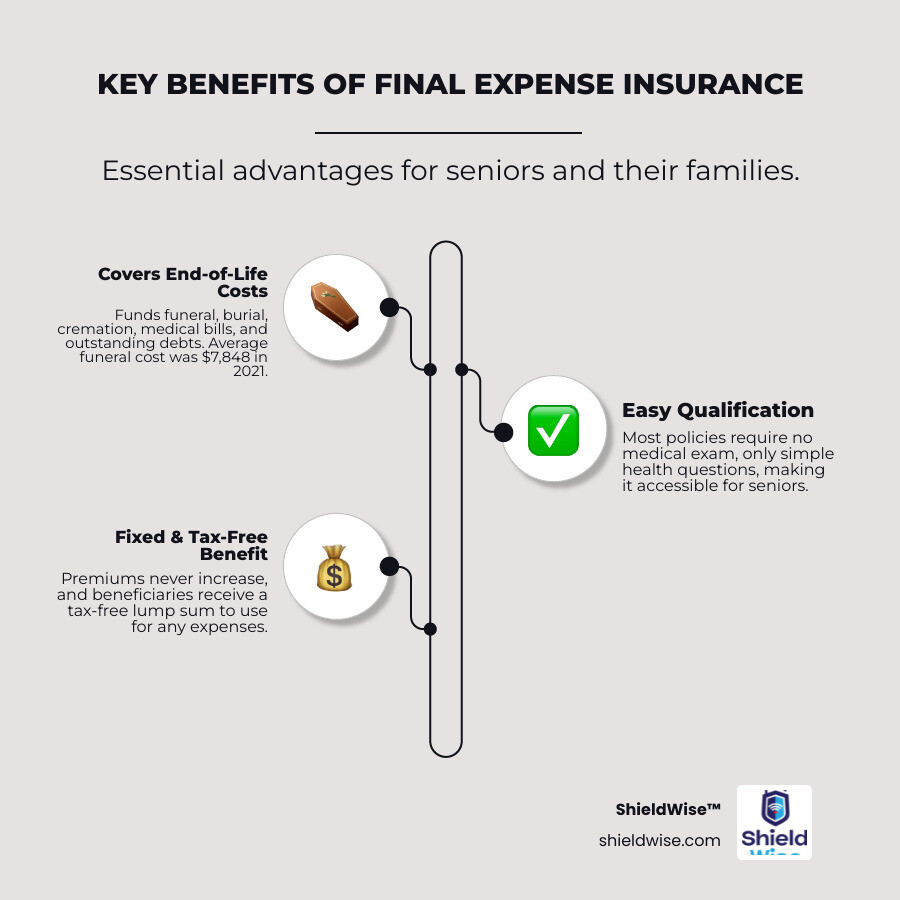
The median cost of a funeral with viewing and burial was $7,848 in 2021—and that’s before adding a vault (which brings it to $9,420), paying off medical bills, or covering other end-of-life expenses. For many families, these costs come as an unwelcome surprise at the worst possible time.
Final expense insurance helps seniors ensure their families won’t be stuck with these bills. It’s specifically designed for older adults who want simple, affordable coverage without the hassle of medical exams or complicated applications. Whether you’re a senior planning ahead or an adult child helping your parents get their affairs in order, understanding how final expense insurance works can bring real peace of mind.
This guide will walk you through everything you need to know—from how these policies work and what they cover, to costs, application processes, and how to choose the right coverage for your family’s needs.
What Is Final Expense Insurance and How Does It Differ from Traditional Life Insurance?
At ShieldWise, we understand that navigating insurance can sometimes feel like trying to solve a Rubik’s Cube blindfolded. But when it comes to final expense insurance for seniors, our goal is to simplify things. So, let’s start with the basics.
Final expense insurance, often referred to as burial insurance or funeral insurance, is a type of whole life insurance policy specifically designed to cover end-of-life costs. Unlike term life insurance that covers you for a specific period, final expense is permanent, meaning it lasts your entire life as long as premiums are paid. It’s built to provide a smaller death benefit, typically ranging from $2,000 to $50,000, making it an affordable option for many seniors.
One of its most appealing features for seniors is the simplified underwriting process. Many policies are “simplified issue,” requiring you to answer just a few health questions, but no medical exam is needed. For those with more significant health challenges, “guaranteed issue” policies might be available, which ask no health questions at all, guaranteeing acceptance. This accessibility is a huge relief for older adults who might have been turned down for traditional life insurance due to age or health.
Like other whole life policies, final expense insurance can accumulate cash value over time. This cash value grows tax-deferred and can be borrowed against or withdrawn in certain circumstances. Premiums for final expense policies are typically fixed, meaning they won’t increase as you get older, providing predictable costs for budgeting. You can learn more about this type of coverage on our More info about What is Burial Insurance page.
Final Expense vs. Traditional Life Insurance
The primary distinction between final expense insurance and traditional life insurance lies in their purpose and structure.
Traditional life insurance, such as term life or universal life (like More info about How Does IUL Work), is generally designed for larger financial needs. This could include replacing lost income for dependents, paying off a mortgage, funding a child’s education, or leaving a substantial inheritance. These policies often come with higher coverage amounts, sometimes in the hundreds of thousands or even millions of dollars. The underwriting process for traditional life insurance is usually more rigorous, often requiring a full medical exam, blood tests, and detailed health questionnaires.
Final expense insurance, on the other hand, is specifically custom to cover the immediate financial burdens that arise after a death. Its purpose is not income replacement, but rather to alleviate the costs associated with funeral arrangements, medical bills, and other smaller outstanding debts. Because the death benefits are smaller, the application process is streamlined, and premiums are generally more affordable on a monthly basis, though the cost per $1,000 of coverage might be higher than a very large traditional policy. For seniors, especially those on a fixed income or with pre-existing health conditions, this makes final expense a much more accessible and practical solution for end-of-life planning.
How the Death Benefit Works
When a final expense policyholder passes away, the death benefit is paid directly to the named beneficiary (or beneficiaries) in a lump sum. A key advantage here is that these benefits are generally paid out tax-free.
Unlike some pre-need funeral plans where the money goes directly to a funeral home, the beneficiary of a final expense policy has complete control over how the funds are used. This flexibility is crucial because it allows your loved ones to address immediate financial needs, whether it’s covering funeral costs, settling medical bills, or simply providing financial breathing room during a difficult time. The funds aren’t restricted to just funeral expenses, offering a safety net for whatever your family needs most.
A Guide to Final Expense Insurance for Seniors: Costs, Coverage, and Benefits

When we talk about end-of-life planning, one of the first things that comes to mind is the cost. And for good reason! Funeral expenses have been steadily climbing. According to 2021 data from the National Funeral Directors Association, the median cost of a funeral with a viewing and burial was approximately $7,848. If you add a vault, that number jumps to $9,420. And these figures don’t even include extras like flowers, death certificates, or the cost of a grave marker. Our More info about End of Life Expenses page offers more insights into these costs.
This is where final expense insurance for seniors steps in. These policies typically offer coverage amounts ranging from $2,000 to $50,000, designed to match the realistic costs of a funeral and other immediate post-death expenses. This range allows seniors to choose a benefit that aligns with their wishes without over-insuring or under-insuring.
What Specific Expenses Can Be Covered?
The beauty of final expense insurance is its versatility. While it’s often called “burial insurance,” the death benefit isn’t exclusively tied to funeral costs. Your beneficiaries receive a cash payout and can use it for a variety of needs. Here’s a list of specific expenses that final expense insurance can cover:
- Funeral and burial costs: This includes the funeral director’s services, embalming, viewing, ceremony, casket, transportation, and grave site.
- Cremation services: If you prefer cremation, the policy can cover the cremation fee, urn, and any associated memorial services.
- Medical bills: Many seniors pass away with outstanding medical bills, hospice care costs, or other end-of-life healthcare expenses that Medicare or private insurance may not fully cover. Final expense insurance can help settle these.
- Legal fees: The process of settling an estate can involve legal and accounting fees. The death benefit can help beneficiaries cover these.
- Outstanding debts: Many Americans die with some form of debt. In 2021, 73% of American consumers died in debt, with an average total balance of roughly $61,554 (including mortgages). Final expense funds can be used to pay off credit card balances, personal loans, or even a small portion of a mortgage or auto loan, preventing your loved ones from inheriting these burdens.
- Travel for family: Sometimes, family members need to travel a significant distance to attend a funeral. The death benefit can help cover these travel costs.
- Daily living expenses: The payout can also provide a financial cushion for a surviving spouse or family members, helping them with immediate living expenses while they adjust to the loss.
The Main Benefits of Final Expense Insurance for Seniors
The advantages of purchasing final expense insurance for seniors are numerous, especially for older adults and their families.
- Peace of mind: This is arguably the biggest benefit. Knowing that your final arrangements are financially covered provides immense peace of mind for both you and your loved ones. It removes the stress of unexpected costs during an already difficult time.
- Protects family savings: Without final expense insurance, your family might have to dip into their savings, go into debt, or even start a GoFundMe campaign to cover costs. This policy protects their financial stability.
- Easy qualification: As mentioned, most policies require no medical exam, just a few health questions. This makes it much easier for seniors, even those with pre-existing conditions, to qualify for coverage. We often see approvals within days, sometimes even instantly.
- Fixed, affordable premiums: Once your policy is approved, your premiums are locked in and will never increase, regardless of age or health changes. This allows for predictable budgeting on a fixed income.
- Lifelong coverage: As a whole life policy, final expense insurance stays in force for your entire life, as long as premiums are paid. It won’t expire at a certain age, offering permanent protection.
- Cash value accumulation: Over time, your policy can build a small cash value that you can borrow against if needed.
For more detailed information on how this type of coverage can benefit seniors, explore our More info about End of Life Insurance for Seniors guide.
Understanding the Cost of Final Expense Insurance for Seniors
The cost of final expense insurance for seniors varies based on several factors, but it’s generally designed to be affordable. While the average final expense policy costs between $30-$70 a month, if you have significant health conditions or are over the age of 70, your premium will probably be higher and may cost between $70-$120 a month. Younger, healthier applicants might even find rates in the $20-$50 range.
Here are the main factors that influence your premium cost:
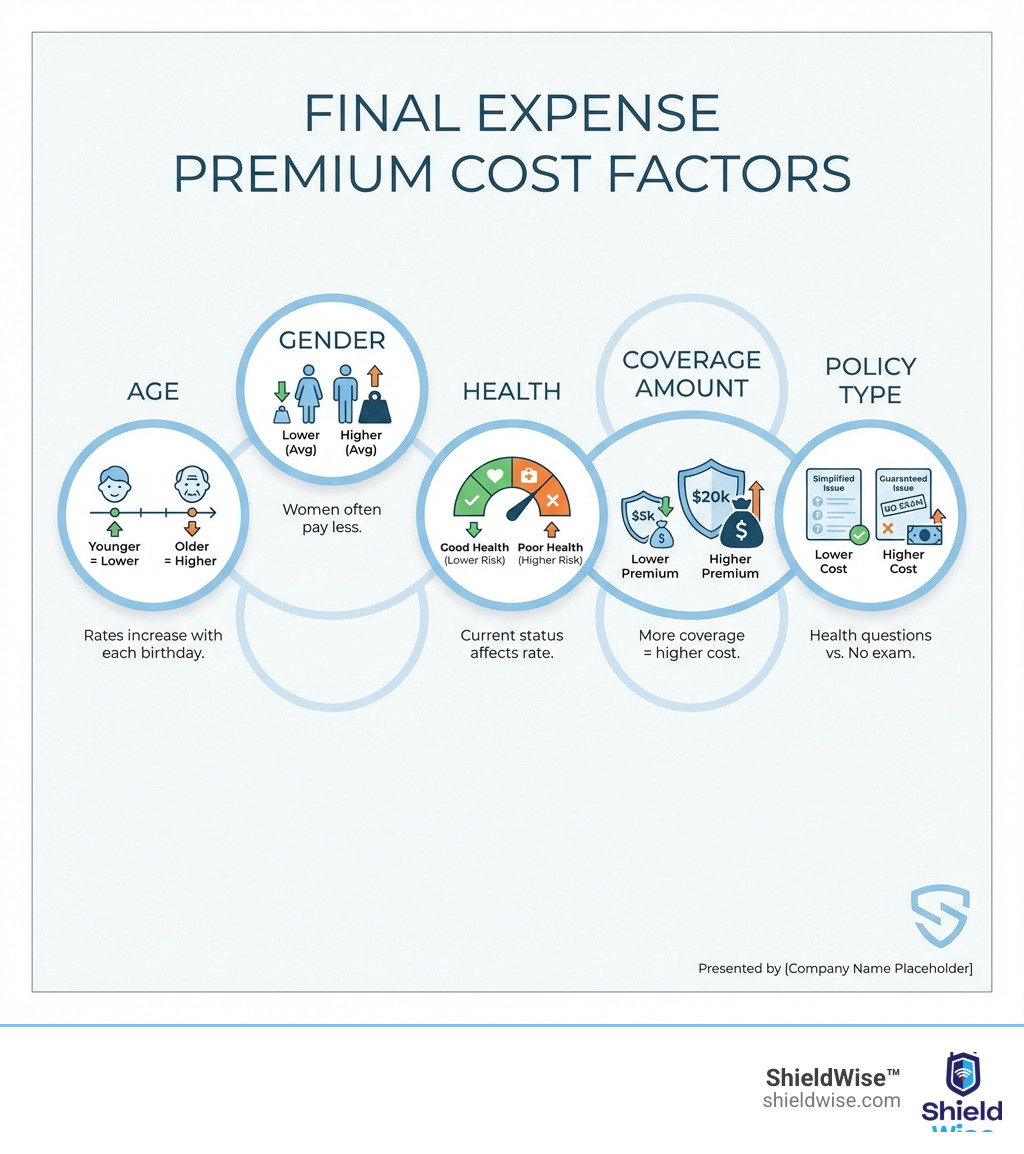
- Age factor: The younger you are when you purchase the policy, the lower your premiums will be. Rates increase with each birthday, so acting sooner rather than later can save you money over the long run.
- Gender differences: Historically, women tend to live longer than men, which often translates to slightly lower premiums for women for the same coverage amount. For example, a 75-year-old man might pay an average of $113 per month for $10,000 in coverage, while a 75-year-old woman would pay around $88 per month for the same coverage.
- Health status: Your current health plays a significant role. For simplified issue policies (no medical exam), the answers to a few health questions determine your risk level. If you have serious health conditions, you might qualify for a guaranteed issue policy, which has higher premiums but ensures acceptance.
- Tobacco use: Smokers almost always face higher premiums due to the increased health risks associated with tobacco use. These rates can be around 30% higher than non-tobacco rates.
- Coverage amount: Naturally, the more coverage you choose (e.g., $20,000 versus $5,000), the higher your monthly premium will be.
While specific quotes vary by individual and carrier, here’s a general idea of sample monthly premiums for a $10,000 policy based on averages from our research:
| Age (Years) | Gender | Sample Monthly Premium for $10,000 Coverage |
|---|---|---|
| 50-60 | Female | $25 – $40 |
| 50-60 | Male | $30 – $48 |
| 61-70 | Female | $28 – $46 |
| 61-70 | Male | $35 – $55 |
| 71-80 | Female | $40 – $65 |
| 71-80 | Male | $40 – $65 |
| 75 | Female | ~$88 |
| 75 | Male | ~$113 |
| 80 | Female | $93 – $152 |
| 80 | Male | $126 – $190 |
(These are sample averages; actual premiums will vary based on your specific health, lifestyle, and the insurance company you choose.)
The Application Process, Policy Types, and Important Considerations
One of the most attractive aspects of final expense insurance for seniors is its straightforward application process. Unlike traditional life insurance that can involve lengthy medical exams and detailed underwriting, final expense policies are designed for simplicity and speed. This means less hassle and quicker approval, providing peace of mind sooner rather than later.
The application typically involves answering a few simple health questions. Based on your answers, you’ll generally be placed into one of two main policy types:
- Simplified Issue Final Expense Insurance: This is the most common type. You’ll answer a short health questionnaire, but no medical exam is required. If you’re in reasonably good health for your age, you can often qualify for immediate coverage with no waiting period. Policies can offer up to $40,000 in coverage.
- Guaranteed Issue Final Expense Insurance: For seniors with significant health conditions who might not qualify for simplified issue, this option is a lifeline. There are no medical exams and no health questions asked – acceptance is guaranteed. However, these policies typically come with higher premiums, lower death benefits (often capped around $25,000), and usually include a “graded death benefit” or waiting period. This means that if death occurs due to natural causes within the first two or three years of the policy, the payout might be limited to a return of premiums paid plus a small amount of interest, rather than the full death benefit. Full benefits are paid immediately for accidental death.
How to Apply and Who Is an Ideal Candidate?
Applying for final expense insurance is typically a quick and easy process. With ShieldWise, you can often get instant online quotes and apply in just a few clicks. The process usually looks like this:
- Request a quote: Provide some basic information about yourself (age, gender, coverage amount desired).
- Answer simple health questions: For simplified issue policies, you’ll answer a few straightforward questions about your medical history. Be honest – discrepancies can lead to claims being denied later.
- Choose your coverage: Select the death benefit amount that best fits your needs and budget.
- Apply and get approved: Applications are often processed quickly, with many approvals happening within 24-48 hours.
So, who is the ideal candidate for final expense insurance for seniors?
- Seniors on a fixed income: The affordable and fixed premiums make it manageable for those living on Social Security or retirement pensions.
- Individuals with health conditions: Because of the simplified or guaranteed issue options, it’s accessible even if you have pre-existing health issues that would preclude you from traditional life insurance. Our More info about Life Insurance Over 85 No Medical Exam page covers options for older seniors.
- Those without significant savings: If you don’t have a large savings account earmarked for end-of-life costs, this policy ensures your family won’t face a financial strain.
- Anyone who wants to protect their loved ones: If your primary concern is to spare your family from funeral costs and other immediate expenses during their grief, final expense insurance is an excellent solution.
- Adult children buying for parents: If you’re an adult child concerned about your parents’ final expenses, this can be a practical way to ensure their needs are met.
Potential Drawbacks and Considerations
While final expense insurance for seniors offers many benefits, it’s important to be aware of its limitations and potential drawbacks:
- Smaller death benefit: Compared to traditional life insurance, the coverage amounts are modest. While sufficient for end-of-life expenses, it’s not designed for large-scale income replacement or estate planning. If you have significant debts or want to leave a large inheritance, a traditional whole or term life policy might be more appropriate (if you can qualify).
- Higher cost per dollar of coverage: Because the coverage is guaranteed or simplified, and aimed at an older demographic, the cost per $1,000 of coverage can sometimes be higher than a fully underwritten traditional policy obtained at a younger age.
- Graded benefit waiting period: For guaranteed issue policies or those with significant health issues, there’s often a waiting period (typically 2-3 years) before the full death benefit is payable for natural causes. If the insured passes away during this period, beneficiaries usually receive a refund of premiums paid plus interest. This is a crucial detail to understand before purchasing.
- Considerations for coverage needs: It’s important to accurately estimate your potential end-of-life costs. While $10,000 to $20,000 is a common range, make sure your chosen coverage amount aligns with the funeral costs in your area and any other debts you wish to cover.
We believe in transparency, and understanding these points helps you make an informed decision that truly fits your situation.
Frequently Asked Questions About Final Expense Policies
We get a lot of questions about final expense insurance for seniors, and we’re always happy to provide clear, jargon-free answers. Here are some of the most common ones:
Can I buy a final expense policy for my parents?
Yes, absolutely! Many adult children choose to purchase final expense policies for their parents. To do so, you’ll generally need to meet a few criteria:
- Insurable interest: You must demonstrate that you would suffer a financial loss if your parent passed away. This is usually easy to prove if you would be responsible for funeral costs or other debts.
- Parent’s consent: Your parent must be aware of and consent to the policy being taken out on their life.
- Application process: You’ll go through the same application process, answering health questions on their behalf (with their knowledge and input).
- Who can be the owner: You can typically be the policy owner, meaning you control the policy and pay the premiums.
- Who can be the beneficiary: You can also name yourself as the beneficiary, ensuring you receive the death benefit to cover the expenses.
This is a wonderful way to offer your parents peace of mind and protect your own finances from unexpected funeral costs.
What is the maximum age to get final expense insurance?
While age limits vary by insurer, most companies offer final expense insurance for seniors up to age 85. Some specialized carriers may even offer coverage for individuals over 85, though premiums will be significantly higher at those advanced ages. The general rule of thumb is: the older you are, the more expensive the premiums will be. This highlights the importance of applying earlier rather than later, as every birthday typically increases your premium cost.
What happens to any money left over after final expenses are paid?
This is where the flexibility of final expense insurance truly shines. The death benefit is paid as a lump sum directly to your named beneficiaries. Once they receive the funds, they have complete control over how to use any remaining money after covering the intended end-of-life expenses. There are no restrictions from the insurance company.
This means any excess proceeds can be used for:
- Living expenses: A surviving spouse might use the funds to cover daily bills or essential living costs during a period of adjustment.
- Outstanding debts: If there are other lingering debts beyond the funeral, the funds can help settle those.
- Inheritance: Many seniors appreciate the idea of leaving a small financial gift for their children or grandchildren, and any leftover funds can serve this purpose.
The key takeaway is that the money belongs to your beneficiaries, allowing them to use it in the way that best supports their needs after your passing.
How to Make the Right Choice for Your Family
Choosing the right final expense insurance for seniors is a thoughtful decision that brings significant peace of mind. We believe it’s one of the kindest gifts you can leave your loved ones.
Here’s how to make the right choice:
- Assess your needs: Start by estimating potential funeral and burial costs in your area. Consider any outstanding debts (medical, credit card, etc.) you’d like covered. This will help you determine an appropriate coverage amount.
- Compare policies: Don’t settle for the first quote you receive. Different carriers offer different rates and policy features. Look for policies with fixed premiums, lifelong coverage, and a clear understanding of any waiting periods.
- Read the fine print: Always review the policy details, especially regarding graded benefits and exclusions. We’re here to help you understand every aspect.
- Consider alternatives: While final expense insurance is often ideal for seniors, it’s worth briefly considering alternatives. Savings accounts require discipline and might be depleted by unforeseen events. Pre-paid funeral plans can tie you to a specific funeral home and services, offering less flexibility than a cash payout. Traditional life insurance might be an option if you’re in excellent health and need a very large death benefit, but final expense is often more accessible and custom for immediate end-of-life costs.
- Use a marketplace: Our ShieldWise marketplace is designed to simplify this process. We compare plans from trusted carriers, providing you with instant online quotes and clear, jargon-free guidance.
- Licensed agent support: Sometimes, you just need to talk to a human. Our licensed agents are here to help you understand your options and secure the right coverage. Feel free to reach out to us on our More info about our Contact Us page.
Protecting your family, controlling costs, and securing the right coverage in just a few clicks is what we do best.
Get your free Final Expense Insurance quote today and take the first step towards lasting peace of mind.