
Why Helping Your Parents Steer Medicare Matters
How to help parents choose a medicare plan starts with understanding that you’re not alone—millions of adult children face this challenge every year. Here’s the quick answer:
The 5 Essential Steps:
- Learn the basics – Understand Medicare Parts A, B, C, and D, plus Original Medicare vs. Medicare Advantage
- Assess their needs – List current doctors, medications, health conditions, and travel habits
- Compare total costs – Look beyond premiums to include deductibles, copays, and drug coverage
- Use official tools – Medicare.gov’s plan finder and SHIP counselors offer free, unbiased help
- Review annually – Plans change every year; review the Annual Notice of Change letter each September
The confusion is understandable—many mistake Medicare Advantage for something other than Medicare. But the stakes are high. The right choice ensures access to trusted doctors and protects their fixed income, while the wrong one can lead to surprise bills and coverage gaps. With open enrollment running just October 15 through December 7, missing deadlines can result in penalties or long waits for coverage changes. It’s easy to feel overwhelmed by the complexity, endless mailers, and sales calls.
That’s where clear guidance matters.
At ShieldWise, we’ve helped countless families steer Medicare decisions through plain-language education and regulatory expertise, specifically focused on how to help parents choose a medicare plan that fits their unique health needs and budget. Our approach cuts through sales pressure to deliver the facts you need.
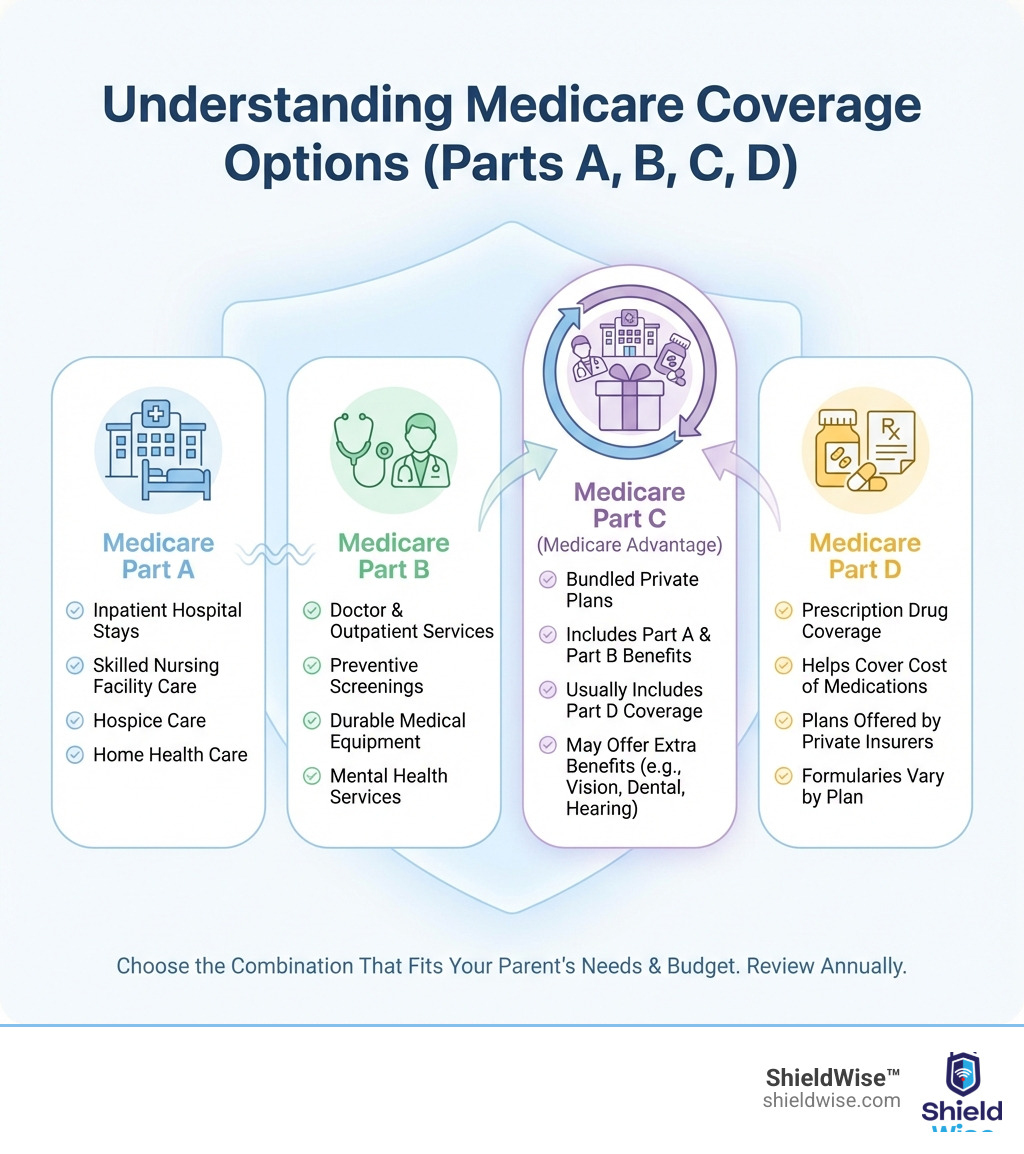
Medicare Part A covers hospital stays and skilled nursing care. Part B covers doctors and outpatient services. Part C (Medicare Advantage) bundles A, B, and usually D through private insurers. Part D covers prescription drugs. You can combine these parts seven different ways—choosing the right combination depends on your parent’s specific situation.
Understanding the Medicare Basics

Navigating Medicare can feel like solving a puzzle, but the fundamentals are straightforward. Medicare is the federal health insurance program for people 65 or older and certain younger people with disabilities. The specific coverage your parents get depends on the plan they choose from the various available options. For a deeper dive, explore our Guide to Understanding Medicare Coverage Options.
Original Medicare (Parts A & B) and Additional Coverage Choices
Original Medicare is the federal program and includes two parts:
- Part A (Hospital Insurance): Covers inpatient hospital stays, skilled nursing facility care, hospice, and some home health care. Most people get Part A premium-free if they or their spouse paid Medicare taxes for about 10 years.
- Part B (Medical Insurance): Covers doctors’ services, outpatient care, medical supplies, and preventive services. Most people pay a monthly premium for Part B (e.g., $185 in 2025), often deducted from Social Security.
Together, Parts A and B are Original Medicare. This allows your parents to see any doctor or hospital that accepts Medicare without referrals, offering great flexibility. However, Original Medicare has significant gaps: it doesn’t cover prescription drugs, routine dental, vision, or hearing services, and has no annual out-of-pocket maximum.
To fill these gaps, your parents can:
- Add a standalone Medicare Part D Prescription Drug Plan.
- Add a Medicare Supplement Insurance (Medigap) policy to help pay for out-of-pocket costs like deductibles and coinsurance.
- Choose a Medicare Advantage Plan (Part C) as an all-in-one alternative. Offered by private insurers, these plans bundle Parts A, B, and usually D, often with extra benefits like dental and vision. These plans typically use provider networks (HMOs or PPOs) and have an annual out-of-pocket maximum. For a complete understanding, refer to our Medicare Advantage Plans Complete Guide.
Here’s a simplified table comparing some common Medicare coverage combinations:
| Feature | Original Medicare (A+B) | Original Medicare (A+B) + Part D + Medigap | Medicare Advantage (Part C) |
|---|---|---|---|
| Coverage | Hospital, Medical | Hospital, Medical, Drugs, Cost-sharing | Hospital, Medical, Drugs, often Extras |
| Prescription Drugs | No | Yes (via Part D) | Yes (usually bundled) |
| Dental/Vision/Hearing | No | No (unless separate plan) | Often Yes (bundled) |
| Provider Access | Any Medicare-accepting | Any Medicare-accepting | Network-based (HMO/PPO) |
| Referrals | No | No | Often Required (HMO) |
| Out-of-Pocket Max | No | Yes (via Medigap, effectively) | Yes (plan specific) |
| Premiums | Part B only | Part B + Part D + Medigap | Often lower, some $0 |
| Flexibility | High | High | Moderate (network limits) |
Filling the Gaps: Supplemental Coverage and Prescription Drug Plans
Original Medicare’s coverage gaps make supplemental plans a crucial consideration when you how to help parents choose a medicare plan.
Medicare Supplement Insurance (Medigap)
Sold by private companies, Medigap policies help pay for out-of-pocket costs that Original Medicare doesn’t cover, like copayments and deductibles. For example, a Medigap policy can cover the 20% coinsurance for doctor services that Original Medicare leaves for your parent to pay. These policies are standardized by letter (e.g., Plan G), so benefits are the same across insurers, making it easier to compare prices. Medigap only works with Original Medicare. For a comprehensive guide, check out our Medicare Supplement and Medigap page.
Medicare Part D Prescription Drug Plans
Since Original Medicare doesn’t cover prescriptions, a Part D plan is essential for most seniors. These are offered by private insurers as a standalone plan or included with a Medicare Advantage plan. Each Part D plan has a drug formulary—a list of covered medications. It is critical to check this list to ensure your parents’ prescriptions are covered at an affordable cost, as formularies change annually. For more details, visit How Does Medicare Part D Work?.
How to Help Parents Choose a Medicare Plan: A Step-by-Step Process

Choosing the right Medicare plan is a personal decision, not a one-size-fits-all solution. Follow these actionable steps to find the perfect match for your parents’ needs. For more insights, our Medicare for Caregivers and Adult Children guide can be invaluable.
Step 1: Assess Your Parent’s Health Needs and Preferences
This is the most important step in how to help parents choose a medicare plan. Get a clear picture of their healthcare needs.
- Health Status & Chronic Conditions: Note any chronic illnesses (e.g., diabetes, heart disease) or anticipated surgeries.
- Preferred Doctors & Hospitals: List their preferred providers. Ensure they are in-network for Medicare Advantage plans or accept Medicare for Original Medicare.
- Prescription Drug List: Create a complete, up-to-date list of all their medications, including dosages.
- Travel Habits: Consider if they travel often. Original Medicare with Medigap offers broader out-of-state coverage than many Medicare Advantage plans.
Step 2: Compare Total Costs
Don’t just look at the monthly premium. To understand the true financial impact, you must compare the total costs of different plans. This includes:
- Premiums: The monthly payment for the plan.
- Deductibles: The amount paid before insurance kicks in.
- Copayments: A fixed amount paid for a service (e.g., $20 for a doctor’s visit).
- Coinsurance: A percentage of the cost of a service (e.g., 20% of the bill).
- Out-of-Pocket Maximums: An annual cap on what your parents will pay for medical services. Medicare Advantage plans have this limit; Original Medicare does not.
Drug Formulary Check: Use your parent’s prescription list to check the formulary of every potential plan. Verify their drugs are covered at an affordable cost tier and check for any restrictions. A plan that doesn’t cover their essential medications is not the right fit. Our Medicare Out-of-Pocket Costs Guide offers more detailed insights.
Step 3: Use Comparison Tools
With a clear understanding of your parents’ needs and costs, use available tools to simplify how you how to help parents choose a medicare plan.
- Medicare.gov Plan Finder: This official government tool lets you enter your parents’ ZIP code, prescriptions, and pharmacies to compare available Medicare Advantage and Part D plans. It provides cost estimates and quality ratings.
- Star Ratings: Medicare uses a 1-to-5-star rating system to measure the quality of Medicare Advantage and Part D plans. A higher rating generally indicates better performance and member satisfaction.
- Comparing Plans Side-by-Side: Evaluate plans based on your parent’s specific needs. The goal is to find a plan that includes their doctors and drugs at an affordable cost, with benefits that match their lifestyle.
Medicare.gov is a primary, unbiased resource with 24/7 support at 1-800-MEDICARE. You can find many Helpful tools – Medicare on their website. For specific guidance on evaluating options, our Compare Medicare Advantage Plans resource can further assist you.
Navigating Enrollment Periods and Annual Reviews
Understanding Medicare enrollment periods is critical to avoid coverage delays and penalties. Missing these windows of opportunity can make it harder to how to help parents choose a medicare plan effectively.
Key Medicare Enrollment Periods
- Initial Enrollment Period (IEP): This is the main 7-month window to sign up for Medicare around their 65th birthday (3 months before, the birthday month, and 3 months after). Enrolling early ensures coverage starts on time. Missing this window without other qualifying coverage can lead to a permanent late enrollment penalty for Part B.
- Special Enrollment Period (SEP): Certain life events, like losing employer health coverage or moving, trigger an SEP, allowing your parents to make changes outside of the standard periods.
- General Enrollment Period (GEP): For those who missed their IEP and don’t qualify for an SEP, the GEP runs from January 1 to March 31 each year. Coverage starts the month after signing up, but late enrollment penalties for Part B often apply.
- Open Enrollment (Annual Enrollment Period – AEP): Running from October 15 to December 7 each year, this is the time for anyone on Medicare to switch plans. During AEP, your parents can switch between Original Medicare and Medicare Advantage, change their Advantage plan, or change their Part D plan. Changes take effect January 1.
Missing deadlines can lead to coverage gaps or lifelong penalties. For more details, check out our guide on How to Sign Up for Medicare.
The Importance of the Annual Review
Even if your parents are happy with their plan, an annual review during Open Enrollment is essential because plans change every year.
- Annual Notice of Change (ANOC): In September, your parents will receive an ANOC letter from their Medicare Advantage or Part D plan. This document details all upcoming changes to costs, benefits, provider networks, and the drug formulary.
Reviewing the ANOC is vital to ensure the plan still meets their health and financial needs. A preferred doctor might leave the network, or a key drug could become more expensive. If the plan is still a good fit after reviewing the ANOC, no action is needed. If not, Open Enrollment is the time to find a better one.
Finding Unbiased Help and Financial Assistance
The sheer volume of Medicare information can be overwhelming. Fortunately, reliable, unbiased resources are available to help you how to help parents choose a medicare plan and find financial assistance.
Where to Get Personalized, Free Guidance
- State Health Insurance Assistance Program (SHIP): SHIPs are free, government-funded programs in every state that provide unbiased, personalized counseling to Medicare beneficiaries. Counselors are not affiliated with any insurance company and can help with plan comparisons, billing issues, and more. For those in Illinois, the Illinois Department on Aging offers SHIP services. You can find your local office via the national directory at Contact your local State Health Insurance Assistance Program (SHIP).
- Licensed Insurance Agents: An independent licensed agent (like us at ShieldWise) can be a valuable resource. They can help you compare plans from various carriers, explain the differences between plan types, and assist with enrollment. A good agent provides clear, jargon-free guidance customized to your parents’ needs, helping you cut through the noise of marketing materials.
- 1-800-MEDICARE: For direct assistance from the federal program, call 1-800-MEDICARE (1-800-633-4227). This service is available 24/7 and can answer questions and help with plan comparisons.
For finding local resources and support, our Medicare Local and Near Me page can point you in the right direction.
Programs to Help with Medicare Costs
Many people qualify for programs that help with Medicare costs, significantly reducing their financial burden.
- Medicare Savings Programs (MSPs): These state-run programs help people with limited income pay for Medicare premiums and cost-sharing. Qualifying can save hundreds or thousands of dollars annually.
- Extra Help (Low-Income Subsidy): This federal program helps people with limited income pay for Medicare Part D prescription drug costs (premiums, deductibles, coinsurance). Qualifying for Extra Help significantly lowers out-of-pocket drug expenses.
- State Pharmaceutical Assistance Programs (SPAPs): Some states have their own programs to help residents pay for prescription drugs. It’s worth checking if your parents’ state offers a program they might qualify for.
To learn more about these programs, visit Medicare.gov/basics/costs/help. Our Best Insurance Options for Seniors on Medicare and Fixed Income also provides valuable information on financial assistance.
Important Considerations and Protecting Your Parents
Beyond choosing a plan, understand how Medicare works with other insurance and how to protect your parents from fraud.
Coordinating Medicare with Other Insurance
If your parents have other health insurance, it’s crucial to understand the “coordination of benefits” to know which plan pays first (primary) and which pays second (secondary).
- Working Past 65 with Employer Coverage: How Medicare works with an employer plan depends on the size of the company. For companies with 20+ employees, the employer plan is primary. For smaller companies, Medicare is primary. It’s crucial to know that once enrolled in Medicare, contributions to a Health Savings Account (HSA) must stop.
- Retiree Health Coverage: If your parents have retiree coverage from a former employer, Medicare generally pays first.
- Medicaid: For those with both Medicare and Medicaid, Medicare pays first, and Medicaid pays second, often covering Medicare costs.
- TRICARE: For military retirees with TRICARE, Medicare pays first.
Always contact the other insurance provider to confirm the specific coordination rules.
Protecting Parents from Fraud and Appealing Decisions
Medicare fraud is a persistent issue. Protecting your parents and knowing their rights is a key part of managing their healthcare.
- Medicare Fraud Prevention:
- Guard their Medicare number: Treat it like a credit card number. Only share it with trusted doctors, pharmacists, and health providers.
- Be wary of unsolicited calls: Scammers often pose as Medicare representatives to steal personal information. Medicare will rarely call beneficiaries.
- Review Medicare Summary Notices (MSNs): Check these statements for services or equipment they didn’t receive.
- Report suspicious activity: Report suspected fraud to 1-800-MEDICARE.
- Appealing a Coverage Denial: If a plan denies coverage for a service your parents need, you have the right to appeal. The process involves understanding the reason for denial (provided in writing by the plan), gathering supporting medical documents, and following the plan’s formal appeals process. This can escalate to an independent review if necessary. SHIP counselors and 1-800-MEDICARE can guide you through the steps.
If you need to speak with insurance carriers on your parent’s behalf, you may need to complete an Authorization to Disclose Personal Health Information Release Form to legally represent them.
Conclusion
Navigating the complexities of Medicare for your parents can feel like a daunting task, but it doesn’t have to be. By understanding the basics, assessing their unique needs, comparing total costs, utilizing available tools, and staying on top of enrollment periods, you can confidently how to help parents choose a medicare plan that provides optimal care and financial security.
Remember these key takeaways:
- Medicare is personal: There’s no single “best” plan. The ideal choice depends entirely on your parents’ health, budget, and lifestyle.
- Look beyond premiums: Always consider deductibles, copayments, coinsurance, and out-of-pocket maximums for a true picture of a plan’s cost.
- Formularies are critical: Ensure all prescription drugs are covered at an affordable cost in any chosen plan.
- Review annually: Plans change. The Annual Notice of Change (ANOC) is your yearly checklist to confirm their plan still meets their needs.
- Don’t go it alone: Use free, unbiased resources like SHIP and the Medicare.gov Plan Finder, and don’t hesitate to consult licensed insurance agents like us at ShieldWise.
Your proactive planning and support can make a profound difference in your parents’ healthcare journey. At ShieldWise, we believe in empowering families with clear, jargon-free guidance. We’re here to help you compare plans from trusted carriers, get instant online quotes, and secure the right coverage for your loved ones.
Secure the right end-of-life insurance for your senior parents