
Why Final Expense Coverage Amounts for Seniors Matter More Than Most People Realize
Final expense coverage amounts for seniors typically range from $5,000 to $25,000, designed to cover funeral costs, outstanding debts, and other end-of-life expenses without burdening family members.
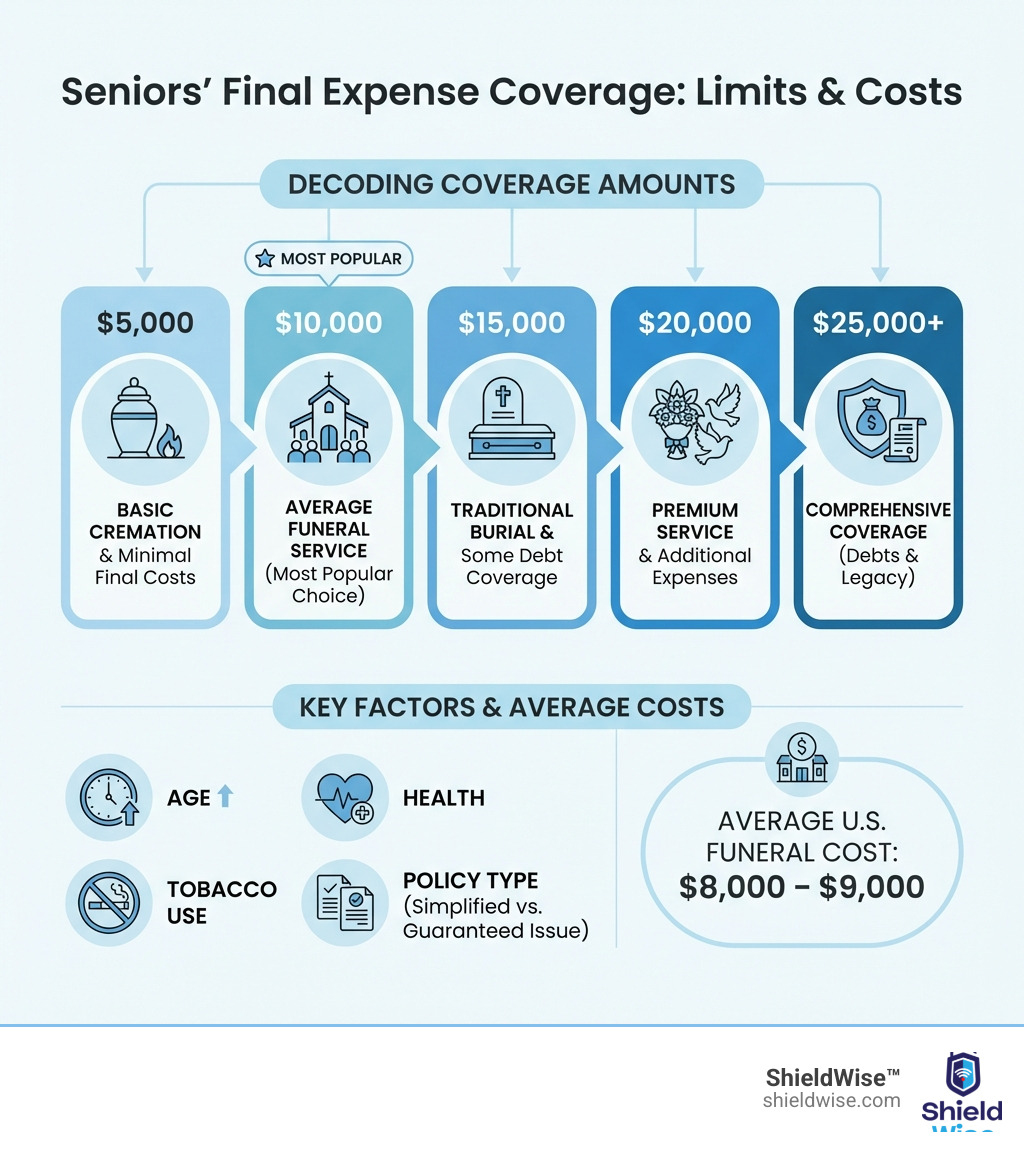
Here’s a quick breakdown of the most common coverage amounts and what they’re typically used for:
| Coverage Amount | Best For |
|---|---|
| $5,000 | Basic cremation and minimal final costs |
| $10,000 | Average funeral service (most popular choice) |
| $15,000 | Traditional burial with some debt coverage |
| $20,000 | Premium service plus additional expenses |
| $25,000+ | Comprehensive coverage including outstanding debts and small legacy |
Quick answer: Most seniors choose between $10,000 and $25,000 in coverage. With the average U.S. funeral running around $8,000–$9,000, a $10,000 policy covers the basics, while $15,000–$25,000 gives your family breathing room for medical bills, debts, and other costs.
Planning for the end of life isn’t easy to think about. But for millions of seniors on fixed incomes, one question keeps coming up: “If something happens to me, will my family be stuck with the bill?”
The answer depends heavily on how much coverage you choose — and that number isn’t the same for everyone. Your age, where you live, the type of service you want, and any debts you’re carrying all affect how much protection actually makes sense. Choose too little and your family may scramble to cover the gap. Choose too much and you’re paying more than your budget can handle every single month.
This guide cuts through the confusion so you can make a confident, informed decision — no jargon, no pressure.
At ShieldWise, our team has spent years helping older adults and their families evaluate final expense coverage amounts for seniors across a wide range of budgets, health situations, and personal goals. We’ll walk you through everything you need to know to find the right fit.
Similar topics to final expense coverage amounts for seniors:
How to Choose the Right Final Expense Coverage Amounts for Seniors

When we talk about final expense insurance, we are essentially looking at a specialized type of small whole life insurance. Unlike traditional life insurance, which might offer hundreds of thousands of dollars to replace a career’s worth of income, these policies are laser-focused on the immediate “final” costs.
Most carriers offer a coverage range starting as low as $2,000 or $3,000 and capping out around $25,000 to $50,000. Because it is a whole life product, it offers permanent protection. As long as you pay your premiums, the policy will never expire, and the death benefit is guaranteed.
The payout is a tax-free lump sum sent directly to your chosen beneficiary. They can use that money for anything—there are no “funeral police” checking receipts. This flexibility is vital because end-of-life costs often involve more than just a casket and a plot.
| Coverage Level | Estimated Purpose | Why Seniors Choose It |
|---|---|---|
| $5,000 | Direct Cremation | Ideal for those who want a simple, low-cost “no-fuss” departure. |
| $10,000 | Standard Funeral | Covers the median cost of a viewing, ceremony, and burial. |
| $25,000 | Comprehensive | Covers a premium service plus remaining medical bills or credit card debt. |
Determining the Right Final Expense Coverage Amounts for Seniors Based on Need
To pick the right number, we have to look at the cold, hard math of what things cost today. According to the National Funeral Directors Association – Statistics, the national median cost of a funeral with a viewing and burial was approximately $7,848 in recent years. If you add a vault (which most cemeteries require), that number jumps closer to $9,135.
However, what are final expenses exactly? It’s a broader category than many realize. When determining your coverage, consider these four pillars:
- The Service: Are you planning a traditional burial or a cremation? Cremation is generally more affordable, often costing between $1,000 and $4,000, while traditional burials rarely cost less than $7,000.
- Medical Bills: Even with Medicare, the final weeks of life can result in significant out-of-pocket costs. Many seniors add $5,000 to their coverage just to ensure their children aren’t stuck with hospital or hospice balances.
- Outstanding Debts: Did you know that over 75% of seniors carry some form of debt? Small credit card balances or personal loans don’t disappear when you do. They are settled by your estate, which can reduce the inheritance you leave behind unless you have insurance to cover them.
- Administrative Costs: Probate, legal fees, and even travel expenses for family members flying into Illinois for the service can add up. A little extra cushion in the death benefit goes a long way.
Calculating Your Ideal Final Expense Coverage Amounts for Seniors
We recommend a simple “Plus-Two” strategy for calculating your needs. Start with the estimated cost of your preferred service (e.g., $9,000 for a burial) and add $2,000 for “unseen” end-of-life expenses.
Ask yourself these questions:
- Do I have existing savings? If you have $5,000 in a dedicated account, you might only need a $5,000 or $10,000 policy to bridge the gap.
- What are my household expenses? If a surviving spouse will lose a portion of Social Security income when you pass, a slightly higher coverage amount can act as a “bridge” for their first few months of solo living.
- What is my legacy goal? Some of our clients choose a $25,000 policy specifically because they want $10,000 for the funeral and $5,000 to go to each of their three grandchildren.
Factors That Influence Coverage Limits and Monthly Premiums
Your monthly premium is determined by a few key factors. The good news is that once you sign the paperwork, your premiums are fixed for life. They will never go up, even if you live to be 100.
- Age: This is the biggest driver of cost. A 60-year-old female might pay $55 a month for $10,000 in coverage, while an 80-year-old might pay $145 for the same amount. The younger you are when you lock in your rate, the more you save over time.
- Gender: Statistically, women live about five years longer than men. Because of this, insurance companies generally charge women 25-30% less than men for the same final expense coverage amounts for seniors.
- Tobacco Use: This is a major factor. Tobacco users (including those who vape or use pipes) can pay 40-60% more in premiums. If you’ve been tobacco-free for at least 12 months, you can qualify for much lower “non-tobacco” rates.
- Health Classification: Most policies use “underwriting classes” like Preferred, Standard, or Modified. If you are in relatively good health, you qualify for Preferred rates, which offer the lowest premiums and the highest available coverage limits (up to $50,000 with some carriers).
For a deeper dive into pricing, check out our guide on final expense cost and quotes.
Simplified Issue vs. Guaranteed Issue Coverage Limits
Understanding how you qualify is just as important as the amount you choose. There are two main paths:
1. Simplified Issue: This is the most common type. You answer a few health questions, but there is no medical exam (no needles, no scales). Because the insurance company takes on slightly less risk, these policies often have no waiting period—meaning you are covered from day one. Coverage limits are usually higher here, often up to $25,000 or $35,000.
2. Guaranteed Issue: This is for seniors with more serious health concerns. There are zero health questions. If you are within the age range (usually 50-85), you are accepted. However, because the risk is higher, these policies often have a “two-year clause” or graded death benefit. If you pass away from natural causes within the first two years, your family receives the premiums you paid plus a small amount of interest (usually 10%). After two years, the full benefit is active. Coverage limits for guaranteed issue are typically lower, often capped at $15,000 or $25,000.
You can learn more about how your health history impacts your options in our final expense health eligibility guide.
Special Policy Features and Riders to Consider
When selecting your final expense coverage amounts for seniors, look for “riders”—these are like optional add-ons that can significantly increase the value of your policy.
- Accidental Death Triple Payout: Some policies include a feature where the payout triples if the death is accidental. For a $10,000 policy, your family could receive $30,000. This provides a massive financial cushion for unexpected tragedies.
- Early Cash-Out (Age 85): Certain policies allow you to “cash out” a portion of your benefit (often 75%) once you reach age 85. If you find you no longer need the full insurance amount, you can take the cash to enjoy your later years.
- Premium Stops (Age 90): We love this feature for seniors on a budget. Some carriers allow you to stop paying premiums once you hit age 90, but your coverage stays in force for the rest of your life.
- Accelerated Death Benefit: This allows you to access a portion of your death benefit while you are still alive if you are diagnosed with a terminal illness. This money can be used to pay for experimental treatments or simply to make your final months more comfortable.
For a full breakdown of these features, see our burial insurance complete guide.
Frequently Asked Questions about Final Expense Insurance
What is the most common coverage amount for seniors?
The most popular choice is $10,000. This amount closely mirrors the average cost of a traditional funeral in the U.S. It provides enough to cover the service, the casket, and basic cemetery fees without leaving much debt behind. It is often the “sweet spot” for seniors who want protection that fits into a monthly budget of $50–$80.
Does the coverage amount decrease as I get older?
No. Because these are whole life policies, the death benefit is “level.” This means if you buy a $15,000 policy at age 65, it will still be a $15,000 policy when you are 95. The amount is guaranteed and will never decrease, regardless of changes in your health or the economy.
Can the payout be used for things other than a funeral?
Absolutely. The beneficiary receives a check and has full discretion. They can use it for your funeral, but they can also use it to pay off your credit cards, settle a remaining car loan, pay for their own travel to the service, or even donate it to a charity in your name.
Conclusion
At the end of the day, choosing the right final expense coverage amounts for seniors is about more than just numbers on a page—it’s about the legacy of care you leave behind. It’s the comfort of knowing that on your family’s hardest day, they won’t have to worry about how to pay for your goodbye.
At ShieldWise, we make this process simple. Our digital marketplace allows you to compare plans from trusted carriers in Illinois and beyond, giving you instant online quotes and jargon-free guidance. Whether you need a basic $5,000 policy or a comprehensive $25,000 plan, we help you secure the right coverage in just a few clicks.
Don’t leave your family’s financial future to chance. Secure your final expense coverage today and gain the peace of mind you deserve.