
Why Traditional College Savings May Not Be Enough
IUL policy for children education planning offers a flexible alternative to 529 plans by combining tax-advantaged cash value growth with permanent life insurance protection. Unlike traditional college savings accounts, an IUL allows families to access funds for any purpose without penalties, provides downside protection through guaranteed minimum interest rates (typically 0%), and doesn’t count as a student asset on the FAFSA—potentially preserving financial aid eligibility.
Quick answer for parents researching IUL for college:
- What it is: A permanent life insurance policy that builds cash value linked to market indexes (like the S&P 500) while protecting against losses
- How it works for education: Cash value grows tax-deferred and can be accessed through tax-free policy loans to pay for tuition, room and board, or other expenses
- Key advantage over 529s: No restrictions on how funds are used, no penalties for non-education expenses, and generally not counted on financial aid forms
- Who benefits most: Families seeking flexibility beyond just college costs, those who’ve maxed out other savings vehicles, or parents wanting to guarantee their child’s future insurability
College costs continue climbing faster than inflation. The average annual cost for a four-year private college now exceeds $50,000, and many families find themselves caught between saving too little and locking funds into rigid 529 plans that penalize non-education withdrawals.
An IUL policy for children education planning addresses this challenge by functioning as both a safety net and a growth vehicle. The cash value accumulates tax-deferred based on market index performance—but with a floor that protects against losses during market downturns. This means your child’s education fund benefits from market gains without the full risk of market losses.
Beyond college, the policy provides lifelong coverage at rates locked in during childhood, creating a financial foundation that can support other major life goals like a first home down payment or even retirement planning.
At ShieldWise, we guide families through the complexities of IUL policy for children education planning. We help you understand how these policies complement or replace traditional strategies, providing clear, unbiased analysis so you can make informed decisions without sales pressure.
What is an IUL and How Does It Work for a Child?
An Indexed Universal Life (IUL) insurance policy is a permanent life insurance policy with a dual identity. It provides a death benefit to ensure your loved ones’ financial security. It also features a cash value component that grows over time, offering a flexible source of funds for future needs like education.
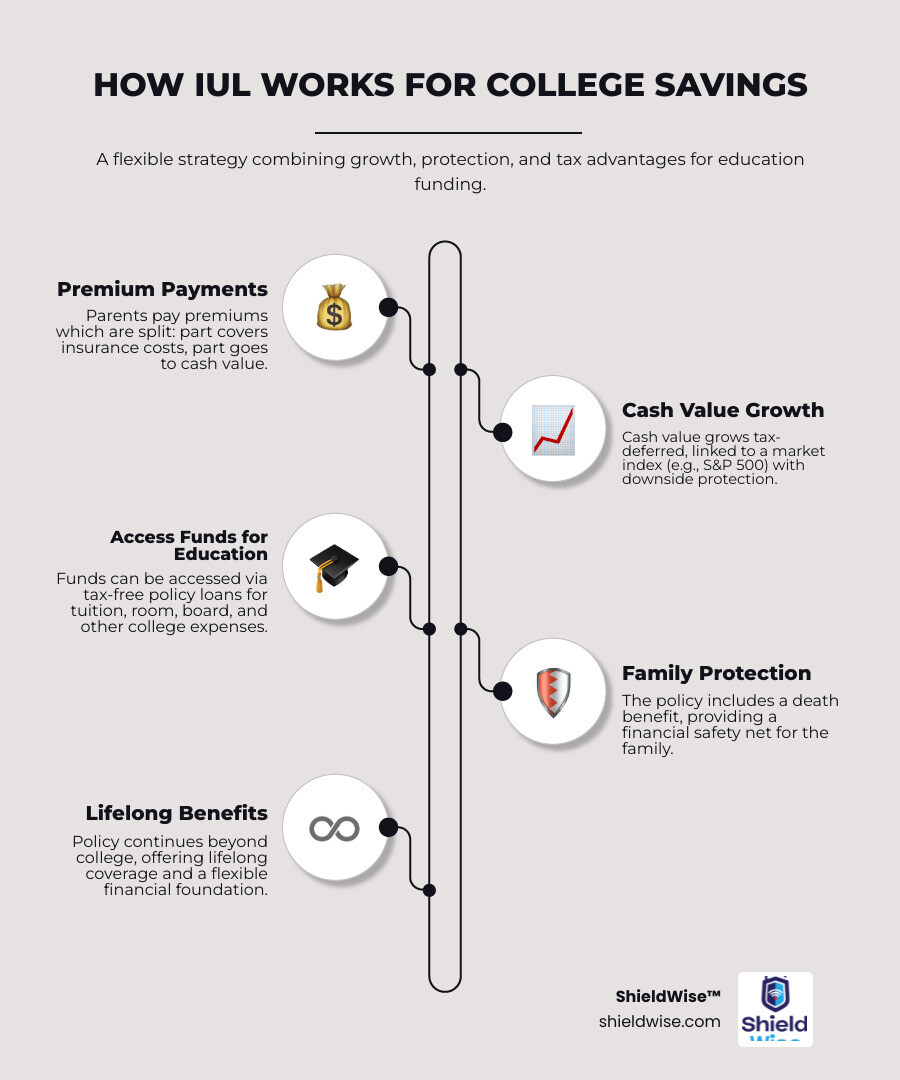
For a child, an IUL policy works by taking a portion of your premium payments and allocating it to cover the cost of insurance, while the remaining portion goes into a cash value account. This cash value account is where the magic happens for education planning. Its growth is linked to the performance of a selected stock market index, such as the S&P 500. What makes it unique is that it typically includes a “floor” (often 0%) that protects your cash value from market losses and a “cap” that limits the maximum gains. This means you can participate in market upsides without fully experiencing the downsides.
This strategic approach to an IUL policy for children education planning can help provide your child with a debt-free start to adult life. To dive deeper, explore our guide on How Does IUL Work?.
How Cash Value Grows and is Accessed for Education
The cash value within an IUL policy grows tax-deferred, much like a 401(k) or IRA. This means you don’t pay taxes on the gains year after year, allowing your money to compound more effectively over the long term. Because children are insured at a young age, their policies have many years to accumulate significant cash value, benefiting greatly from the power of compounding. The cash value in an insurance policy is tax-deferred, which creates a lifetime savings opportunity that could be used for life needs, such as paying for college or supplementing retirement income.
When it’s time to pay for educational expenses—whether it’s tuition, fees, room and board, or books—you can access the accumulated cash value in a couple of ways:
- Policy Loans: You can take out loans against your policy’s cash value. These loans are generally tax-free, provided the policy remains in force. They don’t require credit checks and often have flexible repayment terms.
- Withdrawals: You can also make withdrawals from the cash value. Withdrawals up to the amount of premiums paid (your “basis”) are generally tax-free. However, withdrawals that exceed your basis could be taxable, and withdrawals reduce the policy’s cash value and death benefit.
Choosing policy loans for education expenses can be particularly advantageous as it allows the remaining cash value to continue growing, even while you’re accessing funds. For a comprehensive understanding of how this works, check out How Cash Value Works in Indexed Universal Life.
The Lifelong Benefits Beyond College
While IUL policy for children education planning is a fantastic goal, the benefits of an IUL extend far beyond graduation day. Because you start the policy when your child is young and healthy, you lock in incredibly low premiums for life. This secures their insurability for their entire lifetime, regardless of any future health changes or career choices. This provides them with lifelong financial protection.
Imagine your child entering adulthood with a substantial nest egg to leverage for life goals. For instance, the cash value can fund a down payment on their first home, which is a game-changer in competitive housing markets like those in Illinois.
Beyond a first home, the cash value can supplement their retirement income, provide funds for starting a business, or even serve as an emergency fund for unexpected challenges. It’s a versatile financial tool that adapts to their evolving needs throughout their life. To understand more about how universal life policies protect families, read our article on Universal Life for Families and Protection.
IUL vs. Traditional College Savings: A Head-to-Head Comparison

When securing your child’s financial future, IUL policy for children education planning and 529 plans are popular options. They both help save for education but operate differently. Understanding these differences is crucial for making an informed decision that aligns with your family’s goals. For families in Illinois, this knowledge can help steer college funding complexities, where flexibility is key.
IUL vs. 529 Plans
Let’s lay out a clear comparison between an IUL policy and a 529 plan, highlighting the key aspects where they differ:
| Feature | Indexed Universal Life (IUL) Policy | 529 Plan |
|---|---|---|
| Use of Funds | Highly flexible. Can be used for any purpose (education, down payment, retirement, emergency) without penalty. | Restricted to qualified education expenses (tuition, fees, room & board, books, supplies, K-12 tuition up to $10,000/year). Non-qualified withdrawals incur income tax + 10% penalty. |
| Tax Treatment (Growth) | Cash value grows tax-deferred. | Earnings grow tax-deferred. |
| Tax Treatment (Withdrawal) | Policy loans are generally tax-free. Withdrawals up to basis are tax-free. | Qualified withdrawals are tax-free. Non-qualified withdrawals are taxable and penalized. |
| Financial Aid Impact | Generally not considered an asset on the FAFSA, potentially preserving eligibility for need-based aid. | Considered an asset of the parent (or student if owned by student), which can reduce financial aid eligibility. |
| Contribution Limits | Flexible premium payments. Can be “max-funded” for optimal cash value growth, but must adhere to IRS guidelines to maintain tax status. | Annual contribution limits and aggregate lifetime limits vary by state (though very high). Some states offer tax deductions for contributions. |
| Risk/Growth Potential | Market-linked growth with a “floor” (e.g., 0%) protecting against losses and a “cap” limiting maximum gains. Downside protection. | Market-linked growth (investment options chosen by owner). No downside protection; full exposure to market losses. |
| Beneficiary Rules | Lifelong coverage for the insured. Policy ownership can be transferred to the child later. | Beneficiary can be changed to another qualified family member. Recent changes allow some unused funds to be rolled into a Roth IRA (subject to limits). |
| Insurance Component | Provides a death benefit to beneficiaries. | No life insurance component. |
| Creditor Protection | Often offers strong creditor protection in many states (e.g., Illinois), making cash value exempt from creditors in some cases. | Varies by state; generally protected under federal bankruptcy law for contributions made more than two years prior to filing. |
For more details on 529 plans, you can consult the 529 plans explained by the IRS.
How an IUL Impacts Financial Aid Eligibility
One of the most compelling advantages of an IUL policy for children education planning is its favorable treatment in financial aid calculations. When your child applies for college, the Free Application for Federal Student Aid (FAFSA) is the gateway to federal grants, scholarships, and loans.
The good news? The cash value of an IUL is generally not considered an asset when calculating financial aid eligibility. This is a significant advantage, as traditional savings accounts and even 529 plans are factored into these calculations. While some private colleges may ask about life insurance cash value, the FAFSA form itself does not. This means that funds set aside in an IUL for your child’s education may not impact their eligibility for need-based financial aid as much as assets held in other savings vehicles.
In contrast, the value of a 529 plan is typically considered a parent’s asset (or a student’s asset if owned by the student), which can reduce the amount of financial aid a student is eligible to receive. By using an IUL, you potentially maximize your child’s eligibility for grants and scholarships, giving them a better chance at a debt-free start to their adult life.
Key Advantages of an IUL Policy for Children Education Planning

An IUL policy for children education planning is a versatile and powerful tool for your child’s long-term financial future. It offers a unique blend of tax advantages, flexibility, and a safety net that traditional college savings plans can’t match. It empowers your child with financial freedom, not just a funded tuition bill.
The Triple Tax Advantage
One of the most attractive features of an IUL is its “triple tax advantage,” a benefit that truly sets it apart from many other savings vehicles:
- Tax-Deferred Cash Value Growth: As we discussed, the money growing within your IUL policy’s cash value component accumulates without being taxed annually. This allows for greater compounding over time, meaning your money works harder for longer.
- Tax-Free Policy Loans: When you need to access funds for education or any other purpose, you can do so through policy loans. These loans are generally tax-free, provided the policy remains in force. This means you can tap into your accumulated wealth without triggering a taxable event.
- Tax-Free Death Benefit: Should the unthinkable happen, the death benefit paid to your beneficiaries is typically tax-free. This provides an additional layer of financial protection and can leave a significant legacy for your family.
These combined tax benefits can significantly improve the overall value and efficiency of your education savings strategy. To learn more about these tax benefits, explore our detailed guide on More on IUL tax benefits.
Best Flexibility for Life’s Unknowns
Life has a funny way of throwing curveballs. Your child might decide not to go to a four-year university, pursue a trade, start a business, or travel the world. This is where the flexibility of an IUL truly shines. Unlike a 529 plan, which is limited to qualified educational expenses and imposes penalties for non-education withdrawals, an IUL policy for children education planning allows you and your child to use the funds for any purpose without an early withdrawal penalty.
This adaptability is invaluable. The cash value can be used for:
- College Expenses: Tuition, room, board, books, and even a new laptop.
- Starting a Business: Providing seed money for an entrepreneurial venture.
- A First Home Down Payment: Giving them a significant boost in a competitive housing market.
- A Wedding: Helping them celebrate a major life milestone.
- Emergency Funds: A readily accessible source of funds for unexpected challenges.
This flexibility ensures that the money you save is truly working for your child’s best interests, no matter where their path leads. It’s a living, breathing financial asset that can adapt to changing goals and unforeseen circumstances. We often see this flexibility being a huge advantage for IUL for Young Families and Parents.
The Built-In Safety Net
Beyond its growth potential and flexibility, an IUL policy provides an inherent safety net that offers profound peace of mind.
Firstly, the guaranteed death benefit ensures that if the unexpected happens to the insured child, a tax-free payout is provided to the designated beneficiaries. While we hope this is never needed, it offers a financial cushion for funeral costs and any other expenses, providing a legacy.
Secondly, many IUL policies offer living benefits riders. These are optional features that can provide financial support during the insured’s lifetime if they experience a chronic, critical, or terminal illness. For example, if your child were to face a critical illness, these riders could allow you to access a portion of the death benefit while they are still living, helping to cover medical expenses or replace lost income during a challenging time. This adds another layer of protection, ensuring that the policy can serve your family’s needs even in unforeseen health crises.
Setting Up an IUL for Your Child: A Step-by-Step Guide
Starting an IUL policy for children education planning is a significant step toward securing their financial future. The process is designed to customize the policy to your family’s needs. At ShieldWise, we guide you through each stage, making it clear and straightforward.
Requirements and Best Practices for Parents
When considering an IUL for your child, there are a few key requirements and best practices to keep in mind:
- Insurable Interest: To open a life insurance policy for a child, an “insurable interest” must exist. This means the policy owner (typically a parent or grandparent) would suffer a financial or emotional loss if the insured child were to pass away. This is usually straightforward for direct family members.
- Parent’s Own Coverage: Many insurance carriers require that the parents (or guardians) have adequate life insurance coverage on themselves before a policy can be placed on a child. A common guideline is that parents must have at least twice the death benefit on themselves as will be placed on the child. This ensures that the primary financial providers are sufficiently protected first.
- Minimum Age for a Child’s Policy: Most life insurance companies allow policies to be opened for children as young as a few days old. Starting early is a significant advantage, as it locks in the lowest possible premiums for life and maximizes the time for cash value growth.
- Structuring the Policy: For education planning, a best practice is to “max-fund” the policy with the “minimum death benefit.” This means you contribute as much as IRS guidelines allow into the cash value component while keeping the death benefit at the lowest allowable level. This strategy prioritizes cash value accumulation over the death benefit, optimizing the policy for wealth growth.
- Simplified Underwriting: Often, child IUL policies can be issued without a full medical exam, relying instead on simplified underwriting questions, making the application process smoother.
Here’s a general list of steps we’ll walk you through:
- Consult a Licensed Agent: We’ll start with a personalized consultation to understand your family’s financial goals and discuss how an IUL fits into your overall plan.
- Determine Financial Goals & Budget: We’ll help you assess how much you can comfortably contribute to the policy and what future needs you’re aiming to address.
- Complete the Application: We’ll assist with all the necessary paperwork, ensuring accuracy and compliance.
- Underwriting Process: The insurance company will review the application and health information.
- Policy Issuance & Review: Once approved, we’ll review the policy details with you to ensure everything is in order.
Choosing the Right IUL Provider and Policy
Selecting the right IUL provider and policy is a critical decision. Not all IULs are created equal, and the terms can vary significantly between carriers. We at ShieldWise are experts in comparing plans from trusted carriers to find the perfect fit for your family.
Here’s what we’ll consider:
- Financial Strength Ratings: We’ll look at the financial stability of insurance companies through independent rating agencies. A strong, reputable company ensures long-term security.
- Policy Illustrations: We’ll analyze detailed policy illustrations that project the cash value growth and death benefit over time. These are illustrations, not guarantees, but they provide a roadmap.
- Understanding Fees and Costs: IUL policies have various fees and charges. We’ll help you understand these transparently so you know how they impact your policy’s performance.
- Cap and Participation Rates: These are crucial for cash value growth. The “cap rate” is the maximum interest rate your cash value can earn, while the “participation rate” determines how much of the index’s growth your policy participates in. We’ll help you compare these rates across different policies.
- Working with a Professional: Navigating these complexities is why working with experienced professionals like us at ShieldWise is invaluable. We provide clear, jargon-free guidance to help you compare plans and make informed decisions.
Frequently Asked Questions about IUL for College
We understand that exploring a new financial strategy like an IUL policy for children education planning can bring up a lot of questions. Here are some of the most common ones we hear from families in Illinois and beyond:
What are the risks of using an IUL for education planning?
While an IUL offers many compelling benefits, it’s important to be aware of the potential risks and considerations:
- Potential for Lower-Than-Projected Returns: Policy illustrations show potential growth, but actual returns can be lower if the linked market index performs poorly (though the 0% floor protects against losses). Cap rates can also limit upside potential.
- Policy Costs and Fees: IULs have various fees, including mortality charges, administrative fees, and rider costs, which can impact cash value growth, especially in the early years. It’s crucial to understand these costs. The main considerations include the cost of premiums and the need for ongoing management to maximize benefits.
- Risk of Policy Lapse if Underfunded: If premiums are insufficient to cover the policy’s costs, or if withdrawals are too aggressive, the policy could lapse, leading to a loss of coverage and potential tax implications on prior tax-deferred growth. Proper funding and ongoing management are essential.
- Importance of Proper Management: An IUL is a long-term financial tool that requires regular review and management to ensure it stays on track with your goals.
Despite these risks, the long-term growth and flexibility often outweigh the concerns for families with a sensible budget.
Can a grandparent open an IUL for a grandchild?
Yes, grandparents can open an IUL for a grandchild. It’s an excellent way to contribute to their financial future. As long as an “insurable interest” exists, a grandparent can purchase the policy.
This strategy offers several benefits:
- Gifting Strategy: It can be an efficient way to make a significant financial gift, potentially avoiding gift taxes (within annual exclusion limits).
- Wealth Transfer: It allows for the tax-efficient transfer of wealth across generations.
- Estate Planning Benefits: It can be a valuable component of a broader estate plan, providing a legacy for the grandchild that can grow over decades.
Many grandparents appreciate the ability to provide a financial head start that offers both growth potential and lifelong protection, setting their grandchildren up for success from an early age.
How much should I contribute to a child’s IUL?
The “right” amount to contribute to your child’s IUL depends on several factors: your specific financial goals for the policy (e.g., how much you want for education, first home, or retirement), your budget, and your child’s age.
- Starting Early is Key: The earlier you start, the less you generally need to contribute to achieve significant growth. Imagine turning the modest sum of $200 a month into a comfortable six-figure nest egg for your child’s retirement. A policy started with $150 monthly contributions at birth could have substantial cash value by the 18th birthday.
- Typical Contributions: While some children’s life insurance policies can start with premiums as low as $50 per month, $75 to $150 per month is more typical for significant future benefits. For optimal cash value accumulation and a robust education fund, contributions of $200 or more per month are often recommended if your budget allows.
- Balance with Your Own Planning: While it’s tempting to put everything into your child’s future, it’s a best practice to ensure your own life insurance and retirement planning are adequately addressed first.
The goal is consistent contributions over a long period. Even modest, regular payments can grow significantly due to the power of tax-deferred compounding. The cash value can then be accessed for educational expenses or, if not needed for college, can continue to grow, potentially supplementing their income later in life, as explored in Using Life Insurance in Retirement Planning.
Secure Your Child’s Future Today
As we’ve explored, an IUL policy for children education planning offers a powerful and flexible solution for families looking to fund higher education and build a lasting financial legacy. Its unique combination of tax-advantaged cash value growth, downside protection, and unparalleled flexibility makes it a compelling alternative or complement to traditional college savings vehicles.
With an IUL, you’re not just saving for college; you’re providing a versatile financial tool that can adapt to your child’s evolving needs throughout their entire life—from education to a first home, and even into retirement. The built-in safety net of a death benefit and living benefits riders offers an invaluable layer of protection, giving you peace of mind knowing your child’s future is secure.
At ShieldWise, we provide clear, jargon-free guidance for your financial decisions. We help families in Illinois and beyond compare IUL policies from top-rated carriers to find the perfect fit for your education and long-term goals. Don’t let financial planning complexities deter you. We can help you steer the options and secure your child’s future.
Ready to explore how an IUL can benefit your family? Explore Universal Life Insurance options today and take the first step towards a financially secure future for your child.