
Is Getting Denied Final Expense Insurance Actually Common?
Can I be denied final expense insurance? Yes — but for most seniors, denial is far less likely than you might think.
Here’s the short answer:
- Simplified issue policies (with health questions): You can be denied, mainly for serious health conditions or being over age 85.
- Guaranteed issue policies (no health questions): You cannot be denied based on health. Approval is guaranteed if you meet basic eligibility requirements.
- Basic eligibility requirements for either policy type:
- Be between roughly age 50–85
- Be physically located in the United States when applying
- Have a Social Security Number (SSN) or Tax Identification Number (TIN)
- Have the mental capacity to sign a legal contract
So if you’re a senior in reasonable circumstances, there is almost certainly a final expense policy available to you — even with pre-existing conditions like diabetes, heart disease, or cancer.
Final expense insurance (also called burial insurance) is specifically designed to be accessible. Death benefits typically range from $5,000 to $50,000, sized to cover real costs like the national median funeral price of around $8,300 for burial or $6,971 for cremation (National Funeral Directors Association, 2023). It fills a gap that traditional life insurance often can’t — or won’t.
That said, not all policies are equal, and knowing which type fits your situation can be the difference between easy approval and unnecessary rejection.
At ShieldWise™, our team — including licensed life and health insurance producer Savannah Schipman — works directly with individuals navigating exactly this question of can I be denied final expense insurance, helping families find the right coverage without the confusion or sales pressure. In this guide, we’ll walk you through everything you need to know to get covered with confidence.
Can i be denied final expense insurance word roundup:
Can I be denied final expense insurance?

When we talk about life insurance, many people picture white-coated doctors and stressful medical exams. Fortunately, final expense insurance is different. It is built for seniors who might have a “checkered” medical history. However, the question remains: can I be denied final expense insurance?
The reality is that while these policies are highly accessible, they are not “anything goes” contracts. Insurance companies use a process called underwriting to decide if they can offer you a policy and at what price. For final expense, this underwriting is “light” compared to traditional term or whole life insurance.
According to National Funeral Directors Association data on funeral costs, the median cost of a funeral with viewing and burial in 2023 was approximately $8,300. Because these costs are a certainty for everyone, insurers want to provide products that help cover them. But they still have to manage their risk.
If you apply for a policy that asks health questions, you can be denied if your health is currently in a state of crisis—for example, if you are currently hospitalized or have been diagnosed with a terminal illness. To understand the full landscape of what insurers look for, you can check out our Burial Insurance Complete Guide.
Understanding the “Insurance for the Uninsurable”
Burial insurance is frequently referred to as “insurance for the uninsurable.” This is because it is often the last stop for high-risk applicants who have been turned down elsewhere. Whether you have had a heart attack, struggle with diabetes, or are a former smoker, there is usually a path to coverage.
The death benefits are modest, typically between $5,000 and $50,000, which keeps the risk lower for the insurance company. This allows them to be much more lenient with their health requirements. If you’ve been told you are “uninsurable” by a major term life carrier, don’t lose hope. You should explore What is Burial Insurance to see how these specialized plans work for people in your shoes.
Age limits and geographic availability
While health is a major factor, age and location also play roles in eligibility. Most final expense providers accept applicants between the ages of 50 and 85. If you are over 85, your options become significantly limited; at that point, most companies will require health questions, and “guaranteed” options usually disappear.
Additionally, you must be physically located in the United States at the time you apply. Every U.S. state has its own insurance regulations, and while final expense is widely available, some specific policy features might vary depending on where you live. For a deeper look at how these mechanics work, see our How Burial Insurance Works Guide.
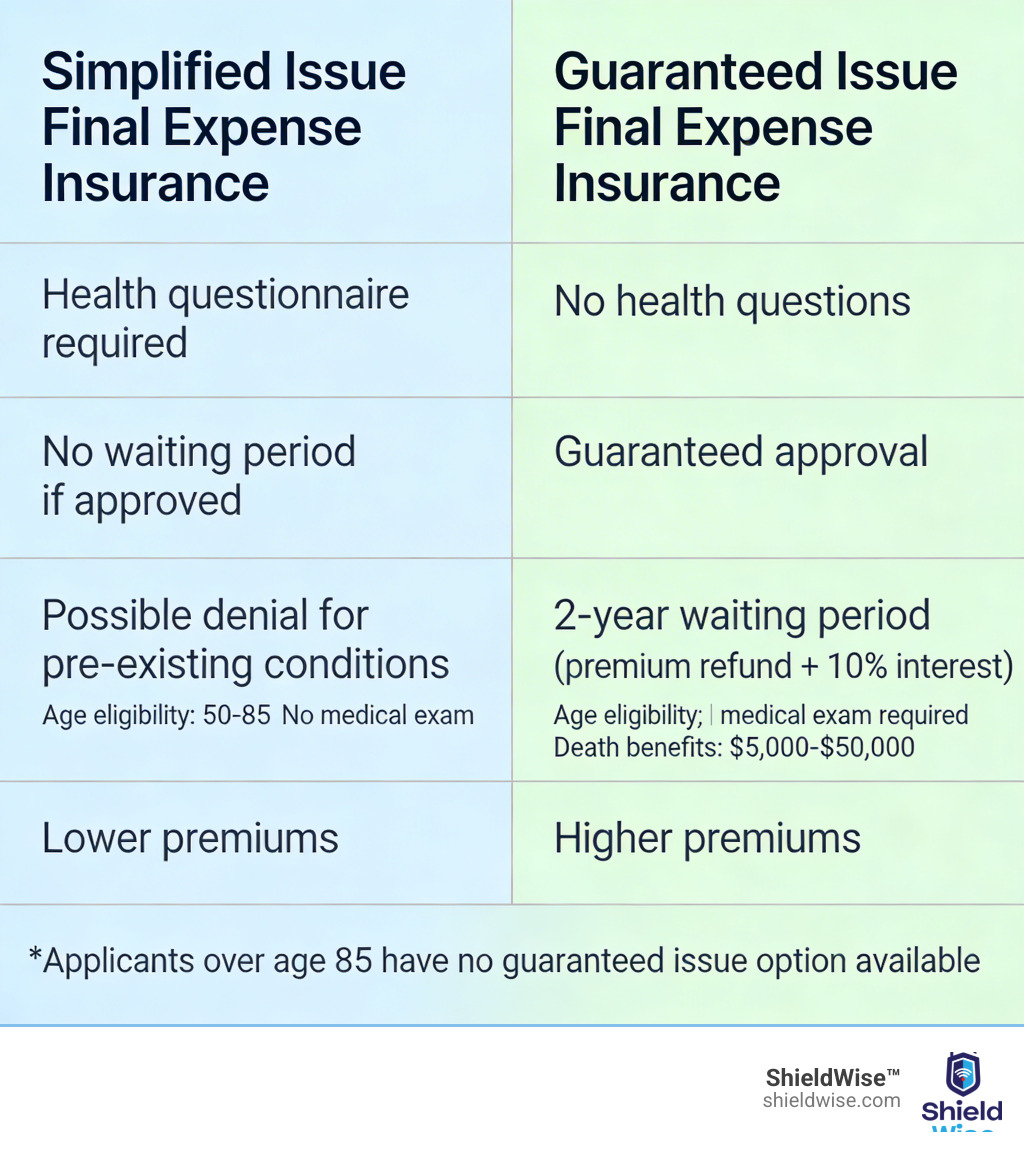
Simplified Issue vs. Guaranteed Issue Policies
Understanding the difference between these two policy types is the most important step in avoiding a denial.
| Feature | Simplified Issue | Guaranteed Issue |
|---|---|---|
| Medical Exam | None | None |
| Health Questions | Yes (Questionnaire) | No |
| Waiting Period | None (Immediate Coverage) | Typically 2 Years |
| Premiums | Lower | Higher |
| Approval | Based on Health History | Assured |
For those looking for the most affordable route, a Low Cost Final Expense plan is usually a simplified issue policy. However, you have to be able to “pass” the health questions to get it.
Why you might be denied final expense insurance under simplified issue
When you apply for simplified issue, the company will look at two main things: your answers to a health questionnaire and your medication history. They don’t need a blood draw, but they will check a national database to see what prescriptions you’ve filled in the last few years.
Can i be denied final expense insurance in this category? Yes. Common reasons for denial include:
- Recent Major Events: A heart attack, stroke, or cancer diagnosis within the last 12 to 24 months.
- Chronic Conditions: Uncontrolled diabetes or severe congestive heart failure.
- Current Care: Being in a nursing home, receiving hospice care, or requiring help with “activities of daily living” (like bathing or dressing).
If you have a complex medical history, it’s worth reviewing our Final Expense Health Eligibility Complete Guide to see where you might stand before you apply.
Guaranteed acceptance: The “no denial” final expense insurance option
If your health history makes simplified issue impossible, guaranteed acceptance is your safety net. With these policies, there are no health questions. You cannot be denied because of your medical condition.
The trade-off is the waiting period. Most guaranteed issue policies have a two-year graded benefit period. If you pass away from natural causes during these first two years, your family won’t receive the full death benefit. Instead, they will receive a refund of all the premiums you paid, plus a little extra (usually 10% interest). For more on how to find plans that skip this wait if you’re healthy enough, see Life Insurance for Seniors No Waiting Period.
Common Reasons for Denial and Health Disqualifiers
It is a sobering fact that according to the National Council on Aging regarding chronic disease, about 95% of older adults have at least one chronic disease, and 80% have two or more. Insurers know this. They aren’t looking for “perfect” health; they are looking for “stable” health.
However, certain “knockout” conditions will lead to an immediate denial for most standard final expense plans:
- Terminal Illness: If a doctor has given you a life expectancy of 12–24 months or less.
- Dialysis: Current kidney failure requiring regular dialysis.
- Organ Transplant: Having received or being on a waiting list for a major organ transplant.
- Alzheimer’s or Dementia: These often trigger a denial because of concerns regarding “mental capacity” (more on that below).
Mental capacity and legal requirements
To buy insurance, you must have the legal definition of mental incapacity in mind—meaning you must be of sound mind to enter into a contract. If an applicant has advanced dementia or is otherwise unable to understand what they are signing, the policy cannot be legally issued.
This creates a hurdle for families. A POA (Power of Attorney) cannot simply sign an insurance application for an incapacitated parent in many cases, especially for online applications. The person being insured must be the one to sign or provide consent, provided they have the capacity to do so.
Administrative and residency hurdles
Sometimes, a denial has nothing to do with your heart or lungs and everything to do with your paperwork.
- Missing Identifiers: Almost all carriers require a SSN or TIN requirements. If you don’t have a Social Security Number or a Taxpayer Identification Number, your options are extremely limited.
- Residency: You must be a legal resident and be physically present in the U.S. (specifically in states like Illinois where we operate) at the time of the application.
- Payment Issues: If you have a history of “bouncing” premium payments with other carriers, a new company might see you as too much of a financial risk.
For a breakdown of how these factors influence your monthly costs, visit Final Expense Cost and Quotes.
What to Do If Your Application Is Denied
If you receive a letter saying you’ve been denied, don’t panic. It’s not the end of the road. Your first step should be to find out why. Under the law, you have a right to a specific explanation for the denial.
Often, denials happen because of an error in a Medical Information Bureau (MIB) report. This is a “credit report” for your health. If a doctor once noted a condition you don’t actually have, it could follow you. You can request your MIB report and dispute any inaccuracies. To learn more about the basics of these policies after a setback, read What is Final Expense Insurance.
The appeal process and legal protections
If you believe you were denied unfairly, you can file an appeal. You should gather medical records from your doctor that prove your condition is well-managed. You can even find examples of appeal letters to help you structure your request.
There are also strong legal protections in place. Laws like the Civil Rights Act of 1964 and the Americans With Disabilities Act prevent insurers from discriminating based on race, religion, or certain disabilities that do not actually shorten life expectancy. If you feel you’ve been discriminated against, contacting your state’s Department of Insurance is a vital next step.
Finding coverage after a denial
If one company says no, another might say yes. Every insurance company has its own “appetite” for risk. One carrier might hate diabetes but be very forgiving of heart stents. This is why we recommend working with independent brokers who have access to multiple carriers.
Instead of applying blindly, you can Compare Final Expense Quotes from several different providers at once. This increases your chances of finding a carrier that looks at your specific health history more favorably.
Frequently Asked Questions about Final Expense Eligibility
What happens if I die during the waiting period of a guaranteed issue policy?
If you have a guaranteed issue policy with a two-year waiting period and you die of natural causes (like a heart attack or illness) in month 18, your family will not get the full $10,000 or $20,000 benefit. Instead, the company will refund all the premiums you paid into the policy, plus interest—usually 10%.
The Exception: If you die due to an accident (like a car crash) during the waiting period, most policies will pay out the full death benefit immediately, regardless of how long you’ve had the plan.
Can I be denied final expense insurance for having cancer or diabetes?
You will not be denied for these conditions if you apply for a guaranteed issue policy. However, for a simplified issue policy (the cheaper kind), it depends on the “recency” and “severity.”
- Diabetes: If it is managed with oral medication and you have no complications like neuropathy, you can often qualify for immediate coverage.
- Cancer: If you are currently in treatment or were diagnosed in the last two years, you will likely be steered toward a guaranteed issue plan. If you have been cancer-free for over two years, you may qualify for standard rates.
Check our Final Expense Health Eligibility page for more specific condition-by-condition details.
Can I buy final expense insurance online for someone else?
You can certainly help a loved one research and fill out the application, but you generally cannot sign for them unless you have specific legal authority and the insurer allows it. Most online applications require the insured person to provide an electronic signature or voice consent. This ensures they are aware of the policy and have the mental capacity to agree to the terms.
Conclusion
At ShieldWise™, we believe that every family deserves the peace of mind that comes with knowing final costs are covered. The answer to “can I be denied final expense insurance” is rarely a hard “no”—it’s usually just a matter of finding the right type of policy for your specific health journey.
Whether you are in great health and want a low-cost plan or have faced medical challenges and need a guaranteed acceptance option, we are here to help. We provide jargon-free guidance and easy-to-use comparison tools to help you secure the right coverage in just a few clicks.
Don’t let the fear of denial stop you from protecting your family. Explore your options for Final Expense Insurance today and take control of your financial legacy.