
Why Comparing Burial Insurance Matters for Your Family’s Future
When you compare burial insurance, you’re looking at small, permanent life insurance policies designed specifically to cover funeral, burial, and final medical expenses—typically ranging from $1,000 to $50,000. Unlike traditional life insurance meant to replace income, burial insurance helps ensure your family won’t face financial hardship when paying for your end-of-life costs, which average over $8,300 according to the National Funeral Directors Association.
Quick Comparison: Key Types of Burial Insurance
| Policy Type | Health Questions | Medical Exam | Waiting Period | Best For |
|---|---|---|---|---|
| Simplified Issue | Yes | No | Usually none | Seniors in fair to good health |
| Guaranteed Issue | No | No | 2-3 years (graded benefit) | Seniors with serious health conditions |
The average funeral and burial now costs over $8,300, and roughly 60% of Americans buy life insurance specifically to cover these final expenses. But not all burial insurance policies are created equal.
Some require you to answer health questions and offer immediate full coverage. Others guarantee acceptance regardless of health but include a waiting period before paying the full death benefit. Premiums for a $10,000 policy can range from $18 to $286 per month depending on your age, gender, health status, and the type of policy you choose.
Understanding these differences helps us find coverage that fits your budget, health situation, and family’s needs—without overpaying or leaving gaps in protection.
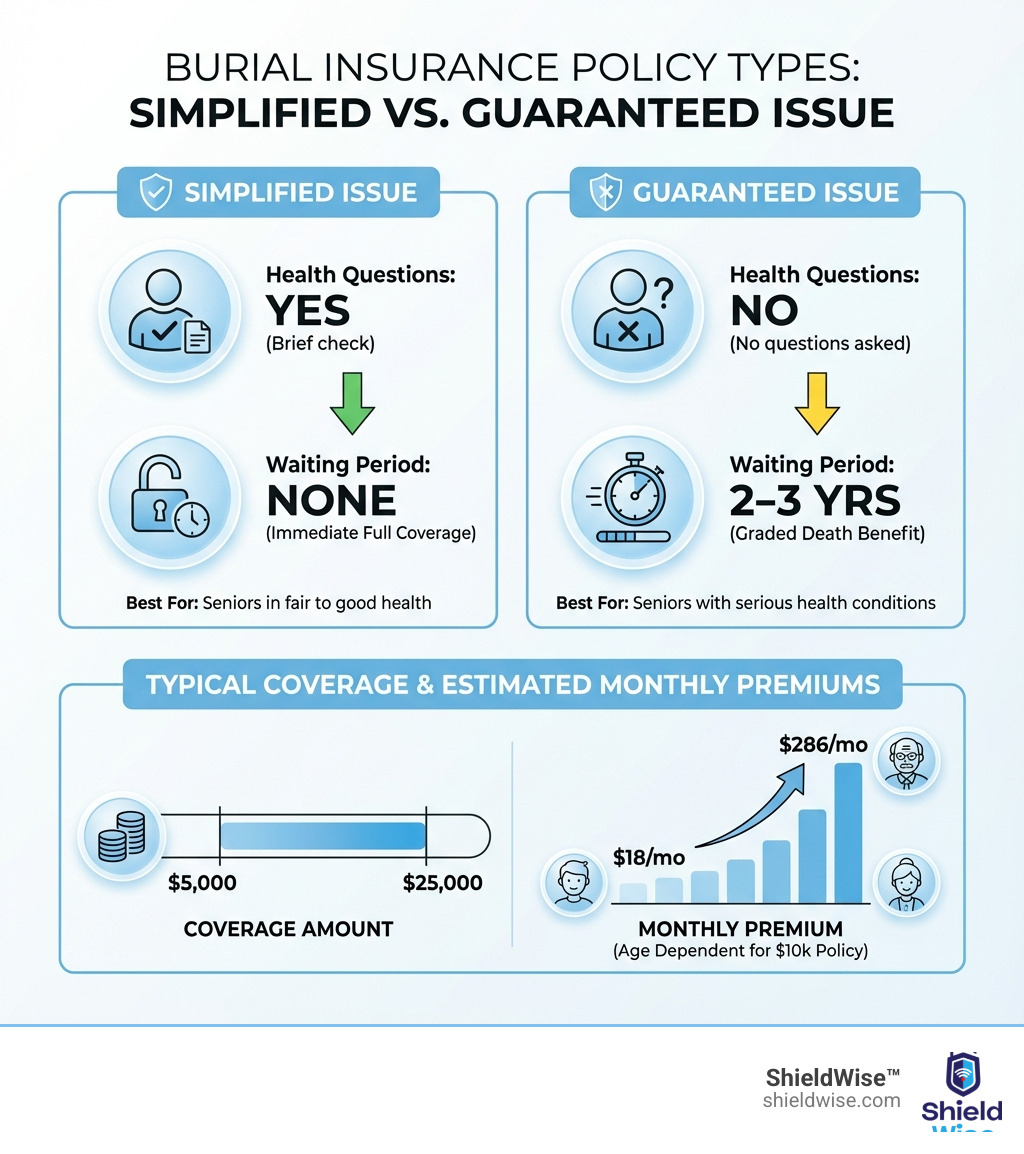
When we talk about burial insurance, we’re discussing what’s often referred to as final expense insurance. These policies are specifically custom to address the financial burden of end-of-life costs, which can include funeral services, cremation, embalming, caskets, urns, cemetery plots, and even outstanding medical bills or legal fees. While traditional life insurance policies, such as term or whole life, aim to replace lost income or cover long-term financial needs for dependents, Final Expense Insurance focuses on these more immediate, smaller-scale expenses.
The coverage amounts for burial insurance are typically modest, often ranging from $1,000 up to $50,000. This smaller benefit amount is precisely what makes them distinct from traditional life insurance, which can offer payouts in the hundreds of thousands or even millions. The application process for burial insurance is also generally more straightforward, often involving simplified underwriting with no medical exam, making it accessible to a wider range of applicants, especially seniors or those with pre-existing health conditions. Our goal at ShieldWise is to offer clear, jargon-free guidance so you can protect your family and control costs.
Understanding the Main Types of Burial Insurance
When we dig into burial insurance, we primarily encounter two main types: simplified issue and guaranteed issue. Each is designed to cater to different health profiles and needs, ensuring that most individuals can find some form of coverage for their final expenses.
Simplified Issue
Simplified issue burial insurance is a popular choice for many because it offers a balance between affordability and accessibility. With this type of policy, you’ll be asked to answer a few health-related questions on the application. However, there’s no need for a medical exam, which can be a relief for those who prefer to avoid the hassle or have minor health concerns.
The key benefit of simplified issue is that if you’re approved, coverage can often begin immediately with no waiting period for the full death benefit. This means your beneficiaries would receive the entire payout from day one, provided death isn’t due to suicide within the first two years, which is a standard exclusion. Premiums for simplified issue policies tend to be lower than guaranteed issue policies because the insurer has a better understanding of your health risk through the health questionnaire. For individuals in Illinois who are in reasonably good health, a simplified issue policy can be an excellent way to secure coverage without the higher costs associated with guaranteed issue plans.
Guaranteed Issue
Guaranteed issue burial insurance, as its name suggests, guarantees acceptance for applicants within a specific age range, typically 45 to 85. The most attractive feature of guaranteed issue policies is that there are no health questions asked and no medical exam required. This makes them an ideal solution for individuals with significant health issues or those who have been declined for other types of life insurance.
However, this ease of access comes with a trade-off: a graded death benefit. This means that if the policyholder passes away from natural causes within the first two to three years (the waiting period), the beneficiaries typically receive only the premiums paid back, often with a small amount of interest (e.g., 10% or 30% on top of paid premiums, as some sources mention). If death occurs due to an accident during this waiting period, the full death benefit is usually paid out. After the waiting period, the full death benefit is available for any cause of death. While these policies can be more expensive per dollar of coverage than simplified issue or traditional life insurance, they provide invaluable peace of mind for those who might otherwise be uninsurable. For more specific information on policies suitable for older individuals, you can explore our guide on Life Insurance Over 85 No Medical Exam.
We understand that navigating these options can feel like deciphering ancient texts, but we’re here to simplify it for you. Both simplified and guaranteed issue policies are types of whole life insurance, meaning they offer lifelong coverage as long as premiums are paid and often build a small cash value over time.
| Feature | Simplified Issue | Guaranteed Issue |
|---|---|---|
| Medical Exam Required? | No | No |
| Health Questions? | Yes (brief) | No |
| Waiting Period for Full Benefit? | Usually none (immediate coverage) | Yes (2-3 years, graded benefit) |
| Premium Cost (relative) | Moderate | Higher |
| Eligibility | Fair to good health | All (within age limits) |
| Beneficiary Flexibility | High | High |
| Cash Value Accumulation | Yes | Yes |
How to Compare Burial Insurance Policies to Find the Best Value
Choosing the right burial insurance isn’t just about picking the first policy you see; it’s about finding the best fit for your unique situation in Illinois. Our goal is to empower you to compare burial insurance effectively, ensuring you get the most value for your investment. This involves looking beyond just the premium price and considering various aspects of the insurer and the policy itself.

When we evaluate insurance companies, especially for something as important as covering final expenses, we consider several critical factors. Financial strength ratings, for instance, are crucial. Ratings from agencies like A.M. Best indicate an insurer’s ability to meet its financial obligations, including paying out claims. We recommend looking for companies with at least an A rating, ensuring they have the stability to be there for your family when needed.
Customer satisfaction is another vital metric. The National Association of Insurance Commissioners (NAIC) provides a complaint index for insurers, which can give you insight into how well a company handles its policyholders. A lower complaint index (below 1.0) generally indicates better customer service. Additionally, surveys from organizations like J.D. Power can offer valuable perspectives on overall customer experience.
Furthermore, we look at policy riders. These are add-ons that can improve your coverage. While burial insurance policies are typically straightforward, some might offer riders like an accelerated death benefit, which allows you to access a portion of your death benefit early if you’re diagnosed with a terminal illness. Other riders, like a child rider, could provide a small amount of coverage for your children. We also consider whether the policy accumulates cash value, a feature common in whole life policies that can be borrowed against or surrendered for its cash value.
Key Factors to Compare Burial Insurance Policies
When you’re ready to compare burial insurance policies, here’s a checklist of key factors we advise you to consider:
- Coverage Amount: Burial insurance policies typically range from $1,000 to $50,000. It’s important to choose an amount that realistically covers your anticipated final expenses. According to the National Funeral Directors Association, the average cost of a funeral and burial is over $8,300, but cremation costs average around $6,000. Use a funeral cost calculator to help determine how much coverage you might need for your desired services.
- Premium Costs: Your monthly premium will be influenced by your age, gender, health, and the coverage amount. The younger and healthier you are when you purchase, the lower your premiums will be.
- Age Eligibility: Most burial insurance policies are designed for seniors, with eligibility typically ranging from ages 45 to 85. Some providers accept applicants up to age 89, while others accept individuals as young as 18 or 45.
- Waiting Periods: As we discussed, guaranteed issue policies come with a 2-3 year waiting period. If immediate full coverage is a priority, a simplified issue policy (if you qualify) would be a better choice.
- Payout Speed: While most insurers aim for quick payouts, some are faster than others, with some stating they pay a high percentage of claims within 24 hours. This can be a crucial factor for families needing immediate funds.
- For a deeper dive into the specifics, our article “What is Burial Insurance?” offers comprehensive details.
Step-by-Step Guide to Compare Burial Insurance Online
Navigating insurance can feel overwhelming, but comparing burial insurance online doesn’t have to be. Here’s a simple guide we recommend:
- Assess Your Needs: Before you start comparing, have a clear idea of what you want to cover. Do you want to cover just the funeral, or also medical bills and outstanding debts? What kind of funeral or cremation services do you envision? The National Funeral Directors Association notes that the median cost of a funeral with burial is over $8,300, not including cemetery costs.
- Estimate Funeral Costs: Research local funeral homes in Illinois to get a realistic estimate of costs. This will help you determine an appropriate coverage amount.
- Gather Multiple Quotes: This is where ShieldWise shines! We allow you to compare plans from trusted carriers, offering instant online quotes. Don’t settle for the first quote you receive. As an expert, we know that comparing prices from multiple providers is crucial for finding the best value. Some research suggests that AI-generated search results can be “overwhelmingly wrong” for insurance searches, so human-vetted comparisons are key.
- Review Policy Fine Print: Pay close attention to details like waiting periods, graded death benefits, policy exclusions (like suicide clauses), and any potential premium increases (though most burial insurance policies have fixed premiums).
- Check Insurer Ratings: Use resources like A.M. Best for financial strength and the NAIC Complaint Index for customer satisfaction. Look for companies with high financial strength ratings and a much better than expected complaint record. Customer satisfaction surveys can also provide valuable insights. These details matter.
By following these steps, you’ll be well-equipped to compare burial insurance policies and make an informed decision that provides peace of mind for you and your loved ones in Illinois.
What Does Burial Insurance Cost?
Let’s talk numbers, because we know cost is a major consideration for anyone looking to compare burial insurance. The average funeral and burial can be a significant expense, cracking over $8,300, according to the National Funeral Directors Association. This figure alone highlights why so many people seek dedicated coverage.
For burial insurance, also known as final expense insurance, policies typically offer coverage between $1,000 and $50,000. For most people, a $10,000 to $30,000 policy is usually sufficient to cover funeral and other immediate end-of-life expenses. The average monthly premiums for these policies can range widely, typically falling between $30 and $100. However, depending on various factors, we’ve seen costs as low as $18 or as high as $286 per month for seniors.
While burial insurance might seem more expensive per dollar of coverage compared to a large traditional life insurance policy, its value lies in its accessibility and specific purpose. For instance, a healthy 50-year-old woman in Illinois might pay about $360 a year for $10,000 in guaranteed issue life insurance. To compare, a $250,000 whole life policy could cost her about $4,740 annually for 25 times the coverage. This illustrates the trade-off: burial insurance provides focused, accessible coverage for final expenses, often without a medical exam, which can be invaluable for many.
Factors That Influence Your Premium
When we determine the cost of your burial insurance premium, several factors come into play. These variables help insurers assess the risk and, consequently, set your monthly payments:
- Age: This is arguably the biggest factor. The older you are, the higher your premiums will generally be. For instance, the average cost of burial insurance for seniors over 60 and under 65 ranges between $18 to $88 per month, while for those over 75 and under 80, it can range between $38 to $162 per month. This is because the older you are, the closer you are to the actuarial end of life, increasing the likelihood of a claim.
- Gender: Historically, women tend to live longer than men, which often translates to slightly lower premiums for women compared to men of the same age.
- Health Status: Even for simplified issue policies that don’t require a medical exam, health questions play a role. If you have certain pre-existing conditions, your premiums might be higher, or you might only qualify for a guaranteed issue policy with a waiting period. However, some companies are noted for lenient underwriting for chronic conditions and accepting applicants up to age 89.
- Tobacco Use: If you smoke or use other tobacco products, you can expect to pay significantly more for your premiums. Insurers view tobacco use as a major health risk.
- Coverage Amount Selected: This one is straightforward: the more coverage you choose (e.g., $25,000 vs. $10,000), the higher your monthly premium will be.
- Policy Type (Guaranteed vs. Simplified): As discussed earlier, guaranteed issue policies are generally more expensive than simplified issue policies because they accept everyone regardless of health, thus taking on more risk.
Understanding these factors allows us to better grasp why premiums vary and helps us guide you in Illinois to find a policy that balances cost with comprehensive coverage.

Pros, Cons, and Considerations
Deciding whether burial insurance is the right fit involves weighing its advantages against its limitations. We want you to feel fully informed as you compare burial insurance options.
The Benefits and Drawbacks of Burial Insurance
Let’s explore the good, the bad, and the practical aspects of these policies.
Pros:
- Accessible for Seniors: Burial insurance is specifically designed for older adults, often with no medical exam and lenient health underwriting. This makes it a viable option for many seniors in Illinois who might struggle to qualify for traditional life insurance.
- Good for Those with Health Issues: If you have pre-existing health conditions, simplified issue or guaranteed issue policies offer a pathway to coverage that might otherwise be unavailable. This is why having an end-of-life plan is so important, especially for older persons with health issues.
- Fixed Premiums: Once you purchase a burial insurance policy, your premiums are typically locked in and will not increase as you age or if your health declines. This predictability is a huge plus for budgeting.
- Simple Application Process: The application is usually quick and straightforward, often completed online or over the phone in minutes, with approvals that can be nearly instant.
- Peace of Mind for Family: The primary benefit is knowing that your loved ones won’t be burdened with unexpected funeral costs during a time of grief. The tax-free cash benefit is paid directly to your beneficiary, who can use it for anything—funeral, medical bills, or other outstanding debts.
- Cash Value Accumulation: As a type of whole life insurance, burial insurance typically builds a small cash value over time that you can borrow against or surrender if needed.
Cons:
- Lower Coverage Limits: Compared to traditional life insurance, burial policies offer much smaller death benefits, typically capping at $50,000. This means they’re not suitable for income replacement or covering large debts like a mortgage.
- Higher Cost-Per-Dollar than Traditional Life Insurance: For the same dollar amount of coverage, burial insurance can be more expensive than larger term or whole life policies, especially guaranteed issue policies.
- Graded Death Benefits on Some Policies: Guaranteed issue policies come with a waiting period (typically 2-3 years) where the full death benefit isn’t paid for natural causes. If you pass away during this period, your beneficiaries usually only receive premiums paid plus a small percentage.
- Risk of Paying More in Premiums than the Death Benefit: If you live significantly longer than expected after purchasing the policy, it’s possible to pay more in premiums over your lifetime than the death benefit your beneficiaries receive.
Who Is Burial Insurance Best For?
Understanding the pros and cons helps us identify who stands to benefit most from burial insurance in Illinois:
- Seniors on a Fixed Income: For those living on a budget, burial insurance offers a manageable way to cover end-of-life costs without dipping into savings or leaving debt for family.
- Individuals with Pre-Existing Health Conditions: If health issues make traditional life insurance difficult or impossible to obtain, burial insurance provides a guaranteed or simplified path to coverage.
- People Without Other Savings or Life Insurance: If you don’t have a large savings account earmarked for final expenses or an existing life insurance policy, burial insurance fills a critical gap.
- Anyone Wanting to Cover Specific End of Life Expenses: Whether it’s the funeral, cremation, or outstanding medical bills, burial insurance ensures these specific costs are covered. The National Funeral Directors Association highlights that a small policy can almost fully cover the average cost of a funeral.
- Those Who Want to Ease the Burden on Family: Many people purchase burial insurance out of love, wanting to spare their family the emotional and financial stress of arranging and paying for final expenses.
Frequently Asked Questions about Burial Insurance
We know you have questions, and we’re here to provide clear, concise answers to help you compare burial insurance effectively.
Is burial insurance worth it?
This is a question we hear often, and the answer, like many things in life, is “it depends.” Burial insurance can be a valuable tool, especially if you lack other funds for final expenses and want to prevent burdening your family. If you’re a senior in Illinois with pre-existing health conditions that make obtaining traditional life insurance difficult, burial insurance offers an accessible solution. It provides peace of mind knowing that the average funeral cost of over $8,300, plus any lingering medical bills, will be covered.
However, it might not be worth it if you already have a permanent life insurance policy with sufficient coverage, or if you have ample savings specifically designated for final expenses. If you’re young and in excellent health, you might find more comprehensive and cost-effective coverage with a traditional term or whole life policy.
Is there a waiting period before the policy pays out?
The existence of a waiting period depends entirely on the type of burial insurance policy you choose:
- Simplified Issue Policies: For these policies, which require you to answer a few health questions but no medical exam, there is typically no waiting period. If you’re approved, full coverage usually begins immediately from day one. This means your beneficiaries would receive the full death benefit for any cause of death (except suicide within the first two years, which is standard).
- Guaranteed Issue Policies: These policies, which ask no health questions and require no medical exam, always come with a waiting period. This is often referred to as a “graded death benefit” period, and it typically lasts for two to three years. If the policyholder passes away from natural causes during this waiting period, beneficiaries usually receive only the premiums paid, often with a small amount of interest (e.g., 10% or 30% additional). If death is due to an accident during this period, the full death benefit is generally paid. After the waiting period concludes, the full death benefit is available for any cause of death.
It’s crucial to understand this distinction when you compare burial insurance, as it directly impacts when your family would receive the full financial protection.
Can my beneficiary use the money for anything?
Yes, absolutely! One of the key advantages of burial insurance (and life insurance in general) is the flexibility of the payout. The death benefit is paid out as a tax-free lump sum directly to your named beneficiary. While the policy’s primary purpose is to cover end-of-life expenses like funeral costs, medical bills, and outstanding debts, your beneficiary is not legally obligated to spend the money in any specific way. They can use the funds to cover funeral arrangements, pay off credit card debts, settle medical bills, or even for daily living expenses during their time of grief. This flexibility ensures that your family has the resources they need, precisely when they need them, without any restrictions.
Find the Right Coverage for Your Peace of Mind
We’ve covered a lot of ground today, from understanding what burial insurance is and how it differs from traditional life insurance, to exploring the different types, costs, and key factors to consider when you compare burial insurance. We’ve seen that while the average funeral costs can be substantial, a well-chosen burial insurance policy can provide immense peace of mind for you and your loved ones in Illinois.
Whether you’re a senior looking for guaranteed acceptance, someone with health concerns seeking simplified underwriting, or simply want to ensure your final expenses don’t become a burden on your family, there’s a policy out there for you. The key is to assess your individual needs, understand the options available, and diligently compare burial insurance policies.
At ShieldWise, we believe that protecting your family and securing your financial future should be straightforward. That’s why we make it easy to compare plans from trusted carriers, providing instant online quotes and clear, jargon-free guidance. We’re here to help you steer the complexities of insurance so you can make confident decisions. Don’t let the thought of end-of-life expenses weigh on your mind. Take the first step towards securing your family’s future today.