
Why Understanding Medicare’s Monthly Costs Matters
How much does Medicare cost per month depends on which parts you enroll in and your household income. Here’s what most people pay in 2026:
| Medicare Part | Average Monthly Premium | Who Pays |
|---|---|---|
| Part A (Hospital) | $0 for most people | Free if you worked 10+ years; up to $565 if not |
| Part B (Medical) | $202.90 standard | Everyone pays; higher earners pay more |
| Part C (Advantage) | $14 average | Optional private plan that replaces A + B |
| Part D (Drugs) | $34.50 average | Optional; required to avoid penalties |
| Medigap (Supplement) | $115–$200+ | Optional; fills gaps in Original Medicare |
Total monthly cost for most retirees: $202.90 for Part B alone, or $237.40–$250+ if you add Part D and/or Medicare Advantage.
Whether you’re approaching 65 or already enrolled, you’ve probably noticed the flood of mail, phone calls, and confusing plan options. One week you’re told Part A is free—the next you’re reading about thousand-dollar deductibles. A neighbor swears by Medicare Advantage, while your sister insists on Medigap. And just when you think you’ve figured it out, someone mentions IRMAA surcharges.
It’s overwhelming by design. Medicare has four parts, dozens of private plan choices, income-based adjustments, and penalties for late enrollment. But the math doesn’t have to be a mystery.
The good news? Most of your monthly costs are predictable. Part B has a standard premium. Part A is free for 99% of beneficiaries. And if you know your income, you can calculate exactly what you’ll owe before you enroll.
The bad news? There are hidden costs beyond premiums. Deductibles reset every year. Hospital stays trigger separate charges. And if your income crosses certain thresholds, your premiums can double—or triple.
This guide walks you through every monthly cost you’ll face in 2026, from the standard Part B premium to income surcharges, drug plan fees, and supplemental coverage. You’ll learn what’s required, what’s optional, and how to avoid expensive mistakes like late-enrollment penalties.
At ShieldWise, we’ve spent years helping retirees and their families steer Medicare enrollment and understand exactly how much does Medicare cost per month based on real-world scenarios and current federal guidelines. We’ll show you how to build your own monthly budget and find the plan that fits your income, health needs, and financial goals.
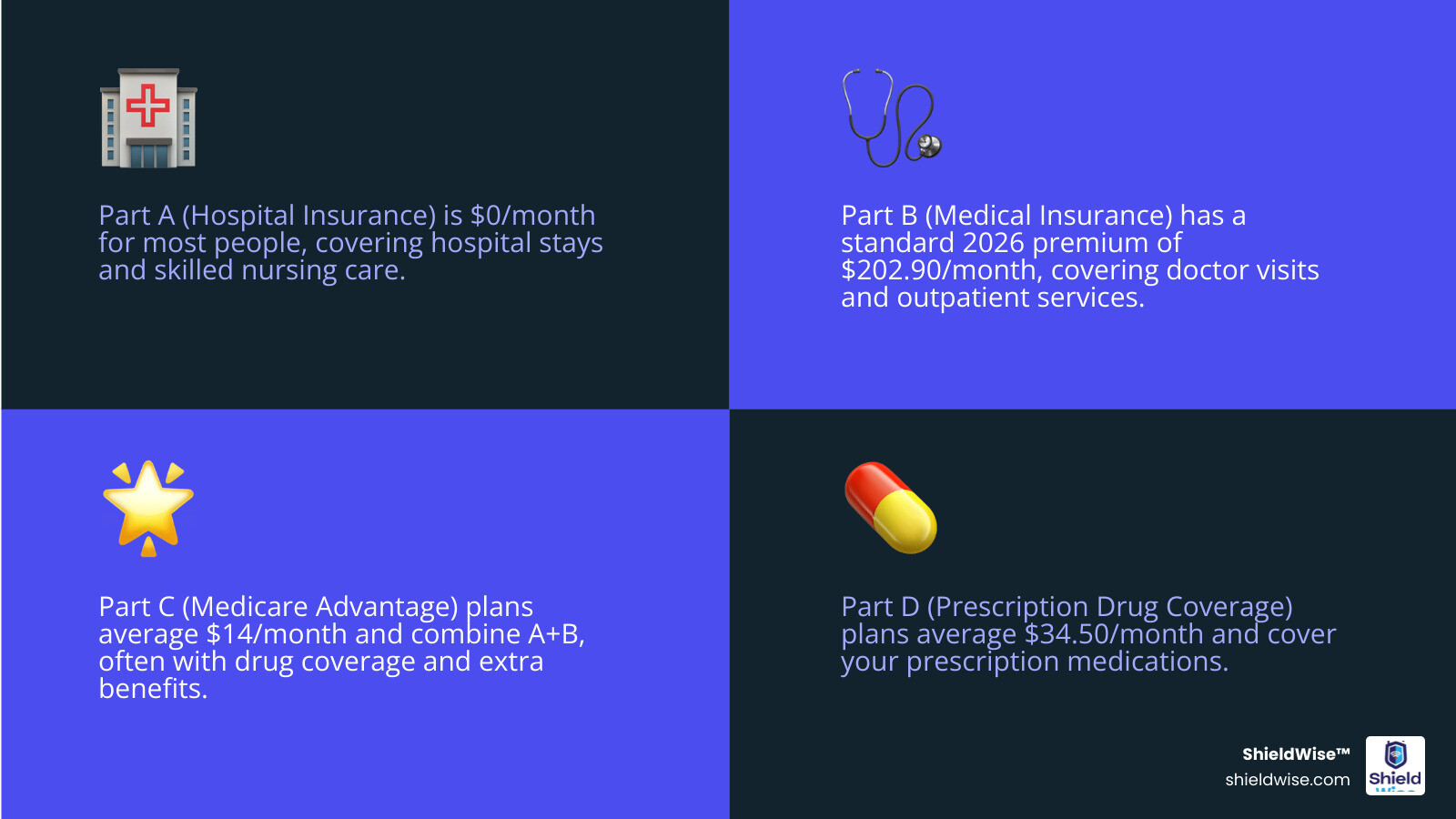
Understanding the Parts: How Much Does Medicare Cost Per Month?

Medicare is divided into several parts, each covering different services and coming with its own cost structure. Understanding these parts is the first step to figuring out how much Medicare costs per month. Let’s break down the different components of Medicare and their associated monthly expenses for 2026.
| Medicare Part | 2025 Standard Premium | 2026 Standard Premium | 2025 Deductible | 2026 Deductible |
|---|---|---|---|---|
| Part A (Hospital Insurance) | $0 for most | $0 for most | $1,676 (per benefit period) | $1,736 (per benefit period) |
| Part B (Medical Insurance) | $185.00 | $202.90 | $257 | $283 |
| Part C (Medicare Advantage) | $17.00 (average) | $14.00 (average) | Varies by plan | Varies by plan |
| Part D (Prescription Drugs) | $38.00 (average) | $34.50 (average) | Up to $590 | Up to $615 |
For a deeper dive into how these parts work and what they cover, especially as you approach your 65th birthday, check out our guide on Medicare Basics: Turning 65. It’s crucial to understand these basics, as they form the foundation of your healthcare costs. The figures listed above are projections for 2026, and these costs can change annually, so staying informed is key. You can find more detailed information on what you’ll pay in out-of-pocket costs directly from official sources like What you’ll pay in out-of-pocket costs in 2026.
Premium-Free Part A vs. Paid Coverage
Let’s start with Medicare Part A, which covers inpatient hospital stays, skilled nursing facility care, hospice care, and some home health services. The great news is that for most people, Part A comes with a $0 monthly premium. Why? Because you (or your spouse) have likely worked and paid Medicare taxes for at least 10 years (or 40 quarters). In fact, about 99% of beneficiaries qualify for premium-free Part A.
However, if you don’t meet the 40-quarter work history requirement, you might have to pay a monthly premium for Part A. For 2026, this premium can be quite substantial, reaching up to $565 each month. If you’ve worked between 30 and 39 quarters, you might qualify for a pro-rated premium, which will be around $311 per month in 2026. These costs are for the hospital insurance portion of Medicare.
The Standard Part B Monthly Premium
Medicare Part B covers medically necessary services like doctor’s visits, outpatient care, preventive services, and some medical equipment. Unlike Part A, almost everyone pays a monthly premium for Part B. For 2026, the standard monthly premium for Medicare Part B is projected to be $202.90. This is the amount most beneficiaries will pay.
Your Part B premium is typically deducted directly from your Social Security benefit payments. If you’re not receiving Social Security benefits yet, you’ll receive a bill directly from Medicare. It’s important to factor this into your monthly budget, as it’s a foundational cost for your medical insurance. To explore your full range of coverage options under Medicare, our Guide to Understanding Medicare Coverage Options can provide valuable insights.
Calculating Your Monthly Medicare Part B Premium
When it comes to figuring out how much Medicare costs per month, especially for Part B, your income plays a significant role. The standard premium of $202.90 for 2026 is just the starting point for many.
How Income Affects How Much Medicare Costs Per Month
For higher-income individuals, the government applies an Income-Related Monthly Adjustment Amount, or IRMAA. This means you’ll pay an additional surcharge on top of your standard Part B premium. The Social Security Administration uses your Modified Adjusted Gross Income (MAGI) from two years prior to determine if you owe IRMAA. So, for your 2026 premiums, they will look at your 2024 tax return.
MAGI includes most income sources like wages, interest, dividends, capital gains, and Social Security benefits. However, some sources, such as distributions from Roth IRAs, life insurance, reverse mortgages, and Health Savings Accounts (HSAs), typically don’t count towards the MAGI calculation for IRMAA purposes.
Only about 5% of all Medicare beneficiaries are subject to IRMAA, but for those who are, the surcharges can significantly increase your monthly costs. For 2026, IRMAA can add anywhere from $14.50 to $689.90 per month to your Part B premium, depending on your income bracket and tax filing status. These income thresholds for 2026 are projected to start for single filers with MAGI above $109,000 and for those married filing jointly with MAGI above $218,000.
It’s not just Part B that can be affected; IRMAA also applies to Medicare Part D prescription drug coverage, adding an additional amount to your Part D premium. We dig into this in more detail in our comprehensive Medicare Costs 2026 | Costs of Medicare Part A & B + IRMAA guide.
Appealing IRMAA Surcharges
Life throws curveballs, and sometimes your income from two years ago doesn’t reflect your current financial situation. If you’ve experienced a significant life-changing event that caused your income to drop, you might be able to appeal your IRMAA surcharge.
Qualifying life-changing events include things like:
- Marriage, divorce, or annulment
- Death of a spouse
- Work stoppage or reduction (e.g., retirement)
- Loss of income-producing property
- Loss of pension income
- Receipt of a settlement payment
If you believe you qualify for an appeal, you’ll need to contact Social Security and provide documentation of the event and your reduced income. They will review your case and determine if your IRMAA can be adjusted. It’s always worth exploring this option if your financial circumstances have changed.
Budgeting for Medicare Advantage and Part D Drug Plans
Beyond Original Medicare (Parts A and B), you have choices for additional coverage that can significantly impact how much Medicare costs per month. These options are offered by private insurance companies and include Medicare Advantage plans (Part C) and stand-alone Part D prescription drug plans.
Average Monthly Costs for Part C and Part D in 2026
Medicare Advantage plans, also known as Part C, are an “all-in-one” alternative to Original Medicare. These plans bundle Part A, Part B, and usually Part D coverage, often including extra benefits like dental, vision, and hearing. While many Medicare Advantage plans boast $0 monthly premiums, it’s crucial to remember that you still must pay your Part B premium. For 2026, the average monthly premium for Medicare Advantage plans is projected to decrease to $14.00, down from $16.40 in 2025. This average, however, can mask a wide range of costs depending on the plan, location, and benefits offered. You can learn more about these plans in our Medicare Advantage Plans Complete Guide.
For prescription drug coverage, if you stick with Original Medicare, you’ll need to enroll in a stand-alone Medicare Part D plan. For 2026, the average monthly premium for a stand-alone Part D plan is projected to decrease to $34.50, down from $38.00 in 2025. Again, this is an average; actual premiums can vary widely based on the specific plan and its formulary (the list of covered drugs). We have more details on Medicare Advantage/Part C premiums and how they compare.
It’s important to consider that while some plans may have low or even $0 premiums, they might have higher deductibles, copayments, or coinsurance for services and prescriptions. Also, Medicare Advantage plans often have network restrictions, meaning you’ll need to use doctors and hospitals within the plan’s network.
How Much Does Medicare Cost Per Month with Medigap?
If you choose Original Medicare (Parts A and B), you might find yourself facing significant out-of-pocket costs like deductibles, coinsurance, and copayments. This is where Medigap, or Medicare Supplement Insurance, comes into play. Medigap policies are sold by private insurance companies and are designed to help pay some of these “gaps” in Original Medicare coverage.
Medigap plans are standardized by letter (e.g., Plan G, Plan N), meaning that a Plan G from one insurer offers the exact same benefits as a Plan G from another. However, the premiums for these plans can vary significantly by carrier, your age, location (like Illinois), and other factors. For example, research indicates that for a 65-year-old nonsmoker in Chicago, a Medigap Plan A could start around $115 per month, while a Plan G could start around $122 per month.
Since Medigap premiums can be a substantial part of your monthly healthcare budget, compare policies from different companies. While they offer standardized benefits, the price for those benefits is not standardized. We have a dedicated resource to help you understand these options: Medicare Supplement and Medigap.
Hidden Costs: Deductibles, Coinsurance, and Late Penalties
When we talk about how much Medicare costs per month, it’s not just about premiums. There are other “hidden” costs—deductibles, coinsurance, and copayments—that can add up. Plus, if you don’t enroll on time, you could face penalties that increase your monthly burden permanently.
Let’s look at the costs associated with a hospital stay under Medicare Part A for 2026:
- Deductible: For each benefit period, you’ll pay a $1,736 deductible. A benefit period begins the day you’re admitted as an inpatient in a hospital or skilled nursing facility and ends after you’ve been out of the facility for 60 days in a row.
- Coinsurance:
- Days 1-60: $0 coinsurance
- Days 61-90: $434 coinsurance per day
- Lifetime Reserve Days (up to 60 days over your lifetime): $868 coinsurance per day
- All costs apply after day 150. For skilled nursing facility stays under Part A in 2026:
- Days 1-20: $0 coinsurance
- Days 21-100: $217 coinsurance per day
- All costs apply after day 100.
For Medicare Part B, after you meet your annual deductible of $283 in 2026, you typically pay 20% of the Medicare-approved amount for most doctor’s services, outpatient therapy, and durable medical equipment. This 20% is your coinsurance. For a comprehensive look at all these potential expenses, our Medicare Out-of-Pocket Costs Guide is an excellent resource.
The Impact of Late Enrollment Penalties
One of the most significant “hidden” costs can be late enrollment penalties, which can permanently increase your monthly premiums for Part B and Part D.
- Part B Late Enrollment Penalty: If you don’t sign up for Part B when you’re first eligible and don’t have other creditable health coverage (like through an employer), your monthly premium may go up by 10% for each full 12-month period you could have had Part B but didn’t sign up. This penalty is permanent, meaning you’ll pay it for as long as you have Part B.
- Part D Late Enrollment Penalty: This penalty applies if you go 63 days or more in a row without Medicare Part D or other creditable prescription drug coverage after your Initial Enrollment Period ends. The penalty is calculated by multiplying 1% of the national base beneficiary premium (which is $38.99 for 2026) by the number of full, uncovered months you were eligible but didn’t enroll. This amount is added to your monthly Part D premium and is also permanent.
Avoiding these penalties is crucial for managing how much Medicare costs per month. If you have creditable coverage (meaning it’s as good as or better than Medicare’s standard Part D coverage), make sure to keep proof of it!
Out-of-Pocket Maximums and Caps
While Original Medicare (Parts A and B) doesn’t have an annual out-of-pocket maximum, Medicare Advantage plans and some Medigap plans do. This can provide a sense of financial security, knowing there’s a cap on your annual spending.
- Medicare Advantage (Part C) Out-of-Pocket Maximum (MOOP): All Medicare Advantage plans must have a maximum out-of-pocket limit for covered services. For 2026, this limit is set at $9,250. Once you reach this amount, your plan will pay 100% of the costs for covered services for the rest of the year. This limit generally applies to costs for medical services, but not typically for prescription drugs covered under the plan.
- Medigap Plans K and L MOOP: Certain Medigap plans, specifically Plan K and Plan L, also have annual out-of-pocket limits. For 2026, the MOOP for Medigap Plan K is $8,000, and for Medigap Plan L, it’s $4,000. After you reach these limits, the plan pays 100% of your covered costs for the remainder of the year.
- Part D Prescription Drug Cap: Starting in 2025, there will be an annual cap on out-of-pocket prescription drug costs for Part D and Medicare Advantage plans with drug coverage. This cap is $2,000 in 2025 and will increase to $2,100 in 2026. Once you reach this limit, you won’t pay anything for covered prescription drugs for the rest of the year.
Understanding these limits is vital for predicting your worst-case scenario for healthcare expenses. For more details on these caps, refer to our guide on maximum out-of-pocket.
Ways to Lower Your Monthly Medicare Expenses
Even with all the costs associated with Medicare, there are programs and strategies available to help reduce your monthly expenses, especially if you have a limited income. Understanding these options can significantly impact how much Medicare costs per month for you.
The Medicare Prescription Payment Plan
Starting in 2025, Medicare beneficiaries will have access to the Medicare Prescription Payment Plan. This innovative program allows you to spread out your out-of-pocket prescription drug costs (like deductibles, copayments, and coinsurance) over monthly payments, rather than having to pay large sums all at once at the pharmacy. This can be a game-changer for managing your budget, especially if you have high drug costs early in the year. It smooths out your payments, making your healthcare expenses more predictable and manageable.
Dual Eligibility and Medicaid
For individuals with low incomes and limited resources, there are federal and state programs that can provide substantial help with Medicare costs. These programs often lead to “dual eligibility” for both Medicare and Medicaid.
- Extra Help (Low-Income Subsidy – LIS): This federal program helps pay for Part D prescription drug costs, including premiums, deductibles, and copayments. If you qualify for Extra Help, your monthly Part D premium could be significantly reduced, or even eliminated, and your drug costs will be much lower.
- Medicare Savings Programs (MSPs): These state-run programs help pay for Medicare Part A and/or Part B premiums, deductibles, and coinsurance. There are different types of MSPs based on income and resource limits:
- Qualified Medicare Beneficiary (QMB) Program: Pays for Part A and Part B premiums, deductibles, and coinsurance.
- Specified Low-Income Medicare Beneficiary (SLMB) Program: Pays for the Part B premium.
- Qualifying Individual (QI) Program: Also pays for the Part B premium.
In Illinois, if you are dual-eligible (eligible for both Medicare and Medicaid), resources like the NCOA’s online decision support tool, My Care, My Choice, can help you understand your Medicare and Medicaid coverage options. This tool is specifically available for residents in Illinois, California, Michigan, and Ohio. You can explore these options by visiting Visit the website for dual-eligible support.
These programs are vital for ensuring that low-income seniors in Illinois can access the healthcare they need without facing impossible financial burdens. For more information on navigating these options, especially for those on a fixed income, check out our guide on the Best Insurance Options for Seniors on Medicare and Fixed Income.
Frequently Asked Questions about Medicare Costs
Navigating Medicare costs can bring up many questions. Here, we address some of the most common ones to help you better understand how much Medicare costs per month.
Is Medicare Part A always free?
No, Medicare Part A is not always free. While most people (about 99%) don’t pay a monthly premium for Part A, this is because they (or their spouse) have worked and paid Medicare taxes for at least 10 years (40 quarters). If you haven’t met this work history requirement, you might have to pay a monthly premium for Part A. For 2026, this premium can be up to $565 per month. If you have 30-39 quarters of work history, you might pay a pro-rated premium of $311 per month.
Can my Medicare Part B premium change every year?
Yes, your Medicare Part B premium can change every year. The Centers for Medicare & Medicaid Services (CMS) sets the standard Part B premium annually, and it typically adjusts to reflect changes in healthcare costs. For 2026, the standard Part B monthly premium is projected to be $202.90. Additionally, if your income changes significantly, you might be subject to an Income-Related Monthly Adjustment Amount (IRMAA), which would further alter your premium. IRMAA is based on your Modified Adjusted Gross Income (MAGI) from two years prior, so a change in your income from 2024 would affect your 2026 premium.
Does my income from ten years ago affect my current premium?
Generally, no, your income from ten years ago does not affect your current Medicare Part B or Part D premiums. IRMAA, the income-related surcharge, is based on your Modified Adjusted Gross Income (MAGI) from two years prior to the current Medicare year. For example, your 2026 premiums will be determined by your MAGI from your 2024 tax return. The only exception related to past income is for premium-free Part A eligibility, which looks at your work history and Medicare tax contributions over your working life, not just recent income.
Conclusion
Understanding how much Medicare costs per month is a crucial step in planning your retirement and ensuring access to essential healthcare. As we’ve explored, these costs aren’t static and can vary significantly based on the parts of Medicare you choose, your income, and whether you enroll on time. From the standard Part B premium to the nuances of IRMAA, deductibles, and private plan options like Medicare Advantage, Medigap, and Part D, there’s a lot to consider.
At ShieldWise, we believe that navigating Medicare shouldn’t be a source of stress. Our mission is to provide clear, jargon-free guidance, helping you compare plans from trusted carriers and find the right coverage that fits your budget and health needs. We’re here to help you make informed decisions, control costs, and secure your financial future.
Whether you’re just starting your Medicare journey or looking to optimize your existing coverage, we invite you to explore our resources and connect with us. For more insights on securing your financial well-being in retirement, visit Affordable Insurance Solutions for Retirees. And if you’re thinking ahead about financial planning, consider getting a quote for important protections like Get a quote for end-of-life expenses. We’re here to help you protect your family and gain peace of mind.