
Why Understanding Your Medicare Choices Matters When You Turn 65
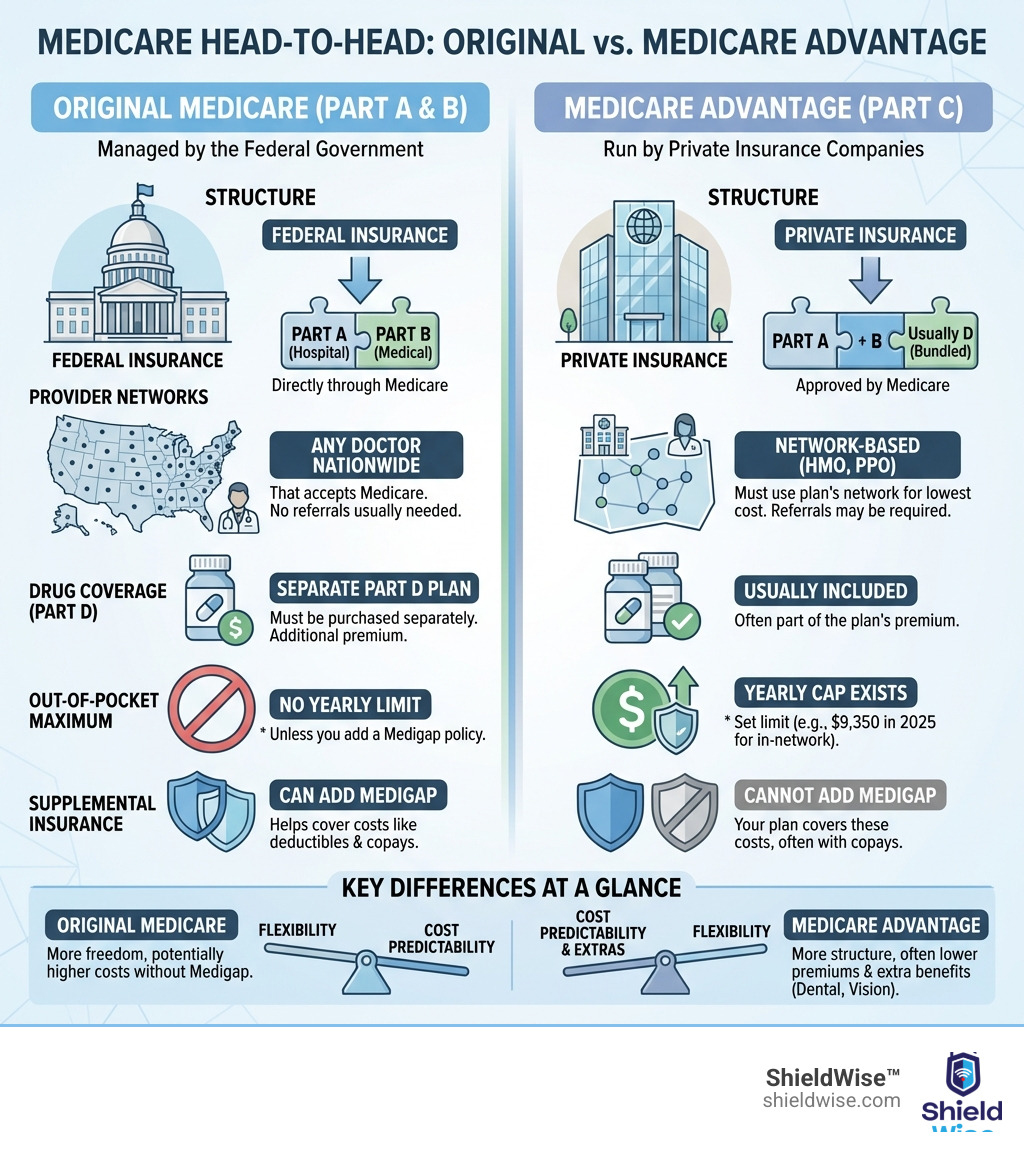
The difference between Medicare Advantage and Original Medicare comes down to how you receive your benefits and who manages your care. Here’s what you need to know:
| Original Medicare | Medicare Advantage |
|---|---|
| Run by the federal government | Run by private insurance companies |
| Includes Part A (hospital) and Part B (medical) | Bundles Part A, Part B, and usually Part D (drugs) |
| See any doctor nationwide that accepts Medicare | Must use plan’s network of doctors and hospitals |
| No out-of-pocket limit (unless you add Medigap) | Has a yearly out-of-pocket maximum ($9,350 in 2025) |
| Prescription drugs require separate Part D plan | Most plans include drug coverage |
| No extra benefits | Often includes dental, vision, hearing |
| Pay 20% coinsurance for most services | Pay copays for services |
If you’re like most people approaching 65, you’re probably drowning in Medicare mail and phone calls. You’ve heard stories from friends who picked the “wrong” plan and ended up with surprise bills. You don’t want to make an expensive mistake.
The truth is, there’s no single “best” choice for everyone. What works for your neighbor might not work for you. Original Medicare gives you freedom to see any doctor, while Medicare Advantage often costs less upfront but limits where you can go.
In this guide, we’ll walk through the real differences without the confusing jargon. You’ll learn about costs, doctor choice, prescription coverage, and when you can switch plans. By the end, you’ll understand which path makes sense for your situation.
At ShieldWise, we’ve helped thousands of people approaching 65 steer the difference between Medicare Advantage and Original Medicare. We provide clear, unbiased guidance so you can choose coverage that protects both your health and your budget.
Understanding the Fundamental Difference Between Medicare Advantage and Original Medicare
When you become eligible for Medicare, you choose between two main paths: Original Medicare or Medicare Advantage. Think of it as choosing between a government-run program and a private insurance package.
Original Medicare is the federal government’s program, consisting of:
- Part A (Hospital Insurance): Covers inpatient hospital stays, skilled nursing, and hospice. Most people pay $0 premium if they worked 10+ years.
- Part B (Medical Insurance): Covers doctor services, outpatient care, and preventive services. You pay a monthly premium for this.
With Original Medicare, you can use any provider in the U.S. that accepts Medicare, usually without referrals. It’s the traditional system most people recognize.
Medicare Advantage (Part C) is an alternative offered by private insurance companies approved by Medicare. Instead of the government paying providers directly, Medicare pays the private insurer a fixed monthly fee to manage your care. These plans must cover all Part A and Part B benefits (except hospice, which remains under Original Medicare).
The core difference between Medicare Advantage and Original Medicare is who administers your benefits. This choice affects your costs, doctor choice, and extra perks. To learn more, see our Guide to Understanding Medicare Coverage Options and Medicare Basics: Turning 65.
The Role of Private Insurance Companies
Medicare Advantage plans contract with the government to provide your benefits. They often operate as managed care plans, like HMOs or PPOs, which use specific networks and may require referrals or prior authorizations. This structure allows them to offer lower premiums, sometimes even $0 (though you still pay your Part B premium). For a deeper dive, explore our Medicare Advantage Plans Complete Guide.
How Claims and Appeals are Handled
In Original Medicare, claims are processed by Medicare Administrative Contractors (MACs). You receive a Medicare Summary Notice (MSN) detailing payments. Appeals are handled through a formal federal process.
In Medicare Advantage, the private insurer handles claims. You receive an Explanation of Benefits (EOB) from the company. Grievances and appeals are initially handled through the plan’s internal procedures rather than directly by Medicare. You can find more details in the official differences between Traditional Medicare and Medicare Advantage guide.
Comparing Costs: Premiums, Deductibles, and Out-of-Pocket Limits
Understanding the financial structure is a vital difference between Medicare Advantage and Original Medicare.
| Cost Factor | Original Medicare (Parts A & B) | Medicare Advantage (Part C) |
|---|---|---|
| Part A Premium | Most pay $0 | Most pay $0 |
| Part B Premium | $185/month in 2025 | $185/month in 2025 |
| Part B Deductible | $257 in 2025 | Varies by plan |
| Coinsurance (Part B) | 20% of approved amount | Typically fixed copays |
| Out-of-Pocket Maximum | None (without Medigap) | Yes, $9,350 in 2025 (in-network) |
| Plan Premium | Separate Part D/Medigap premiums | Often $0 additional premium |
The most significant cost difference between Medicare Advantage and Original Medicare is the out-of-pocket maximum. Original Medicare has no limit on your 20% coinsurance, which is why many buy Medigap. Medicare Advantage plans must have a yearly limit (capped at $9,350 in 2025), after which the plan pays 100%. For more, see our Medicare Out-of-Pocket Costs Guide.
Financial Protections and Medigap
Medigap (Medicare Supplement Insurance) is sold by private companies to cover Original Medicare’s “gaps,” like the 20% coinsurance. Popular options include Plan G and Plan N. You cannot have both a Medicare Advantage plan and a Medigap policy. If you choose Medicare Advantage, the plan’s out-of-pocket maximum is your safeguard. For details, visit Medicare Supplement and Medigap.
The Difference Between Medicare Advantage and Original Medicare Networks

Original Medicare allows you to see any provider in the U.S. that accepts Medicare, usually without referrals. Medicare Advantage plans typically use networks:
- HMOs: Require a primary care doctor and referrals for specialists. Out-of-network care is usually not covered.
- PPOs: Offer more flexibility to see out-of-network providers at a higher cost, usually without referrals.
Many Advantage plans also require prior authorization for certain procedures. To find local options, check Medicare Local and Near Me.
Prescription Drugs and Additional Benefits
Prescription coverage is another major difference between Medicare Advantage and Original Medicare.
With Original Medicare, you must enroll in a separate Part D plan for drug coverage. If you delay enrollment without other coverage, you may face a lifetime penalty. Medicare Advantage plans usually bundle Part D coverage (MAPD plans) into the single monthly package.
Starting in 2026, all Part D enrollees will benefit from a $2,100 out-of-pocket cap on medications. For more, see How does Medicare Part D work?.
Extra Perks: Dental, Vision, and Hearing
Original Medicare generally excludes routine dental, vision, and hearing care. Medicare Advantage plans frequently include these “extra perks,” such as:
- Routine dental/vision/hearing: Exams, cleanings, and allowances for glasses or hearing aids.
- Fitness: Programs like SilverSneakers.
- Support: Transportation to appointments or OTC allowances.
While these are attractive, coverage levels vary. For instance, comprehensive dental is less common than basic cleanings.
The Difference Between Medicare Advantage and Original Medicare Travel Coverage
Original Medicare offers seamless nationwide coverage within the U.S. Medicare Advantage plans may limit non-emergency coverage to their service area, though emergency care is covered nationwide.
Neither option covers routine international care. However, some Medigap plans (C, D, F, G, M, N) offer limited foreign travel emergency benefits. Some Advantage plans may also offer this as an extra perk. Compare these options on the Compare Original Medicare & Medicare Advantage page.
Enrollment Rules and Switching Plans
Understanding when you can change plans is a critical difference between Medicare Advantage and Original Medicare.
- Initial Enrollment Period (IEP): A 7-month window around your 65th birthday.
- Annual Enrollment Period (AEP): Oct 15 – Dec 7. You can switch between Original Medicare and Advantage, or change Part D plans.
- Medicare Advantage Open Enrollment (MA OEP): Jan 1 – Mar 31. If already in an Advantage plan, you can switch to another or return to Original Medicare.
Missing these windows can lead to penalties or being stuck in a plan. See our guide: How to Sign Up for Medicare.
Switching Back to Original Medicare
Switching from Advantage back to Original Medicare is possible during AEP or MA OEP, but adding a Medigap policy later can be difficult. In most states, including Illinois, insurers use medical underwriting for Medigap if you apply after your initial 6-month Medigap Open Enrollment Period. They can deny coverage or charge more for pre-existing conditions.
There are limited “trial rights” (e.g., if you switch back within the first 12 months of trying Advantage), but generally, choosing Advantage first can make it harder to get Medigap later. This “lock-in” effect is a major consideration. For more, see Switching from MA plans to Traditional Medicare.
Frequently Asked Questions
Can I have both a Medicare Advantage plan and a Medigap policy?
No, you cannot have both a Medicare Advantage plan and a Medigap (Medicare Supplement Insurance) policy at the same time. If you have a Medicare Advantage plan, it is illegal for anyone to sell you a Medigap policy unless you are switching back to Original Medicare. Medicare Advantage plans are designed to be an all-in-one alternative to Original Medicare, and they already incorporate their own out-of-pocket limits to protect you from high costs.
Do I need a referral to see a specialist under Original Medicare?
In most cases, you do not need a referral to see a specialist if you have Original Medicare. You can typically go directly to any doctor, specialist, or hospital that accepts Medicare, anywhere in the U.S., without needing prior authorization from your primary care physician. This offers a high degree of flexibility in choosing your providers.
What is the maximum I will pay out-of-pocket for medications in 2026?
Starting in 2026, individuals enrolled in Part D plans (whether a standalone plan with Original Medicare or included in a Medicare Advantage plan) cannot pay more than $2,100 in out-of-pocket costs for their medications per year. Once you reach this limit, you will pay $0 for your covered prescription drugs for the remainder of the year. This provides a significant cap on prescription drug spending.
Conclusion
Deciding between Original Medicare and a Medicare Advantage plan is one of the most important healthcare choices you’ll make as you approach 65. As we’ve explored, the difference between Medicare Advantage and Original Medicare impacts everything from your monthly costs and provider choices to prescription drug coverage and extra benefits.
Original Medicare offers unparalleled flexibility in choosing your doctors and hospitals nationwide, but it comes with unlimited out-of-pocket costs unless you add a Medigap policy and a separate Part D plan. Medicare Advantage plans, on the other hand, often provide bundled benefits, including prescription drugs and extra perks like dental and vision, usually with a yearly out-of-pocket maximum. However, this often means working within a plan’s network and potentially dealing with referrals and prior authorizations.
There’s no one-size-fits-all answer. Your ideal choice depends on your health, budget, lifestyle, and how much flexibility you desire versus how much you value predictable costs and extra benefits.
At ShieldWise™, we understand that navigating these options can be overwhelming. That’s why we’re here to provide personalized guidance and jargon-free comparisons. We work with trusted carriers to help you understand your choices, get instant online quotes, and ultimately secure the right coverage that protects your family, controls your costs, and gives you peace of mind.
Ready to explore your options with confidence? Compare Medicare Advantage Plans or visit ShieldWise today to secure the right coverage.