
Why Young Families Are Turning to IUL for Long-Term Financial Security
IUL for young families and parents is becoming a popular choice for those seeking both life insurance protection and a tax-advantaged way to build wealth over time. If you’re weighing your options, here’s what you need to know right away:
Quick Answer: What IUL Offers Young Families
- Lifelong Protection: Coverage that doesn’t expire, locking in insurability at a young, healthy age
- Cash Value Growth: A savings component tied to market indexes (like the S&P 500) with downside protection
- Tax Advantages: Tax-deferred growth and tax-free access to funds through loans or withdrawals
- Flexible Funding: Use accumulated cash value for college, a first home, business ventures, or retirement
- Low Entry Cost: Starting early means lower premiums—often $75-$150/month for children
Imagine turning a modest monthly payment into a six-figure asset for your child’s future. That’s the core promise of Indexed Universal Life insurance.
As a parent, you’re constantly thinking about your child’s financial well-being and long-term security. You want more than just a death benefit—you want a financial tool that grows with your family. IUL combines life insurance protection with investment-like growth potential, making it an attractive option for parents who’ve already maxed out traditional savings vehicles or who want a flexible, tax-efficient way to build wealth.
Unlike term life insurance that expires, or a 529 plan that’s limited to education expenses, an IUL policy offers permanent coverage and multipurpose cash value that can adapt to whatever life brings—whether that’s college tuition, a wedding, a business startup, or even your child’s retirement.
But IUL isn’t simple. It comes with caps on returns, fees, and the need for active management. This guide will walk you through exactly how it works, what it costs, and whether it’s the right fit for your family’s financial plan.
What is Indexed Universal Life (IUL) and How Does It Work?
Indexed Universal Life (IUL) insurance is a type of permanent life insurance policy that offers a unique blend of benefits. It’s designed to provide lifelong coverage, meaning it won’t expire as long as premiums are paid, and it includes a cash value component that can grow over time.
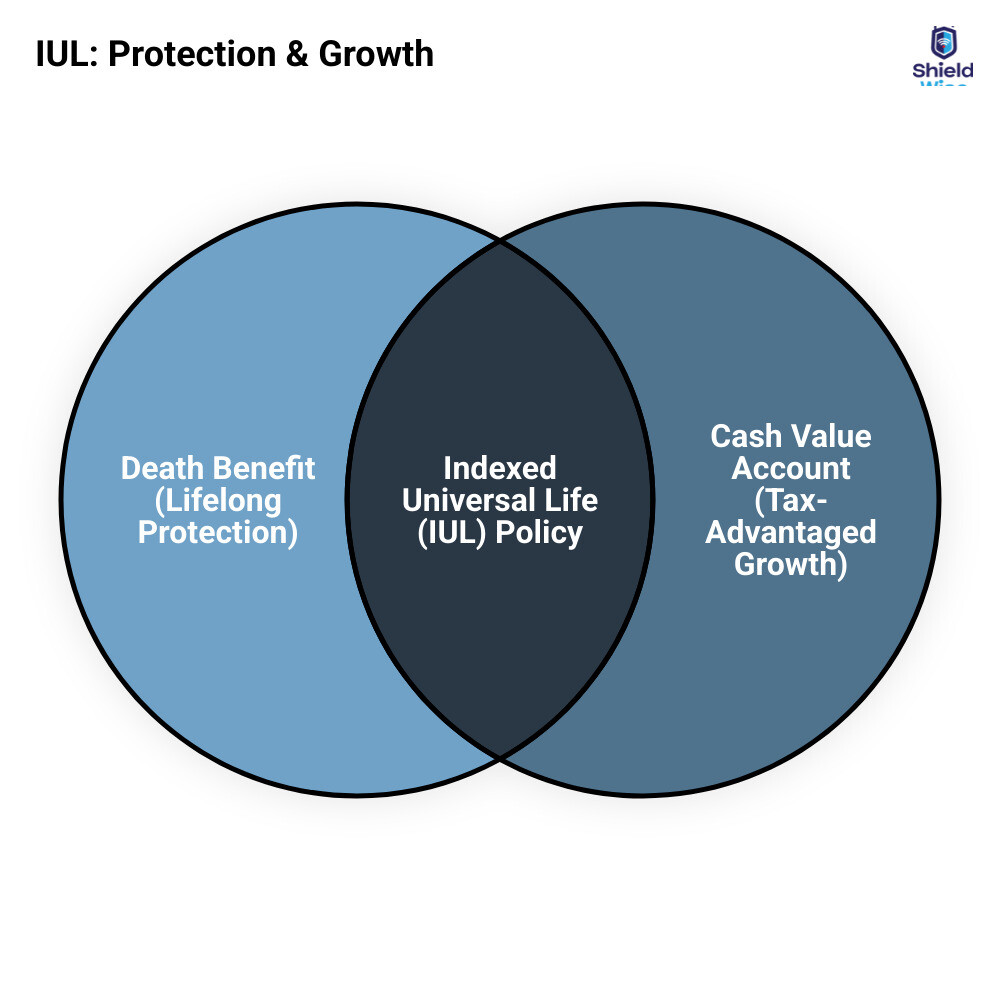
At its core, an IUL policy has two main components: a death benefit and a cash value account. The death benefit provides financial protection to your beneficiaries upon your passing, just like traditional life insurance. What sets IUL apart is how its cash value grows.
The cash value in an IUL policy grows based on the performance of a selected market index, such as the S&P 500. However, it’s crucial to understand that your money isn’t directly invested in the stock market. Instead, the interest credited to your cash value is linked to the index’s performance using options strategies. This approach allows for potential growth while providing a layer of protection.
A key feature of IUL policies is the inclusion of “caps” and “floors.” A cap is the maximum interest rate your cash value can earn, even if the linked index performs exceptionally well. For example, if the index gains 15% but your policy has a 10% cap, your interest credited will be no more than 10%. Conversely, a “floor” is a guaranteed minimum interest rate, typically 0%, which protects your cash value from market losses during downturns. If the index drops 20% in a year, your cash value won’t lose money; it simply earns 0% for that period. This downside protection is a significant appeal for many families.
IUL policies also feature “participation rates,” which determine how much of the index’s gains your policy participates in. If the S&P 500 gains 10% and your policy has an 80% participation rate, your cash value would be credited with an 8% gain (before other factors). This mechanism, combined with flexible premiums, allows us to adjust payments based on our financial situation, making it a versatile tool for long-term financial planning.
For a deeper dive into the specifics, you can learn more info about what is iul and get more info about how iul work.
The Core Benefits of IUL for Young Families and Parents
For IUL for young families and parents, it’s not just about a death benefit. It’s a dynamic financial tool that grows with your child, offering lifelong protection, tax-advantaged growth, financial flexibility, and valuable living benefits.

A compelling aspect of IUL is lifelong protection. Unlike term insurance, an IUL policy covers your child for life, regardless of future health changes. This guarantees their insurability and offers peace of mind.
IUL policies also offer significant tax-advantaged growth. The cash value grows tax-deferred, allowing money to compound more efficiently. This cash value can be accessed tax-free through policy loans or withdrawals (up to the premium basis), providing financial flexibility.
IUL policies can also include living benefits. These riders allow access to a portion of the death benefit if the insured experiences a chronic or critical illness, providing a safety net for medical expenses or lost income.
Building a Financial Safety Net for Your Child
The cash value accumulation is a key financial safety net for your child. For example, by contributing $150 monthly to an IUL for a newborn, the cash value could grow substantially by their 18th birthday. This fund can then be used for future milestones:
- Education: Covering college tuition, vocational training, or other educational expenses without incurring early withdrawal penalties, unlike some other savings plans.
- First Home Down Payment: Providing a significant boost for your child to enter the housing market.
- Business Startup: Offering capital for entrepreneurial ventures.
- Retirement Income: Supplementing their retirement savings, providing a stream of income that ensures a comfortable and financially secure future.
This financial head start, fueled by tax-deferred growth, can help your child achieve their dreams without excessive debt. It’s a safe way to save for a child’s future.
Why IUL for young families and parents offers unique advantages
Choosing an IUL for your child offers unique advantages:
- Guaranteed Insurability: Securing a policy when your child is young and healthy locks in their insurability for life. Their coverage cannot be revoked due to future health conditions.
- Locking in Low Premiums: Starting an IUL early results in significantly lower premiums locked in for life, a major benefit for IUL for young families and parents.
- Compound Interest: Time and compound interest are powerful allies. Starting a policy for an infant gives the cash value decades to grow, creating a significant head start in wealth accumulation.
- Creating a Legacy: An IUL can be used for the care of special needs siblings or to contribute to family trusts, ensuring a lasting financial legacy.
- Financial Discipline: Consistently funding an IUL instills financial discipline and fosters a habit of long-term savings.
IUL in Your Family’s Financial Plan: A Parent’s Perspective
Integrating an IUL policy into your family’s overall financial plan requires careful consideration. For IUL for young families and parents, the goal is always about making informed decisions that align with our long-term financial goals and aspirations for our children. It’s about understanding how IUL complements other savings strategies and how it compares to other insurance options.
How IUL Complements Other Savings Strategies
IUL offers a distinct set of advantages that can complement or even outperform other traditional savings vehicles for families:
- Flexibility for Various Life Events: Unlike some plans, the funds accumulated in an IUL are not limited to specific expenses. They can be used for anything—college, a down payment on a home, starting a business, or even retirement income. This flexibility means there are no early withdrawal penalties for non-education use, a common restriction with other plans.
- Tax Advantages: As mentioned, cash value growth is tax-deferred, and withdrawals up to the basis (amount paid in premiums) are generally tax-free. Policy loans can also be taken tax-free, offering a versatile source of funds.
- Protection from Market Downturns: The guaranteed minimum interest rate (often 0% floor) means your cash value won’t decline due to market performance. While gains are capped, this downside protection provides a level of security that many market-dependent accounts lack.
- Financial Aid Considerations: For college planning, the cash value in an IUL policy is generally not counted as a parental asset when determining eligibility for federal financial aid (FAFSA). This can be a significant advantage compared to other savings plans that might impact financial aid eligibility. We can find more information about FAFSA on their official website.
- Lifelong Asset: While new laws now allow some money in a 529 plan to be rolled into a child’s retirement account, an IUL will stay with your child for the rest of their life, offering a permanent and adaptable financial asset.
While an ideal scenario might involve both a 529 plan and an IUL, we understand that isn’t always practical. For parents seeking a more flexible, tax-advantaged, and protected way to save for their child’s future, IUL can be a compelling choice.
IUL vs. Term Life Insurance
When considering life insurance for our children, we often compare IUL with term life insurance. However, for children, the comparison isn’t always straightforward:
- Permanent Coverage vs. Temporary Coverage: IUL provides permanent, lifelong coverage, ensuring your child is always protected. Term life insurance, on the other hand, provides coverage for a specific “term” or period (e.g., 10, 20, or 30 years) and then expires.
- Cash Value vs. Death Benefit Only: A major differentiator is the cash value component of IUL. Term life insurance typically does not build cash value; it’s a death benefit only product. This means IUL offers a savings and growth component that term life does not.
- Insurability for Children: Importantly, term life insurance generally cannot be purchased for children. If we want life insurance coverage for our child, we’ll need to choose a permanent policy like IUL or whole life. This makes IUL for young families and parents a key option for securing coverage for our kids.
- Cost Comparison: While term life insurance is generally more affordable than IUL for adults due to its temporary nature and lack of cash value, the cost structure for children is different. IUL premiums for children are often quite low, especially when started early, making it an accessible option to secure lifelong coverage and cash value growth. For adults, term life is often recommended for maximum death benefit at the lowest cost, but for children, IUL serves a different, long-term wealth-building purpose.
Understanding the Risks, Costs, and Requirements
While the benefits of IUL for young families and parents are compelling, we must approach this financial tool with transparency, understanding its potential drawbacks, costs, and requirements. As a sophisticated product, IUL policies require ongoing management and an awareness of their complexities.
What are the potential costs and parental requirements?
The costs of an IUL policy for a child include premiums, cost of insurance, and administrative fees. These are important factors to consider in our financial planning.
- Premium Costs: Premiums for children’s policies can start as low as $50 per month, but $75 to $150 per month is more typical for significant future benefits. The younger the child, the lower the premiums we can lock in.
- Cost of Insurance and Administrative Fees: A portion of each premium covers insurance costs and administrative fees. While a 0% floor protects against market losses, we can still lose money if fees exceed cash value growth, potentially causing the policy to lapse if not properly funded.
- Surrender Charges: If we surrender the policy or withdraw significant cash value early on, surrender charges may apply.
- Policy Lapse Risk: IUL policies require management. If premiums are underpaid or cash value growth is insufficient to cover internal costs, the policy could lapse, losing coverage and creating potential tax consequences.
Beyond costs, there are specific parental requirements to purchase a child’s IUL policy:
- Parent Insurability Rule: Typically, parents must have at least twice the life insurance death benefit on themselves as on the child. For example, a $125,000 child policy requires parents to have at least $250,000 in coverage. This ensures the policies are proportionate.
- No Medical Exam for Child: Most child IUL policies do not require a medical exam. Coverage is usually issued based on health questions on the application, which simplifies the process.
IUL is not a “set it and forget it” product. Insurers can adjust cap and participation rates annually, impacting growth potential. Awareness of these elements helps us manage expectations and ensure the policy meets our child’s financial goals.
Can Parents Borrow Against the Policy?
A significant advantage of an IUL’s cash value is accessing funds through policy loans. This feature is useful for IUL for young families and parents, providing a flexible source of funds for various needs:
- Policy Loans: We can borrow against the accumulated cash value. These loans accrue interest but can be a great way to fund a down payment on a home, cover unexpected expenses, or supplement income.
- Loan Interest: These loans accrue interest. Any outstanding loan balance and interest will be deducted from the death benefit if the insured passes away before repayment.
- Tax Implications of Loans: Policy loans are generally tax-free, provided the policy remains in force. If the policy lapses with an outstanding loan, however, the loan amount could become taxable income.
- Impact on Death Benefit and Cash Value: An outstanding loan reduces the available cash value and the net death benefit. Careful management is essential to ensure the policy continues to meet its intended goals.
Using policy loans wisely provides access to funds without liquidating other assets or incurring early withdrawal penalties, making IUL a powerful financial tool for our family.
Getting Started with an IUL for Your Child
Taking the first step toward securing your child’s financial future with an IUL policy can feel like a big decision. However, with the right information and guidance, we can make an informed choice that benefits our family for decades to come.

The Best Time to Start and Key Features to Look For
The best time to start an IUL policy for a child is as early as possible – ideally, as an infant. Most life insurance companies allow policies to be opened for children just a few days old. Starting early offers several advantages:
- Maximizing Growth Time: The sooner we start, the more time the cash value has to grow through compounding interest, potentially maximizing the policy’s benefits over the long term.
- Lower Insurance Costs: Locking in premiums when our child is young and healthy means we benefit from significantly lower insurance costs that are fixed for life, ensuring lifelong protection at an affordable rate.
When comparing different IUL policies for your child, here are some key features to look for:
- Cap Rates: Understand the maximum interest rate your cash value can earn. Higher caps allow for greater growth potential.
- Participation Rates: This determines how much of the index’s gains your policy participates in. Look for competitive rates.
- Floor Guarantees: Confirm the minimum interest rate, typically 0%, which protects against market downturns.
- Available Riders: Look for riders like guaranteed insurability (allowing them to purchase more coverage later without a medical exam), waiver of premium (if the parent becomes disabled), and living benefits (for chronic or critical illnesses).
- Company Financial Strength: Choose a reputable insurance company with strong financial ratings and positive customer reviews to ensure reliability and long-term stability.
The Purchasing Process and Key Considerations for IUL for young families and parents
Setting up an IUL plan for your child is a straightforward process when guided by experts. Here are the steps involved:
- Research: Begin by researching reputable insurance companies that offer child-specific IUL policies. Look for strong financial ratings and customer reviews to ensure reliability.
- Consult an Agent: Speak to a licensed insurance agent specializing in IUL policies. They can help us understand the nuances, model realistic scenarios, and tailor a policy to our child’s financial goals and our family’s budget.
- Complete the Application: This involves filling out paperwork and answering health questions about the child. As mentioned, a medical exam is usually not required for children.
- Fund the Policy: Once approved, we begin making premium payments. Consistency in funding is key to maximizing cash value growth over time.
- Monitor and Adjust: Periodically review the policy’s performance with our agent to ensure it continues to meet our child’s evolving needs and financial goals.
What happens if the child passes away?
While it’s a difficult topic to consider, it’s important to understand the death benefit aspect. If your child passes away while the IUL policy is in force, the death benefit will be paid out to the beneficiaries we designated. This tax-free payout can provide financial support to our loved ones during a difficult time and help cover expenses like funeral costs or outstanding debts. It will also provide a financial legacy for our child’s future family, offering a final layer of financial security.
Frequently Asked Questions about IUL for Children
We know that navigating life insurance can bring up many questions, especially when it comes to securing a financial future for our children. Here, we address some of the most common inquiries regarding IUL for young families and parents.
What are the tax implications of an IUL policy for a child?
One of the most attractive features of an IUL policy is its favorable tax treatment. For IUL for young families and parents, the tax implications are generally quite beneficial:
- Tax-Deferred Growth: The cash value within an IUL policy grows tax-deferred. This means we don’t pay taxes on the interest gains each year, allowing the money to compound more efficiently over decades.
- Tax-Free Withdrawals up to Basis: We can make withdrawals from the cash value up to the amount we’ve paid in premiums (our “basis”) generally tax-free.
- Tax-Free Policy Loans: Policy loans are typically tax-free, provided the policy remains in force. This can be a flexible way to access funds for various needs like college tuition or a down payment on a home without triggering immediate tax events. However, if the policy lapses with an outstanding loan, the loan amount could become taxable.
- Tax-Free Death Benefit: The death benefit paid to beneficiaries is generally tax-free.
It’s important to be aware of the “Modified Endowment Contract” (MEC) rules. If we overfund the policy too quickly, it can become a MEC, which alters some of these favorable tax treatments, especially regarding withdrawals and loans. Always consult with a tax professional and your agent to ensure your policy maintains its intended tax advantages. You can find more information about life insurance and taxes on the Life Insurance & Disability Insurance Proceeds – Internal Revenue Service website.
Is an IUL policy a good investment for a child?
An IUL policy is not a traditional investment in the sense of a stock or mutual fund. It’s a hybrid product that primarily provides life insurance protection but also includes an investment-like cash value component. For a child, we believe it can be a valuable long-term financial tool:
- Insurance Protection: It guarantees lifelong insurability and provides a death benefit, which is its primary function.
- Investment-like Growth: The cash value grows based on a market index, offering potential for higher returns than traditional whole life policies, while being protected from market downturns by a floor. This allows the cash value to accumulate significantly over a child’s long lifespan.
- Comparison to Other Tools: While a 401(k) or IRA might be better for an adult’s primary retirement savings due to lower fees and no caps on earnings, an IUL for a child serves a different purpose. It offers a flexible, tax-advantaged vehicle for future needs that are not limited to retirement, such as college or a first home, and does not impact financial aid in the same way some other savings might.
Whether an IUL is a “good investment” depends on our family’s specific financial goals, risk tolerance, and the overall financial plan. It’s best suited for those who value lifelong coverage, tax advantages, and flexible access to cash value for various future needs.
How much does an IUL for a child typically cost?
The cost of an IUL for a child can vary, but generally, it’s more affordable than policies for adults due to their young age and good health.
- Premium Range: Children’s life insurance policies can start with premiums as low as $50 per month. However, for policies intended to provide significant future benefits and cash value accumulation, a range of $75 to $150 per month is more typical for IUL for young families and parents.
- Factors Affecting Cost: Several factors influence the exact premium:
- Age: The younger the child, the lower the premium. Starting as an infant locks in the lowest possible rates.
- Health: Children are generally very healthy, which contributes to lower costs.
- Death Benefit Amount: A higher death benefit will result in higher premiums.
- Funding Goals: The premium amount can also be adjusted based on how aggressively we want the cash value to grow for future needs.
We can work with an agent to structure the policy to meet our budget while maximizing the long-term benefits for our child.
Conclusion
For IUL for young families and parents, the decision to purchase an Indexed Universal Life policy for our children is about more than just insurance; it’s about making a proactive choice for their financial future. We’ve explored how IUL combines lifelong protection with tax-advantaged cash value growth, offering a flexible financial tool that can adapt to a multitude of future needs—from college tuition and a first home to retirement income.
While IUL policies come with complexities, including caps on gains and various fees, their unique blend of market-linked growth potential with downside protection and tax benefits makes them a compelling option for families looking beyond traditional savings vehicles. By starting early, we can lock in low premiums, leverage the power of compound interest, and secure our child’s insurability for life.
At ShieldWise™, we believe in empowering families to make informed financial decisions. Understanding IUL is a step towards building a robust financial foundation for your loved ones. We encourage you to consult with our licensed agents to explore how an IUL policy can be custom to your family’s specific goals and help create a lasting legacy of financial security for your child.
Ready to explore how an IUL can fit into your family’s financial plan? Explore Universal Life Insurance options for your family today.