
More Than a Safety Net: Why Life Insurance Belongs in Your Retirement Plan
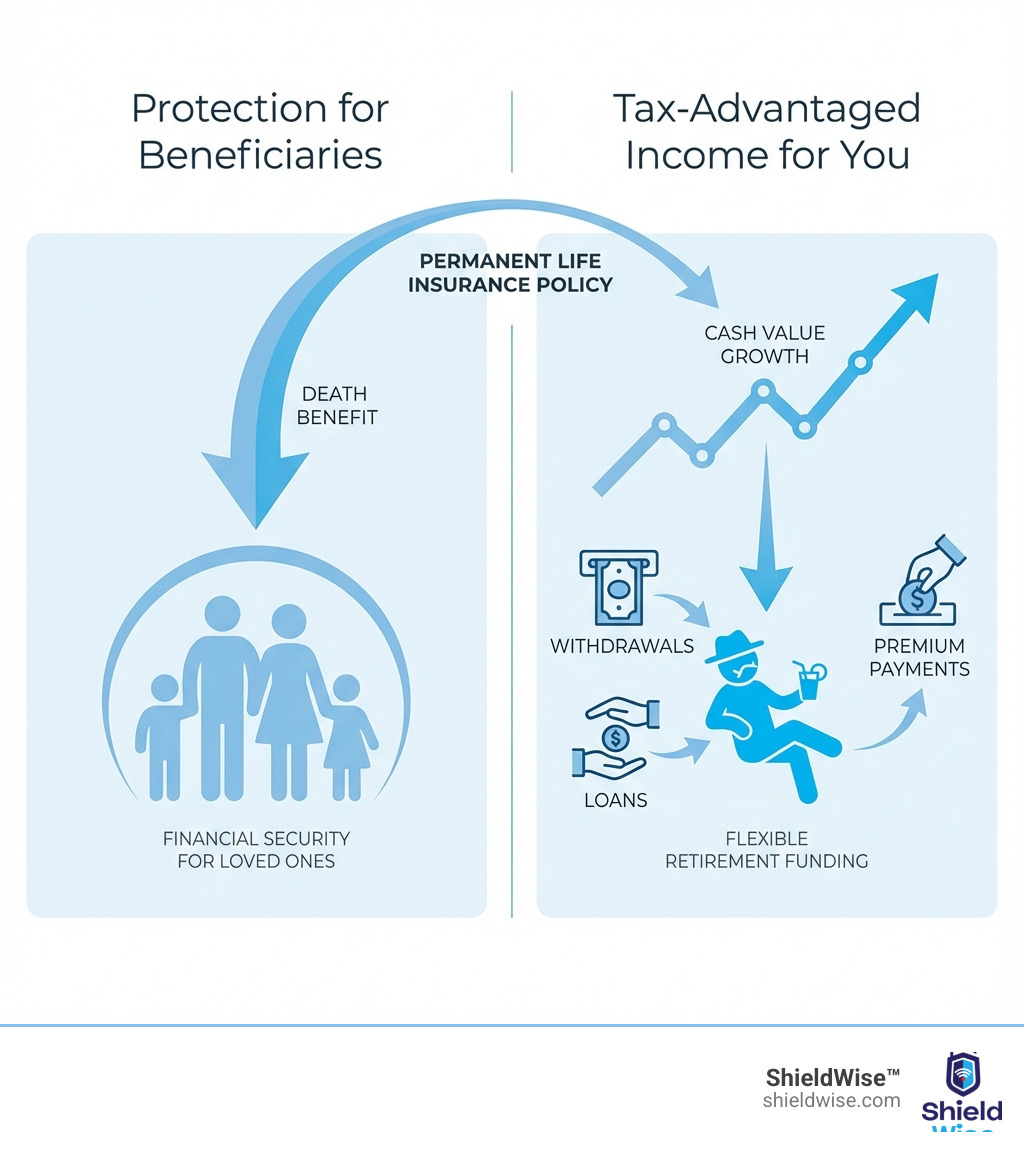
Using life insurance in retirement planning means leveraging the cash value component of permanent life insurance policies to create tax-advantaged income, supplement traditional retirement accounts, and maintain lifelong protection for your beneficiaries. Here’s how it works:
Key Ways to Use Life Insurance for Retirement:
- Access Cash Value – Withdraw or borrow against accumulated cash value tax-free (up to basis)
- Supplement Income – Create a stream of retirement income without triggering required minimum distributions
- Tax Diversification – Grow wealth tax-deferred with potential for tax-free distributions
- Estate Planning – Transfer wealth efficiently while bypassing probate
- No Contribution Limits – Continue building savings beyond 401(k) and IRA caps
When most people think about life insurance, they picture a safety net—money that goes to loved ones after they’re gone. But what if your policy could do more than protect your family? What if it could also help fund the retirement you’ve always imagined?
About half of Americans have life insurance coverage, yet few realize that certain policies build cash value over time—a living benefit you can tap into while you’re still here. Unlike term life insurance, which simply provides a death benefit, permanent life insurance policies accumulate a cash reserve that grows tax-deferred and can be accessed for retirement income.
This isn’t about replacing your 401(k) or IRA. It’s about creating a flexible, tax-advantaged layer of financial security that complements your existing retirement strategy—especially if you’ve already maxed out traditional accounts or want more control over when and how you pay taxes in retirement.
The challenge? Understanding how this strategy actually works, what it costs, and whether it makes sense for your situation. Let’s break it down.
The Foundation: Understanding Cash Value Life Insurance
When we talk about using life insurance in retirement planning, we’re specifically referring to permanent life insurance. This is where the magic happens, offering benefits far beyond a simple death payout.
Why Permanent Life Insurance Matters for Retirement
The primary difference between term life insurance and permanent life insurance in the context of retirement planning lies in their structure and purpose. Term life insurance, as its name suggests, covers you for a specific period—say, 10, 20, or 30 years. It’s often the most affordable option, with a nonsmoking 35-year-old man in good health potentially getting a $1 million, 20-year term policy for about $1,030 per year. However, term life insurance has no cash value component; it’s purely a death benefit, and only 2% to 3% of these policies ever pay out a death benefit because most people outlive their term. “Think of term insurance like paying your car insurance,” explains Steven Conners, founder and president of Conners Wealth Management. “As you pay, you’re covered. Should you stop paying your premium, you do not have insurance then.”
Permanent life insurance, on the other hand, provides lifelong coverage and, crucially for retirement planning, builds cash value. This cash value grows over time, creating a valuable asset you can use during your lifetime. While a whole life policy for that same 35-year-old might cost $13,500 or more annually for a $1 million death benefit—up to 15 times more expensive than a term policy—its unique living benefits make it a powerful tool for retirement. It’s this cash value component that allows us to explore how to integrate life insurance into a robust retirement strategy.
How the Cash Value Component Works
So, how exactly does this cash value build up? When you pay premiums for a permanent life insurance policy, a portion of that payment goes towards the cost of the insurance itself (the death benefit), and another portion is allocated to a separate account that accumulates cash value. This cash value grows on a tax-deferred basis, meaning you don’t pay taxes on the growth until you access the funds.
The way this cash value grows depends on the type of permanent policy:
- Whole life policies often offer guaranteed interest rates and may pay dividends (typically 1% to 2% annually on the cash value), providing predictable, stable growth.
- Universal life (UL) and Indexed Universal Life (IUL) policies tie their growth to market performance or an index, offering the potential for higher returns, though with varying levels of risk.
This growing cash value is what transforms a life insurance policy from just a death benefit to a flexible financial asset you can leverage in retirement. For more detailed information on how these strategies work, you can refer to Strategies To Use Life Insurance for Retirement.
A Practical Guide to Using Life Insurance in Retirement Planning

Once your permanent life insurance policy has accumulated a significant cash value, you gain incredible financial flexibility. This can be a game-changer for your retirement income strategy, offering an alternative or supplemental source of funds while maintaining crucial beneficiary protection.
Accessing Your Cash Value for Tax-Advantaged Income
One of the most appealing aspects of permanent life insurance is the ability to access its cash value in retirement. We have several ways to do this, each with its own nuances:
- Policy Loans: You can borrow money directly from your policy’s cash value. This isn’t like a traditional loan from a bank; it’s a loan from the insurance company, using your cash value as collateral. These loans are generally tax-free, and you’re not typically required to repay them on a fixed schedule. However, interest accrues, and any outstanding loan balance (plus interest) will reduce the death benefit paid to your beneficiaries. Many retirees appreciate this flexibility, as it allows them to supplement income without selling investments or taking taxable distributions from other accounts.
- Withdrawals: You can also withdraw a portion of your cash value. Withdrawals up to the amount of premiums you’ve paid (your “cost basis”) are generally received tax-free. If you withdraw more than your cost basis, the excess amount (which represents investment gains) will be subject to income tax. This option reduces both your cash value and your death benefit.
- Partial or Full Surrender: If you no longer need the policy’s death benefit or require a substantial lump sum, you can partially or fully surrender the policy. A partial surrender means taking out a portion of the cash value, while a full surrender means giving up the policy entirely in exchange for its cash value, minus any surrender charges. This typically makes sense if your financial needs or family situation have changed significantly.
- Using Cash Value to Pay Premiums: As you approach or enter retirement, your income might change. You can use your accumulated cash value to pay future policy premiums, effectively making the policy “self-funding.” This ensures your coverage remains in force without requiring out-of-pocket payments, preserving your retirement income.
Understanding the Tax Implications of Your Strategy
The tax advantages are a significant draw for using life insurance in retirement planning. As we mentioned, the cash value in a permanent policy grows on a tax-deferred basis. This means you don’t pay taxes on the interest or investment gains as they accumulate, allowing your money to compound more efficiently over time.
When it comes to accessing the cash value, policy loans are generally tax-free. Withdrawals are tax-free up to your cost basis (the total premiums paid). Only if your withdrawals exceed this amount will you owe taxes on the gains.
However, there’s a crucial consideration: a Modified Endowment Contract (MEC). If your policy is “overfunded” according to IRS rules (meaning you’ve paid in too much premium too quickly), it can be reclassified as a MEC. This changes the tax treatment of withdrawals and loans, making them taxable first on gains, and potentially subject to a 10% penalty if accessed before age 59½. It’s vital to design your policy carefully to avoid MEC status if tax-advantaged income is your goal.
Beyond income, life insurance plays a significant role in estate planning and wealth transfer during retirement. The death benefit paid to beneficiaries is generally income tax-free. When structured correctly, such as through an irrevocable life insurance trust (ILIT), the death benefit can also be excluded from your taxable estate, which is particularly beneficial for high-net-worth individuals facing federal estate taxes. For more information on estate taxes, you can consult IRS information on Estate Tax.
How Loans and Withdrawals Affect Your Death Benefit
While accessing your cash value offers great flexibility, understand the impact on your policy’s death benefit and beneficiaries.
Any outstanding policy loans, plus any accrued interest, will be deducted from the death benefit when you pass away. This means your beneficiaries will receive a smaller payout. Similarly, withdrawals directly reduce both the cash value and the death benefit.
It’s a balancing act: you’re trading some of the future death benefit for current liquidity and income. If not managed carefully, taking too many loans or withdrawals, especially without repayment, could potentially lead to the policy lapsing if the remaining cash value is insufficient to cover ongoing policy charges. This is why careful policy management and periodic review with a financial advisor are crucial to ensure your strategy aligns with your goals and doesn’t inadvertently jeopardize your beneficiaries’ inheritance.
Choosing the Right Policy for Your Retirement Goals

When considering using life insurance in retirement planning, the type of permanent policy you choose makes a big difference. Each offers a unique blend of guarantees, flexibility, and growth potential.
Whole Life Insurance: Predictability and Guarantees
Whole life insurance is the most traditional form of permanent life insurance, known for its predictability and guarantees. With a whole life policy, your premiums remain fixed for life, making budgeting straightforward. The cash value grows at a guaranteed rate, and the death benefit is also guaranteed, provided premiums are paid. This stability is very appealing for retirement planning, especially for those who prefer conservative, low-risk growth. Many whole life policies also pay dividends, which can further improve cash value or be used to reduce premiums or purchase additional coverage. This steady, reliable growth can be a comforting addition to a retirement portfolio.
Universal Life (UL) and Indexed Universal Life (IUL)
Universal Life (UL) insurance offers more flexibility than whole life. With UL, you can typically adjust your premium payments (within certain limits) and even modify your death benefit. The cash value grows based on an interest rate declared by the insurer, which can fluctuate but often has a minimum guarantee.
Indexed Universal Life (IUL) takes this flexibility a step further. IUL policies link their cash value growth to the performance of a stock market index, such as the S&P 500, without directly investing in the market. This means you can participate in market gains, but with a crucial safety net: a 0% floor, which protects your cash value from market losses. While there are caps on how much you can gain, the combination of market participation and downside protection makes IUL a unique tool for retirement. To dive deeper into IUL, you can read What is IUL? and understand How Does IUL Work?.
A Key Strategy for Using Life Insurance in Retirement Planning: IUL
For many, Indexed Universal Life (IUL) stands out as a particularly compelling option when using life insurance in retirement planning. It strikes a balance between the guaranteed growth of whole life and the higher potential returns of direct market investments.
Here’s why IUL is often highlighted:
- Market Participation with Less Risk: Your cash value gains are tied to a market index, allowing you to benefit when the market performs well. However, the 0% floor ensures your cash value won’t lose money due to market downturns, offering significant peace of mind.
- Potential for Higher Returns: While caps limit your upside, IUL often has the potential to generate higher returns on its cash value compared to the more conservative guaranteed rates of whole life.
- Tax-Advantaged Income Stream: Like other permanent policies, the cash value grows tax-deferred, and you can access it through tax-free loans or withdrawals (up to basis) in retirement, creating a valuable income stream that complements your other retirement assets.
This blend of growth potential and protection makes IUL a powerful component for those looking to diversify their retirement income sources and hedge against market volatility.
Is This Strategy Right for You? Weighing the Pros and Cons
Considering a Life Insurance Retirement Plan (LIRP) as part of your overall financial strategy involves careful consideration. It’s not a one-size-fits-all solution, but for the right individual, it can offer substantial benefits.
Key Advantages Over Other Retirement Savings Vehicles
When compared to traditional retirement accounts like 401(k)s and IRAs, permanent life insurance, particularly as a LIRP, offers several unique advantages:
- No Contribution Limits: Unlike 401(k)s (which have a limit of $23,500 in 2025) and IRAs (limited to $7,000 in 2025), there are no government-imposed limits on how much premium you can pay into a life insurance policy (though you must stay within IRS guidelines to avoid MEC status). This is excellent for high-income earners who have maxed out other retirement vehicles.
- No Income Restrictions: There are no income phase-outs that restrict your ability to contribute, unlike some Roth IRA options.
- Tax Diversification: While 401(k)s and IRAs offer tax benefits, a LIRP provides another bucket of tax-advantaged money. Cash value grows tax-deferred, and if structured properly, distributions can be tax-free, giving you more control over your taxable income in retirement.
- No Required Minimum Distributions (RMDs): Traditional 401(k)s and IRAs generally require you to start taking distributions at a certain age, whether you need the money or not. LIRPs have no such RMDs, allowing your cash value to continue growing and giving you complete control over when and how you access your funds.
- Creditor Protection: In many states, including Illinois, the cash value and death benefit of life insurance policies are protected from creditors, offering an additional layer of asset protection that traditional investment accounts may not provide.
Potential Drawbacks and Risks to Consider
No financial strategy is without its downsides, and LIRPs are no exception. It’s important to be aware of these before diving in:
- Higher Premiums: As we’ve seen, permanent life insurance is significantly more expensive than term life. The annual premium for a whole life policy can be up to 15 times higher than a term policy for the same death benefit. This requires a substantial, long-term financial commitment.
- Surrender Charges: If you decide to surrender your policy in its early years, you may face significant surrender charges, which can reduce the amount of cash value you receive.
- Complexity and Fees: Permanent life insurance policies, especially UL and IUL, can be complex. They involve various fees and charges that can impact the net growth of your cash value. Understanding these intricacies requires careful attention and often professional guidance.
- Slower Growth Than Direct Market Investing: While IUL offers market participation, its growth is often capped, and whole life offers guaranteed but modest returns. The average annual return for the stock market has been around 10% for the last century, while life insurance cash value dividends typically range from 1% to 2% annually. If your primary goal is aggressive growth, direct market investing might yield higher returns, albeit with more risk.
Who Benefits Most from Using Life Insurance in Retirement Planning?
So, who is this strategy truly designed for? While it’s not for everyone, certain individuals and situations align particularly well with the benefits of a LIRP:
- High-Income Earners: If you’re consistently maxing out your contributions to your 401(k), IRA, and other tax-advantaged retirement accounts, a LIRP offers an excellent way to save additional money on a tax-deferred basis, beyond those government-imposed limits.
- Individuals Seeking Tax-Free Retirement Income: For those who anticipate being in a higher tax bracket in retirement or want to diversify their income streams to include tax-free options, a LIRP can be invaluable.
- Business Owners: Business owners often face unique tax and estate planning challenges. Life insurance can offer solutions for executive benefits, key-person insurance, and tax-efficient wealth transfer.
- Those with Significant Estate Planning Needs: If you’re concerned about estate taxes or want to ensure a specific legacy for your heirs, life insurance can provide a tax-free death benefit that bypasses probate. This can also be crucial for covering Final Expense Insurance costs.
Essentially, if you’ve already covered your basic financial needs, built an emergency fund, and are looking for advanced strategies to optimize your wealth accumulation and distribution in retirement, a LIRP could be a powerful tool in your arsenal.
| Feature | Life Insurance Retirement Plan (LIRP) | Traditional 401(k)/IRA |
|---|---|---|
| Contribution Flexibility | No IRS contribution limits (though MEC rules apply) | Strict annual limits ($23,500 for 401k, $7,000 for IRA in 2025) |
| Tax Treatment of Contributions | After-tax (typically) | Pre-tax (401k, Traditional IRA) or After-tax (Roth IRA) |
| Cash Value Growth | Tax-deferred | Tax-deferred |
| Tax Treatment of Distributions | Tax-free loans/withdrawals up to basis (if not MEC) | Taxable (401k, Traditional IRA) or Tax-free (Roth IRA) |
| Required Minimum Distributions | No RMDs | RMDs apply to 401k/Traditional IRA |
| Liquidity | Access via loans/withdrawals (can impact death benefit) | Early withdrawal penalties apply before 59½ |
| Death Benefit | Tax-free to beneficiaries, bypasses probate | Taxable to beneficiaries |
| Creditor Protection (IL) | Yes (generally) | Limited |
Frequently Asked Questions about LIRPs
We understand that using life insurance in retirement planning can raise a lot of questions. Let’s address some of the most common ones we hear.
Can I rely solely on life insurance for my retirement?
No, we strongly advise against relying solely on life insurance for your retirement. While a LIRP can be a powerful financial tool, it is best used as a supplemental strategy to diversify your retirement income alongside other traditional investments. It complements, rather than replaces, accounts like your 401(k), IRA, and other savings. Think of it as another robust leg on your financial stool—it adds stability and flexibility, but it’s not the entire stool itself.
What happens to the cash value when I die?
This is a common question, and the answer is important for estate planning. Typically, when the policyholder dies, the insurance company pays out the policy’s death benefit to your named beneficiaries. In most cases, the accumulated cash value is absorbed by the insurer and is not paid out in addition to the death benefit. However, some specific policy riders or structures (like a “return of cash value” rider or certain types of universal life policies with an increasing death benefit option) can alter this, leading to a larger payout that includes some or all of the cash value. It’s crucial to understand your specific policy’s terms.
Is it better to have life insurance or a retirement account?
For most people, traditional retirement accounts like a 401(k) or IRA should be the primary vehicle for retirement savings. These accounts offer significant tax advantages, and often employer matching contributions (in the case of 401(k)s), which are hard to beat.
However, once you’ve maximized your contributions to these traditional accounts, a LIRP becomes an incredibly powerful secondary tool. It offers benefits like tax-free income potential, no RMDs, and asset protection that traditional accounts might not. So, it’s not a matter of “better” but rather “better together.” A well-rounded retirement plan often includes both: leveraging the strengths of traditional retirement accounts first, then supplementing with the unique advantages of a LIRP.
Conclusion: Building a Resilient and Richer Retirement
As we’ve explored, using life insurance in retirement planning extends far beyond its traditional role as a death benefit. Permanent life insurance, particularly policies with a robust cash value component like Indexed Universal Life, can serve as a versatile financial asset, offering tax-advantaged growth, flexible income streams, and valuable estate planning benefits.
We’ve seen the potential for tax-deferred growth, the ability to access funds tax-free through loans or withdrawals (up to basis), and the freedom from required minimum distributions. These advantages can provide a resilient layer of financial security, complementing your 401(k)s and IRAs, and helping you steer market fluctuations with greater confidence.
Building a truly rich and resilient retirement requires a balanced strategy, one that considers multiple income sources and leverages every available tool. At ShieldWise™, we believe in providing clear, jargon-free guidance to help you understand all your options. We’re here to help you compare plans from trusted carriers and find the right coverage to protect your family, control costs, and secure your financial future.
Ready to explore how Universal Life Insurance can improve your golden years? Explore Universal Life Insurance plans to secure your retirement.